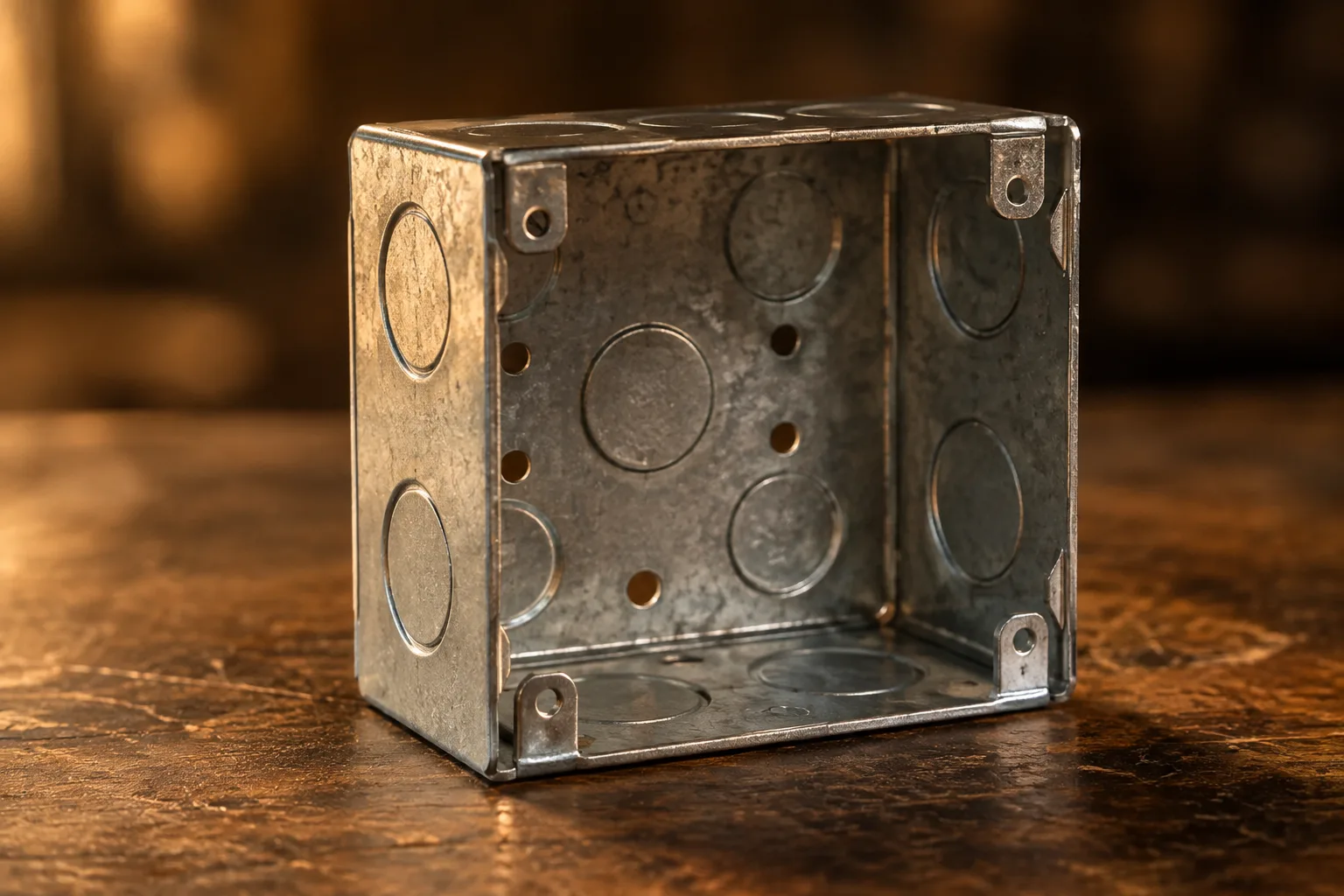
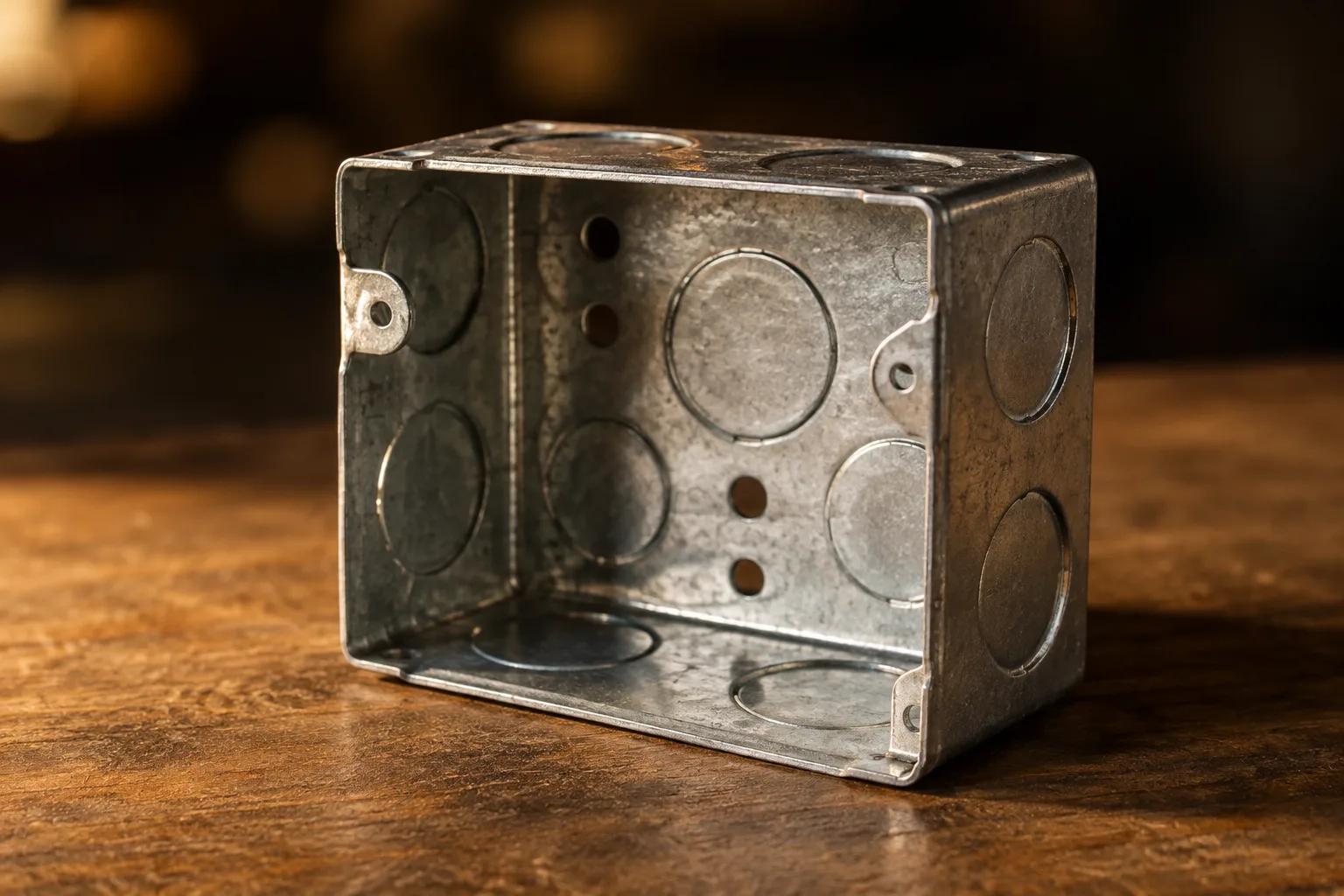
Mismatched fixing centres and shallow boxes cause rework on Saudi fit-outs. Here is how to specify steel back boxes that mate with modular plates first time.
What Makes a Steel Back Box Compatible With a Modular Plate?
A galvanized steel back box is compatible with a modular plate when three dimensions agree: the fixing centre spacing between the box lugs, the internal depth available for the device and its wiring, and the module format the plate is designed to carry. Get all three right at the specification stage and the plate screws down first time. Get any one wrong and the contractor is either re-drilling lugs, packing out the box, or rejecting the submittal. In an electrical box specification Saudi Arabia projects rely on, these three interface values matter more than the box's external footprint, because they are what the installer actually touches.
The fixing centres are the first checkpoint. A modular plate carries its accessory modules on a frame, and that frame presents two screw holes at a fixed spacing. The back box must present matching lugs at the same spacing, at a depth that lets the plate sit flush with the finished wall or ceiling line. When the plate and the box come from different supply chains, this is where the mismatch appears: the plate frame expects one spacing, the box lugs sit at another, and the screw simply will not start. On a fit-out with hundreds of points, that becomes a systematic problem rather than an isolated one.
Depth is the second checkpoint. A box that is too shallow forces the installer to compress wiring behind the device, which stresses terminations and makes the plate sit proud of the wall. A box that is too deep relative to the plate's frame can leave the plate floating unless the fixing screws have enough engagement. The right depth is the one that gives the device room, gives the wiring room to dress neatly, and still lets the plate land flush. This is a selection decision, not a site decision, and it belongs in the specification.
The third checkpoint is module format. A single-gang plate carries one module; a multi-gang plate carries several side by side, and each additional module changes the load on the frame and the spacing of the fixing points relative to the box. The box must be sized and lugged for the plate it will receive, not for a generic assumption about what a switch point looks like. Treating the box-to-plate interface as an engineering selection problem — spacing, depth, format — is how rework is designed out before the first fixing is drilled.
Why Do Modular Plates and Steel Boxes Fail to Mate on Saudi Sites?
They fail to mate because the plate and the box are usually procured as separate line items, from separate suppliers, against separate submittals, and nobody owns the interface between them. The electrical contractor buys the back boxes against a box schedule; the finishing or MEP package buys the modular plates against an architectural or accessories schedule. Each document can be internally correct and the pair can still be incompatible. This is the single most common origin of rejected submittals and site rework on fit-out packages in the Eastern Province.
The second cause is substitution. A plate format is approved, then a different frame or module series is brought in later for availability or cost reasons, and the fixing centres shift. The boxes are already fixed in the blockwork. The result is either a plate that cannot be screwed down or a box that has to be cut out and replaced — the most expensive possible outcome, because it happens after first fix. Substitution control on the plate side is therefore just as important as substitution control on the box side.
A third cause is depth assumptions made on site rather than in the specification. Installers working to a drawing that does not state internal depth will use whatever box is on the shelf. If that box is shallow for the wiring configuration at that point — particularly where a multi-gang plate concentrates several circuits in one location — the wiring is compressed and the plate sits off the wall. The defect appears at second fix, long after the box was set.
Finally, there is the earthing question. A steel back box is part of the earthing path, and the plate's earth continuity depends on a sound metal-to-metal connection through the fixing and the earth terminal. Where boxes with a brass earth facility are specified, that facility must be present and correctly positioned relative to the plate frame. Where it is omitted or substituted, the earth path depends on screw contact alone, which is exactly the kind of detail a consultant's inspector will pick up at handover. Alrouf manufactures switch boxes and junction boxes in Dammam 2nd Industrial City from G90 galvanized steel as per ASTM-A653, with brass earth variants available across the switch box range, so the earth facility can be specified as part of the box rather than improvised on site.
How Should Box Depth Be Selected Against Device and Wiring Space?
Box depth should be selected from the device and wiring requirement backwards, not from the wall thickness forwards. The question is not how deep the box can be, but how much space the module, its terminal block and the dressed conductors need behind the plate. For a single switch or socket module on a straightforward circuit, a shallower box is adequate. For multi-gang plates, dimmer or control modules, or points where several circuits converge, the wiring volume rises sharply and the box must be selected accordingly.
In the Alrouf switch box range, depth is expressed across two families. The BB6 switch boxes are 7×14×3.5 cm, and the BB7 switch boxes are 7×14×4.7 cm. Both are 7 cm by 14 cm on the face, so the difference between them is the 1.2 cm of internal depth — precisely the variable that decides whether a plate lands flush with comfortable wiring space behind it or sits proud with compressed conductors. Specifying BB7 where the wiring configuration demands it, and BB6 where it does not, is a cost-and-performance decision that belongs in the box schedule.
Thickness is a separate axis and should not be confused with depth. Within the BB6 family, the 0.6 mm variants (BB6-003 and BB6-004, both 109 g) and the 0.9 mm variant (BB6-002, 160 g) share the same 7×14×3.5 cm envelope. Within the BB7 family, the 0.9 mm variants (BB7-001 and BB7-002, both 196 g) and the 1.2 mm variants (BB7-003 and BB7-004, both 260 g) share the 7×14×4.7 cm envelope. Thickness governs rigidity and resistance to deformation during fixing and plastering; depth governs device and wiring accommodation. A specification that states only one of them is incomplete — see this galvanized electrical box thickness and weight guide for the full breakdown.
For junction points rather than accessory points, the same logic applies at a larger scale. The BB8 junction box is 10×10×5.5 cm at 0.9 mm and 298 g; the BB9-001 is 15×15×5.5 cm at 0.9 mm and 620 g; the BB9-002 is 15×15×10 cm at 0.9 mm and 825 g; and the BB10-001 is 20×20×5.5 cm at 952 g. Where a fit-out routes multiple circuits through a ceiling void before dropping to accessory points, the junction box depth and volume determine how comfortably those conductors can be dressed and identified — which in turn affects how cleanly the accessory plates close out at second fix.
What Fixing Centres and Knockout Patterns Should the Specification State?
The specification should state the fixing centre spacing explicitly, in millimetres, as a requirement of the box rather than an assumption inherited from a catalogue. It should also state the plate format the box is intended to receive, so that the two documents reference each other. Where the project uses more than one plate series — for example a different frame in wet areas or in public-facing rooms — the box schedule should carry a line per plate series, not a single generic switch box line.
Knockout patterns belong in the same clause because they determine how the conduit reaches the box, and an awkward entry can push wiring into the space the plate needs. Alrouf switch boxes carry bottom knockouts of 1/2" (3) and 3/4" (1), and side knockouts of 1/2" (4) and 3/4" (6). The BB8 junction box carries bottom knockouts of 1/2"-3/4" (6) and 3/4"-1" (2), with side knockouts of 1/2"-3/4" (4) and 3/4"-1" (4). The BB9 junction box carries bottom knockouts of 1/2"-3/4" (2) and 3/4"-1" (1), with side knockouts of 1/2"-3/4" (8) and 3/4"-1" (4). Stating these in the schedule lets the contractor plan conduit entry before the box is set, rather than punching the box in place — the trade-off covered in this comparison of knockouts vs field punching on steel boxes.
Marking is the third element of a complete interface clause. Alrouf switch boxes (BB6 and BB7) are marked AL-ROUF KSA BS4662. The junction boxes (BB8, BB9 and BB10) are marked AL-ROUF KSA, without BS4662. A specification that names the marking it expects gives the inspector an objective check at delivery and gives the contractor a clear basis for accepting or rejecting a delivered batch. It also closes the substitution loophole, because a box that does not carry the specified marking is visibly non-compliant.
Finally, the specification should state country of origin and the steel grade. Alrouf boxes are made of G90 galvanized steel as per ASTM-A653 and are of Kingdom of Saudi Arabia origin, manufactured in Dammam. For Vision 2030 local content objectives and for projects where the consultant is tracking origin, stating this in the box clause is straightforward and removes an argument later. Fire resistance should be stated too: the boxes carry a 2 hours fire rating, which is a relevant line item wherever the wall or ceiling assembly itself has a fire rating to satisfy.
How Do Single-Gang and Multi-Gang Module Configurations Change the Box Requirement?
A single-gang configuration is the simplest case: one module, one plate frame, one set of fixing points, and a wiring volume that a 3.5 cm deep box will usually accommodate. A multi-gang configuration changes all three. The plate frame is longer, the fixing points sit further apart or are distributed differently, and several modules mean several circuits converging in one location — which raises the wiring volume and the number of terminations that must be dressed behind the plate.
This is why a box schedule built on a single generic switch box line tends to break down on multi-gang points. The box that works for a single switch may be marginal for a four-module plate carrying lighting, a fan and a socket circuit. The practical response is to schedule by configuration: single-module points against one box line, multi-module points against another, with depth and thickness stated for each. Where the plate format is not yet frozen, the schedule should say so and hold the box line open rather than defaulting to the smallest option.
The earthing decision also scales with configuration. A multi-gang plate concentrates more metal and more circuits on one frame, and the earth continuity through the box becomes more important, not less. Alrouf offers brass earth variants across the switch box range — BB6-004 and BB6-002 in the BB6 family, and BB7-002 and BB7-004 in the BB7 family — so the earth facility can be specified per point type rather than applied uniformly or omitted. Specifying brass earth on multi-gang and socket points, and plain boxes on simple lighting points, is a defensible and inspectable position.
Where a fit-out mixes accessory points and junction points in the same ceiling or wall zone, the junction box selection should follow the same configuration logic. A BB8 at 10×10×5.5 cm suits a local convergence of a few circuits; a BB9-001 at 15×15×5.5 cm or BB9-002 at 15×15×10 cm suits a larger grouping; and a BB10-001 at 20×20×5.5 cm suits the largest local concentration in the range. Matching the junction volume to the number of circuits converging is the same discipline as matching box depth to module count — it is the same interface problem at a different scale.
How Do You Keep Plate and Box Sourced Together Through Procurement?
The most reliable way to keep plates and boxes compatible is to make the interface an explicit, named requirement in both procurement packages, with a single point of accountability. In practice that means the box schedule states the plate format and fixing centres it is built for, and the plate schedule states the box it is intended to mount on. When both documents carry the same interface values, a substitution on either side is visible immediately rather than at second fix.
A second control is to freeze the plate format before the box schedule is released. Fit-out programmes often run the other way — boxes are needed early for first fix, plates are selected later — which is precisely how mismatches are created. If the plate format genuinely cannot be frozen, the box line should be held to a format-agnostic specification with the interface values stated as a range, and the final plate selection should be checked against that range before order placement. This is a programme discipline as much as a technical one.
A third control is delivery inspection against the stated marking and dimensions. Because Alrouf switch boxes are marked AL-ROUF KSA BS4662 and junction boxes are marked AL-ROUF KSA, a receiving inspector can confirm the box family at a glance. Dimensions and mass can be checked against the schedule: BB6-003 and BB6-004 at 109 g, BB6-002 at 160 g, BB7-001 and BB7-002 at 196 g, BB7-003 and BB7-004 at 260 g, BB8-001 and BB8-002 at 298 g, BB9-001 at 620 g, BB9-002 at 825 g, and BB10-001 at 952 g. Pack quantities are stated per line — 50 pcs per pack for the BB6, BB7 and BB8 families, 20 pcs per pack for BB9-001, and 12 pcs per pack for BB9-002 — which lets the store reconcile deliveries against the schedule without opening cartons.
Sourcing boxes from a Saudi manufacturer in Dammam shortens the loop between the box schedule and the delivered product. Alrouf has manufactured electrical accessories since early 2003, and the manufacturing operation in Dammam 2nd Industrial City includes progressive die stamping, automated assembly, robotic welding, tooling and die design, tubular manufacturing, coil slitting and plastic injection molding. That breadth matters at the interface stage because it means the box geometry is controlled by tooling the manufacturer owns, not assembled from third-party components. For a procurement lead closing out a fit-out in the Eastern Province, that is the difference between an interface that is specified once and an interface that is renegotiated on site.
What Should the Box-to-Plate Interface Clause Contain?
A complete interface clause should contain, at minimum: the plate format and module configuration the box is intended to receive; the fixing centre spacing required; the internal depth required; the steel thickness required; the knockout pattern; the earthing arrangement, including whether a brass earth facility is required; the marking expected on the box; the steel grade and standard; the country of origin; and the fire rating where relevant. Each of these is a checkable line, and together they close the gap between the box schedule and the accessories schedule.
For Alrouf products, the clause can be written directly against the published values. Steel grade is G90 galvanized steel as per ASTM-A653. Fire resistance is 2 hours. Country of origin is the Kingdom of Saudi Arabia. Switch boxes BB6 and BB7 are marked AL-ROUF KSA BS4662; junction boxes BB8, BB9 and BB10 are marked AL-ROUF KSA. Switch box knockouts are bottom 1/2" (3) and 3/4" (1), side 1/2" (4) and 3/4" (6). BB8 knockouts are bottom 1/2"-3/4" (6) and 3/4"-1" (2), side 1/2"-3/4" (4) and 3/4"-1" (4). BB9 knockouts are bottom 1/2"-3/4" (2) and 3/4"-1" (1), side 1/2"-3/4" (8) and 3/4"-1" (4).
The clause should also state what is not acceptable. Substitution of the box family without re-checking the plate interface should be explicitly prohibited. Field modification of lugs or fixing points should be prohibited, because a re-drilled lug is a weakened lug and an inspector will flag it. Mixing box families within a single plate type should be prohibited, because it produces inconsistent fixing behaviour across a floor. These prohibitions are cheap to write and expensive to omit.
Finally, the clause should be carried into the receiving process. A delivery check against marking, dimensions, mass and pack quantity takes minutes and catches the substitution that would otherwise surface at second fix. On a fit-out with hundreds of accessory points, that check is the highest-return quality activity in the whole procurement cycle. Alrouf's Dammam manufacturing base and its range of switch and junction boxes give the specifier a single source for the box side of the interface, which is the practical starting point for making the plate side mate first time.
◈ Key Takeaways
✦Specify fixing centre spacing in millimetres and name the plate format the box must receive — do not leave the interface to site interpretation.
✦Select box depth from the module count and wiring volume: BB6 at 3.5 cm for simple points, BB7 at 4.7 cm where multi-gang plates concentrate circuits.
✦State steel thickness separately from depth — 0.6 mm, 0.9 mm and 1.2 mm variants share envelopes but behave differently under fixing and plastering.
✦Require brass earth variants on multi-gang and socket points to keep earth continuity inspectable through the plate frame.
✦Freeze the plate format before releasing the box schedule, and prohibit field modification of lugs or fixing points in the specification.
Frequently Asked Questions
❓ What is the standard electrical box specification in Saudi Arabia?
In Saudi Arabia, electrical boxes are typically specified according to BS 4662 for switch boxes, with requirements for galvanized steel construction and fire resistance. Alrouf, a manufacturer in Dammam, produces switch boxes marked AL-ROUF KSA BS4662, ensuring compliance with these standards.
❓ Which steel boxes are compatible with modular plates in Saudi Arabia?
Modular plates are designed to fit standard switch boxes, such as those with dimensions 7×14 cm and depths of 3.5 cm or 4.7 cm. Alrouf's switch boxes (BB6 and BB7 series) are manufactured to these specifications, ensuring compatibility with common modular plate designs used in Saudi construction projects.
❓ Why is fire-rated electrical box specification important in Saudi Arabia?
Fire-rated electrical boxes help contain electrical fires and prevent their spread, which is crucial for safety in residential and commercial buildings. Alrouf's boxes are tested for 2 hours fire rating, meeting stringent safety requirements often demanded in Saudi building codes.
❓ How much does an electrical box specification affect installation in Saudi Arabia?
The specification of an electrical box, including size, knockouts, and material thickness, directly impacts installation efficiency and compatibility with conduits and modular plates. Alrouf offers a range of boxes with various knockout configurations to suit different installation needs in Saudi projects.
❓ Can I use Alrouf electrical boxes for both switch and junction applications in Saudi Arabia?
Yes, Alrouf manufactures both switch boxes (BB6 and BB7 series) and junction boxes (BB8, BB9, and BB10 series) to meet different application requirements. Switch boxes are marked with BS4662, while junction boxes are marked AL-ROUF KSA, ensuring they meet relevant specifications for their intended use.
See the full Alrouf product range
Download the Alrouf 2023 catalogue and browse the product range.
A GI box 3x3 is a galvanized steel back box for switches and sockets. Learn size mapping, specifications, and sourcing from Alrouf in Dammam.
What Is a GI Box 3x3?
A GI box 3x3 is a galvanized steel electrical back box measuring approximately 3 inches by 3 inches (about 7 cm by 7 cm), used to house switches, sockets, or data outlets in wall and ceiling installations. The term "GI" stands for galvanized iron—though in modern manufacturing, the material is typically galvanized steel sheet, such as G90 galvanized steel per ASTM-A653. These boxes are also known as GI back boxes or GI junction boxes, depending on their application. In the GCC construction market, including Saudi Arabia, the UAE, Qatar, and Kuwait, the 3x3 size is a standard reference for single-module switch boxes.
At Alrouf Electrical Accessories Manufacturer, based in Dammam 2nd Industrial City, Saudi Arabia, we produce a range of galvanized steel boxes that align with these inch-based trade names. Our 7×7 cm switch boxes correspond closely to the 3x3 inch designation. These boxes are engineered for durability and precise fit, with options for brass earth terminals and varying steel thicknesses to suit project requirements. Since 2003, we have been manufacturing electrical accessories that meet the demands of Saudi Arabia's construction and industrial sectors. You can learn more about our manufacturing history and capabilities.
The 3x3 GI box is commonly used in residential, commercial, and light industrial buildings. It provides a secure enclosure for electrical connections, protecting them from dust, moisture, and mechanical damage. The galvanized coating offers corrosion resistance, which is essential in the humid coastal climates of the Eastern Province and other GCC regions. While the term "GI box 3x3" is widely used, it's important to understand how inch names map to metric sizes to ensure compatibility with conduits, fittings, and modular devices.
In this guide, we will explain the common sizes, the mapping between inch and metric dimensions, and the key specifications to consider when sourcing GI boxes for projects in Saudi Arabia and the wider GCC. We will also highlight Alrouf's product range, including switch boxes, junction boxes, and accessories, all manufactured to precise standards.
How Do Inch Names Map to Metric Sizes for GI Boxes?
Inch-based names like 3x3, 3x6, and 4x4 are traditional trade references that originated in markets using imperial units. However, in Saudi Arabia and many GCC countries, the construction industry often uses metric dimensions for specifications and procurement. Understanding the conversion is straightforward: 1 inch equals 25.4 mm. Therefore, a 3x3 inch box is approximately 76.2 mm by 76.2 mm, which is commonly rounded to 7 cm by 7 cm in metric terms. Similarly, a 3x6 inch box is about 7 cm by 14 cm, and a 4x4 inch box is about 10 cm by 10 cm.
It's important to note that these conversions are nominal. Actual product dimensions may vary slightly due to manufacturing tolerances and design considerations. For example, Alrouf's 7×7 cm switch boxes are designed to accommodate standard modular devices and are often referred to as 3x3 boxes in the trade. The depth of the box also matters: a 3x3 box might have a depth of 3.5 cm or 4.7 cm, depending on the model and the number of modules it supports.
When specifying GI boxes, always refer to the actual product dimensions and knockout configurations rather than relying solely on the inch name. This ensures that the box will fit the intended conduit and devices. For instance, a 3x3 box with 1/2-inch knockouts may not be suitable for a project requiring 3/4-inch conduit. Alrouf provides detailed specifications for each product, including dimensions, steel thickness, weight, and knockout sizes, to facilitate accurate selection. Our electrical box sizes chart is a useful reference for metal boxes on Saudi projects.
To help buyers navigate the terminology, here is a size mapping table for common GI box sizes:
| Inch Name | Metric Equivalent (approx.) | Common Application |
|-----------|-----------------------------|---------------------|
| 3x3 | 7 cm x 7 cm | Single switch/socket box |
| 3x6 | 7 cm x 14 cm | Multi-module switch box |
| 4x4 | 10 cm x 10 cm | Junction box or large device box |
| 2x4 | 5 cm x 10 cm | Narrow device box |
This table serves as a general guide. Always confirm with the manufacturer's datasheet for exact dimensions and tolerances.
What Are the Common Sizes of GI Boxes?
GI boxes come in a variety of sizes to accommodate different electrical devices and installation requirements. The most common sizes in the GCC market include 3x3, 3x6, and 4x4, but there are also smaller and larger options. At Alrouf, we manufacture a comprehensive range of galvanized steel boxes, including switch boxes and junction boxes, to meet diverse project needs.
For switch boxes, our 7×7 cm (approximately 3x3 inch) range includes single-module boxes with different steel thicknesses and optional brass earth terminals. Models such as BB6-003 (0.6 mm thick, 109 g) and BB7-001 (0.9 mm thick, 196 g) are designed for standard switch and socket installations. We also produce 7×14 cm (approximately 3x6 inch) boxes, which are wider to accommodate multiple modules, such as double or triple switches. These are available in various thicknesses, including 0.9 mm and 1.2 mm, to suit different load-bearing and durability requirements.
For junction boxes, we offer sizes ranging from 10×10 cm to 20×20 cm, with depths of 5.5 cm or 10 cm. The 10×10 cm (approximately 4x4 inch) junction box, such as BB8-001, is a popular choice for housing electrical connections in ceilings and walls. Larger boxes like the 15×15 cm (BB9 series) and 20×20 cm (BB10 series) are used for more complex junctions or where additional wiring space is needed. All our boxes are made from G90 galvanized steel per ASTM-A653, ensuring corrosion resistance and longevity. For a deeper comparison of the 4×4, 20×20 and other formats, see our guide to junction box sizes.
It's worth noting that while inch names are common, the actual metric dimensions are what matter for installation. For example, a 4x4 GI box from Alrouf is 10×10 cm, which is slightly larger than the nominal 4x4 inch (10.16 cm) due to rounding. This small difference is generally acceptable, but for precise fit, always refer to the manufacturer's specifications. Additionally, knockout sizes and configurations vary between models, so it's essential to match the box to the conduit and fittings used in your project.
What Specifications Should You Check When Sourcing a GI Box 3x3?
When sourcing a GI box 3x3, several specifications should be verified to ensure it meets project requirements and local standards. First, consider the material: galvanized steel with a G90 coating per ASTM-A653 is standard for corrosion resistance. Alrouf uses G90 galvanized steel for all our boxes, providing a reliable barrier against rust and environmental degradation. The steel thickness is another critical factor; thicker steel offers greater mechanical strength but may be heavier and more expensive. Our 3x3 switch boxes are available in 0.6 mm and 0.9 mm thicknesses, with weights of 109 g and 160 g respectively, allowing you to choose based on the required durability and load.
Second, examine the knockout configuration. Knockouts are pre-punched holes that allow conduit entry. A typical 3x3 switch box may have bottom knockouts of 1/2 inch (3) and 3/4 inch (1), and side knockouts of 1/2 inch (4) and 3/4 inch (6). This variety accommodates different conduit sizes and routing options. Ensure the knockout sizes align with the conduits and fittings specified for your project. Alrouf boxes are designed with industry-standard knockouts to facilitate installation.
Third, check for fire resistance ratings. Alrouf boxes have a 2-hour fire rating, which can be important for compliance with building codes in Saudi Arabia, especially in commercial and multi-family residential projects. While certifications are not claimed, the fire rating is a tested performance characteristic that specifiers should consider. Additionally, look for features like brass earth terminals, which provide reliable grounding connections. Our BB6-004 and BB7-002 models include brass earth terminals for enhanced safety.
Finally, consider the country of origin and manufacturer reputation. Alrouf has been manufacturing electrical accessories in Saudi Arabia since 2003, supporting local content initiatives under Vision 2030. Our boxes are marked with "AL-ROUF KSA" and, for switch boxes, "BS4662" to indicate conformity to relevant standards. While we do not claim certifications, these markings reflect our commitment to quality and traceability. When sourcing, request product datasheets and samples to verify specifications before placing orders.
How Does Alrouf Manufacture GI Boxes in Saudi Arabia?
Alrouf Electrical Accessories Manufacturer operates from Dammam 2nd Industrial City, where we produce galvanized steel boxes using a combination of progressive die stamping, automated assembly, and robotic welding. Our manufacturing process begins with coil slitting, where we source galvanized steel coils—such as those from Hadeed (SABIC)—and slit them to the required width. This ensures consistent material quality and minimizes waste. The slit coils are then fed into progressive dies, which stamp and form the box components with high precision and repeatability.
Progressive die stamping allows us to produce complex shapes with tight tolerances, including knockouts, mounting holes, and earth terminal provisions. The dies are designed and maintained in-house by our tooling and die design team, enabling quick turnaround and customization when needed. After stamping, the components undergo automated assembly, where parts are joined using robotic welding for strength and consistency. This automated approach ensures that every box meets the same specifications, reducing variability and defects.
For plastic components, such as those used in some accessories, we utilize plastic injection molding. However, our focus for GI boxes is on steel fabrication. The finished boxes are inspected for dimensional accuracy, surface finish, and functionality. While we do not claim per-box inspection, our quality control processes are integrated into the production line to monitor key parameters. The boxes are then packed in standard quantities—for example, 50 pieces per pack for switch boxes—and prepared for shipment.
Our manufacturing capabilities also include tubular manufacturing, which supports the production of conduit and fittings. By controlling the entire process from coil to finished product, we can maintain high quality and respond to market demands efficiently. This vertical integration is a key advantage for buyers seeking reliable supply and consistent specifications. As a Saudi manufacturer, we contribute to the local economy and support the goals of Vision 2030 by providing high-quality electrical accessories for construction projects across the Kingdom.
Why Choose Locally Manufactured GI Boxes for Saudi Projects?
Choosing locally manufactured GI boxes for Saudi projects offers several advantages, particularly in terms of supply chain resilience, quality control, and alignment with national initiatives. Alrouf's manufacturing facility in Dammam is strategically located to serve the Eastern Province and other regions of Saudi Arabia. By sourcing locally, contractors and procurement teams can reduce lead times and avoid the uncertainties associated with imported products, such as customs delays and shipping disruptions.
Local manufacturing also facilitates better communication and collaboration. Buyers can visit the factory, discuss specifications directly with the production team, and request samples or custom modifications (within our standard range). This proximity enables faster resolution of any issues and ensures that the products meet the project's exact requirements. Additionally, local production supports the Saudi government's Vision 2030 goal of increasing local content and diversifying the economy. By specifying Saudi-made GI boxes, projects can contribute to this national agenda.
Quality is another key consideration. Alrouf's boxes are made from G90 galvanized steel per ASTM-A653, which is a recognized standard for corrosion resistance. Our manufacturing processes, including progressive die stamping and robotic welding, are designed to produce consistent, high-quality products. While we do not claim certifications, our adherence to material standards and our investment in automated equipment reflect our commitment to quality. The 2-hour fire rating of our boxes further demonstrates their suitability for demanding applications.
Finally, local manufacturing reduces the carbon footprint associated with transportation. By producing and supplying within Saudi Arabia, we minimize the environmental impact of long-distance shipping. This aligns with the growing emphasis on sustainability in the construction industry. For projects in the Eastern Province, sourcing from Alrouf means shorter delivery distances and a more responsive supply chain.
Frequently Asked Questions About GI Box 3x3
**What does "GI" stand for in GI box?**
GI stands for galvanized iron, but in modern manufacturing, it refers to galvanized steel. The steel sheet is coated with zinc to provide corrosion resistance, making it suitable for electrical boxes in various environments.
**Is a 3x3 GI box the same as a 7x7 cm box?**
Yes, approximately. A 3x3 inch box is about 76.2 mm by 76.2 mm, which is commonly rounded to 7 cm by 7 cm in metric terms. Alrouf's 7×7 cm switch boxes are the metric equivalent of the 3x3 inch size.
**What is the difference between a GI box and a junction box?**
A GI box is a general term for a galvanized steel box, which can be used as a switch box or a junction box. A junction box specifically refers to an enclosure used to house electrical connections and splices. Alrouf manufactures both switch boxes and junction boxes in various sizes.
**Can I use a 3x3 GI box for outdoor applications?**
Galvanized steel boxes offer corrosion resistance, but for outdoor or coastal applications, additional protection may be needed. Alrouf's boxes are made from G90 galvanized steel, which provides a good level of corrosion resistance. However, for harsh environments, consider using boxes with additional coatings or enclosures.
**What knockout sizes are available on Alrouf's 3x3 boxes?**
Alrouf's 7×7 cm switch boxes typically have bottom knockouts of 1/2 inch (3) and 3/4 inch (1), and side knockouts of 1/2 inch (4) and 3/4 inch (6). This configuration accommodates common conduit sizes used in Saudi projects.
◈ Key Takeaways
✦A GI box 3x3 is approximately 7x7 cm and is used for single switches or sockets; verify actual metric dimensions before ordering.
✦Inch names like 3x3, 3x6, and 4x4 are nominal; always refer to the manufacturer's datasheet for exact sizes and knockouts.
✦Check steel thickness (0.6 mm to 1.2 mm) and knockout configurations to match project requirements.
✦Alrouf manufactures GI boxes in Dammam, Saudi Arabia, using G90 galvanized steel per ASTM-A653, supporting local content.
✦For outdoor or coastal projects, consider additional corrosion protection beyond standard galvanized coating.
Frequently Asked Questions
❓ What is a GI box 3x3?
A GI box 3x3 is a galvanized iron electrical box measuring 3 inches by 3 inches, commonly used for switch or junction boxes in wiring installations. In Saudi Arabia, these boxes are typically made from G90 galvanized steel as per ASTM-A653 for corrosion resistance.
❓ Which GI box 3x3 is best for Saudi building projects?
For Saudi building projects, choose a GI box 3x3 that meets local standards and is made from G90 galvanized steel as per ASTM-A653. Alrouf, a manufacturer in Dammam, produces switch boxes (BB6, BB7) marked AL-ROUF KSA BS4662, ensuring quality and compliance.
❓ Why choose a GI box 3x3 from Alrouf in Dammam?
Alrouf has been manufacturing electrical accessories in Saudi Arabia since early 2003, using G90 galvanized steel as per ASTM-A653. Their switch boxes (BB6, BB7) are marked AL-ROUF KSA BS4662 and offer a 2-hour fire rating, making them reliable for local projects.
❓ Can I use a GI box 3x3 for outdoor electrical installations in Saudi Arabia?
GI box 3x3 boxes are made of galvanized steel, which provides corrosion resistance, but for outdoor use, additional protection may be needed against harsh weather. Alrouf's boxes are made of G90 galvanized steel as per ASTM-A653 and have a 2-hour fire rating, suitable for many applications.
❓ How long does a GI box 3x3 last in Saudi Arabia's climate?
The lifespan of a GI box 3x3 depends on installation conditions and maintenance, but galvanized steel offers good durability. Alrouf's boxes are made of G90 galvanized steel as per ASTM-A653 and have a 2-hour fire rating, contributing to long-term performance in Saudi Arabia's climate.
See the full Alrouf product range
Download the Alrouf 2023 catalogue and browse the product range.
Factory knockouts preserve galvanized coating and enclosure integrity. Field punching risks corrosion and rating loss. Spec guidance for Saudi MEP teams.
What Is the Difference Between Factory Knockouts and Field-Punched Openings on Galvanized Steel Electrical Boxes?
Factory knockouts are pre-formed, partially sheared openings stamped into the box wall during manufacturing. They are sized to standard conduit trade sizes and remain attached until the installer removes them with a controlled twist or light strike. Field-punched openings are cut on site using a hole saw, step drill, chassis punch, or knockout punch set. The critical difference is not the hole itself but what happens to the galvanized coating and the enclosure's structural and rating integrity around that hole. Factory knockouts preserve the zinc coating because the shear line is created before the box is formed and the coating is applied or because the stamping process is designed to keep the coating continuous at the knockout perimeter. Field punching cuts through the zinc layer, exposing bare steel to the atmosphere. In the Eastern Province's coastal humidity, that exposed edge becomes a corrosion initiation site within months. For MEP consultants naming boxes in a specification and contractors receiving them on site, the choice between relying on factory knockouts and resorting to field punching is a durability and compliance decision, not merely a convenience one.
How Many Knockouts and What Trade Sizes Should a Galvanized Steel Electrical Box Have for Saudi Projects?
The number and size of knockouts should match the conduit entry schedule for the box's location, with spare capacity for future modifications. Alrouf switch boxes (BB6 and BB7) are marked AL-ROUF KSA BS4662 and provide bottom knockouts of 1/2" (3) and 3/4" (1), plus side knockouts of 1/2" (4) and 3/4" (6). That configuration supports typical lighting and power switch points where a small number of 1/2-inch and 3/4-inch conduits enter from the bottom or side. For junction boxes, the knockout count increases with box size. The BB8 junction box (10×10×5.5 cm) has bottom knockouts of 1/2"-3/4" (6) and 3/4"-1" (2), with side knockouts of 1/2"-3/4" (4) and 3/4"-1" (4). The BB9 junction box (available in 15×15×5.5 cm and 15×15×10 cm) has bottom knockouts of 1/2"-3/4" (2) and 3/4"-1" (1), with side knockouts of 1/2"-3/4" (8) and 3/4"-1" (4). These are concentric or eccentric configurations depending on the model, allowing the installer to select the trade size that matches the conduit without cutting new holes. Review the full range of junction box sizes to match knockout patterns to your conduit schedule.
Why Does Field Punching Damage Galvanized Coating and What Does That Mean for Eastern Province Humidity?
Field punching removes the zinc coating at the cut edge, exposing bare steel to moisture and chlorides. In the Eastern Province, relative humidity routinely exceeds 60 percent, and coastal areas of Dammam, Khobar, and Jubail carry airborne chloride from the Arabian Gulf. Bare steel in that environment begins to corrode quickly, and the corrosion front can migrate under the adjacent zinc coating. The result is a rust ring around the field-punched opening, which is both a durability problem and an inspection finding. Factory knockouts avoid this because the opening is formed during stamping, and the coating around the knockout is continuous. When the knockout is removed, the break is clean and the exposed edge is minimal. The difference in coating integrity between a factory knockout and a field-punched hole is visible on close inspection and matters over the service life of the installation. For projects in coastal zones, see this guide to outdoor and coastal junction box corrosion protection.
Concentric vs Eccentric Knockouts: Which Should Be Specified?
Concentric knockouts are best where the conduit entry position is fixed and the installer needs to select a trade size without moving the centerline. Eccentric knockouts are best where the installer needs to remove a larger ring while keeping the opening close to the box edge or to an adjacent knockout. In practice, many Alrouf boxes use a combination: the BB8 junction box has bottom knockouts of 1/2"-3/4" (6) and 3/4"-1" (2), and side knockouts of 1/2"-3/4" (4) and 3/4"-1" (4). The 1/2"-3/4" knockouts are typically concentric, allowing either size at the same center. The 3/4"-1" knockouts may be eccentric to allow the larger size without shifting the opening. The specification should state which configuration is required where the conduit routing is tight, because the wrong choice can force a field modification.
What Workmanship Standards Should Contractors Follow When Using Factory Knockouts?
Factory knockouts should be removed with the correct tool and technique: a knockout punch or a controlled twist with pliers, not a hammer and chisel. The knockout should be removed completely for the trade size being used, and the resulting edge should be inspected for burrs. If a burr is present, it should be removed with a deburring tool or file before the conduit is connected. The connector should be seated firmly against the box wall, with the locknut tightened to the manufacturer's recommendation. The box should be inspected after knockout removal to confirm that the coating around the opening is intact and that the box wall has not been deformed. Any deformation should be corrected before the box is installed, because a distorted box can affect cover fit and device alignment. For proper connector seating, follow this guide on connecting EMT conduit to junction boxes.
How Should MEP Consultants Specify Knockouts to Avoid Field Modifications?
The specification should name the box model and the knockout configuration explicitly, and it should require the contractor to verify the conduit schedule against the knockout pattern before ordering. A generic specification that describes a "galvanized steel junction box" without naming the model leaves the knockout pattern to the supplier's discretion and increases the risk of a mismatch on site. Naming the model, such as BB8-001 or BB9-002, tells the contractor exactly what entry points are available and allows the supplier to confirm availability. The specification should also state the conduit trade sizes expected at each box location, so that the knockout pattern can be checked against the schedule. Where the schedule includes a size that is not covered by the standard knockout pattern, the specification should identify an alternative box model from the range rather than allowing field punching as a default.
What Is the Bottom Line for Saudi MEP Contractors on Knockouts vs Field Punching?
The bottom line is that factory knockouts should be the default and field punching should be the exception. Factory knockouts preserve the galvanized coating, maintain the box's structural and rating integrity, and reduce the risk of corrosion in the Eastern Province's humid and chloride-bearing environment. Field punching exposes bare steel, introduces burrs that can damage insulation, and creates an opening that was not part of the tested configuration. The cost of specifying the right box model with the right knockout pattern is small compared with the cost of remediating corrosion or addressing an inspection finding. For MEP consultants, the specification should name the model and the knockout configuration, require verification against the conduit schedule, and treat field punching as a deviation. For contractors, the workmanship standard should require correct knockout removal, deburring, and coating repair where field punching is approved.
◈ Key Takeaways
✦Specify the box model and knockout configuration explicitly so the contractor receives a box that matches the conduit schedule without field modification.
✦Treat field punching as a deviation: require deburring, zinc-rich coating repair, and recording on the as-built drawing.
✦Match knockout trade sizes to the conduit schedule; use concentric or eccentric patterns as appropriate for the routing.
✦In Eastern Province coastal projects, minimize field-punched openings to protect the G90 galvanized coating from humidity and chloride exposure.
✦Inspect boxes on delivery for knockout integrity and store them dry to prevent pre-installation damage.
Frequently Asked Questions
❓ What is the difference between knockouts and field punching on galvanized steel electrical boxes?
Knockouts are pre-cut, partially stamped openings in a galvanized steel electrical box that can be removed with a hammer or screwdriver, while field punching involves cutting or drilling holes on-site using tools like hole saws or punches. Knockouts save time and ensure clean, consistent openings, whereas field punching may be needed for custom configurations but can compromise the box's galvanized coating and structural integrity.
❓ Why should I use galvanized steel electrical boxes with knockouts in Saudi Arabia?
Galvanized steel electrical box knockouts in Saudi Arabia offer corrosion resistance and durability, essential for the region's harsh climate and construction standards. Pre-made knockouts simplify installation, reduce labor time, and maintain the protective zinc coating, unlike field punching which can expose bare steel to rust.
❓ Which knockout sizes are available on Alrouf galvanized steel electrical boxes?
Alrouf switch boxes feature bottom knockouts of 1/2" (3) and 3/4" (1), and side knockouts of 1/2" (4) and 3/4" (6). Junction boxes have varying configurations: BB8 has bottom knockouts 1/2"-3/4" (6) and 3/4"-1" (2), and side knockouts 1/2"-3/4" (4) and 3/4"-1" (4); BB9 has bottom knockouts 1/2"-3/4" (2) and 3/4"-1" (1), and side knockouts 1/2"-3/4" (8) and 3/4"-1" (4).
❓ Can I punch additional holes in a galvanized steel electrical box without damaging it?
Yes, you can field punch additional holes, but it requires proper tools like hole saws or knockout punches to avoid deformation. However, punching may remove the galvanized coating around the hole, exposing the steel to corrosion; it's advisable to use pre-knockout boxes where possible and apply a protective coating if field modifications are necessary.
❓ How long does it take to remove knockouts compared to field punching?
Removing knockouts is typically much faster, taking seconds per opening with a hammer or screwdriver, while field punching can take several minutes per hole and requires specialized tools. In time-sensitive projects in Saudi Arabia, using pre-knockout boxes can significantly speed up installation and reduce labor costs.
See the full Alrouf product range
Download the Alrouf 2023 catalogue and browse the product range.
A site-level guide to fixing galvanized steel electrical boxes in blockwork, precast and steel-frame construction across Saudi projects.
How Do You Fix a Galvanized Steel Electrical Box to Blockwork, Precast or Steel Frame?
For galvanized steel electrical box installation Saudi Arabia sites, the fixing method depends on the substrate: in blockwork the box is set into the wall during block laying or chased in afterwards and bedded in mortar; in precast panels the box is cast in at the factory or fixed to the panel face with proprietary anchors; on steel frames the box is mounted on bracketry or directly to studs before the drywall or cladding closes. In every case the box must be set to the finished plaster line, kept level and plumb, and anchored so that conduit entry and cover fit are not disturbed.
The decision is made daily on site, usually by the electrical foreman coordinating with the block layer or the precast erector. Getting it right the first time controls alignment, plaster depth, pull-out strength and rework. A box set 10 mm too deep will need a plaster ring or a longer screw; a box set too proud will stand out of the wall and crack the plaster around it. Neither is acceptable on a project with a snag list.
Alrouf manufactures its boxes in Dammam 2nd Industrial City from G90 galvanized steel as per ASTM-A653, with a 2-hour fire rating and country of origin Kingdom of Saudi Arabia. Switch boxes BB6 and BB7 are marked AL-ROUF KSA BS4662; junction boxes BB8, BB9 and BB10 are marked AL-ROUF KSA without BS4662. Those markings matter at handover, but they only survive if the box is fixed correctly in the first place.
The three substrates behave differently. Blockwork is forgiving but slow; precast is fast but unforgiving of dimensional error; steel frame is precise but demands coordination with the drywall or cladding package. The sections below take each in turn, then cover the interface details that apply to all three.
What Is the Correct Fixing Method for Galvanized Boxes in Blockwork Walls?
In blockwork, the correct method is to set the box during block laying wherever possible, bedding it in mortar to the plaster line and checking level with a spirit level before the mortar sets. Where the wall is already built, the box is chased in: cut a pocket slightly larger than the box, wet the pocket, bed the box in mortar or a suitable repair mix, and brace it until set. The box must be set so its front face finishes flush with the finished plaster, not the block face.
Plaster depth is the single most common source of rework. On a typical Eastern Province project the plaster may be 15 mm, but it can vary between internal and external walls and between specification sections. The foreman should confirm the plaster build-up with the finishing subcontractor before the first box is set, then use a setting gauge or a straight edge across the wall face to hold that depth consistently. A box set to the block face will end up buried; a box set to the plaster face will end up proud.
Conduit entry must be planned before the box is bedded. Alrouf switch boxes have bottom knockouts of 1/2" (3) and 3/4" (1), and side knockouts of 1/2" (4) and 3/4" (6). Choose the entry that matches the conduit route so the conduit does not have to be bent sharply behind the box, which strains the knockout and can crack the galvanized coating. Remove only the knockouts you need; the rest stay closed to keep mortar and plaster out.
Bracing matters. Mortar does not hold a box against gravity while it sets, so use a temporary brace, a batten screwed across the wall, or a purpose-made box support. Check level and plumb again after the mortar has taken its initial set, because bedding can shift a box slightly. On long runs of switch boxes, set a string line or laser at the finished plaster line and work to it; this is faster than checking each box individually and gives a consistent line that the plasterer can work to.
How Should Boxes Be Cast Into or Fixed to Precast Panels?
In precast, the box should be cast in at the factory wherever the design allows. The box is fixed to the mould or to the reinforcement cage in the correct position, with the conduit entry protected and the box face held to the finished panel face. Cast-in boxes give the best pull-out strength and the cleanest finish because there is no chase and no repair. The trade-off is that the position is fixed at the factory, so the setting-out must be right before the panel is cast.
Where the box is not cast in, it is fixed to the panel face after erection. The method depends on the panel: on a solid precast panel, use proprietary anchors rated for the substrate and the load, and set the box on a packing piece or a plaster ring to bring it to the finished line. Do not rely on mortar alone on a smooth precast face; it will not bond reliably. On a precast panel with a screed or drylining zone, treat the fixing as you would for blockwork, but confirm the panel thickness and the anchor embedment depth first.
Coordination with the precast erector is essential. The electrical contractor needs the panel layout and the cast-in positions before the panels are made, and needs to inspect the cast-in boxes on delivery. A box cast in the wrong position cannot be moved without cutting the panel, which is expensive and slow. A box cast in with its face proud or recessed will need a plaster ring or a chase, both of which add cost.
Alrouf junction boxes BB8, BB9 and BB10 are commonly used in precast for larger pull and jointing points. BB8-001 is 10×10×5.5 cm at 0.9 mm and 298 g, packed 50 pcs per pack; BB9-001 is 15×15×5.5 cm at 0.9 mm and 620 g, packed 20 pcs per pack; BB9-002 is 15×15×10 cm at 0.9 mm and 825 g, packed 12 pcs per pack; BB10-001 is 20×20×5.5 cm at 952 g. Their knockout patterns — BB8 with bottom 1/2"-3/4" (6) and 3/4"-1" (2), side 1/2"-3/4" (4) and 3/4"-1" (4); BB9 with bottom 1/2"-3/4" (2) and 3/4"-1" (1), side 1/2"-3/4" (8) and 3/4"-1" (4) — should be matched to the conduit route before the panel is cast. For a full comparison of enclosure formats, see this guide to pull box vs junction box selection.
What Changes When Fixing Boxes to Steel Frames and Drywall?
On steel frames, the box is fixed to the stud or to a purpose-made bracket, not to the drywall. The drywall is a finish, not a structure; a box fixed only to the board will move, crack the finish and fail at the first pull on a cable. Fix to the stud with a bracket or a box support that holds the box at the finished board line, and brace the stud if it is a light gauge that will deflect.
The finished line on a steel frame is the face of the drywall, not the face of the stud. The box must be set forward of the stud by the board thickness, plus any skim coat. Use a box support or a plaster ring to make that adjustment; do not pack the box out with timber or offcuts, which will shrink and move. On a fire-rated wall, the box and its fixing must not compromise the fire performance; the 2-hour fire rating of Alrouf boxes is a property of the box, but the wall assembly has its own rating that the fixing must respect.
Coordination with the drywall contractor is the main risk. The electrical first fix must be complete before the boards go on, and the boxes must be set to the correct line before the boards are fixed. If the boards go on first, the boxes have to be cut in, which is slower and gives a poorer finish. Agree the sequence with the drywall contractor at the start of the floor, not when the boards are being delivered.
On steel frames, the conduit route is often in the stud zone or above the ceiling, so the box entry should be planned to suit. Alrouf switch boxes have bottom and side knockouts in 1/2" and 3/4" sizes, which gives flexibility, but the entry should still be chosen to avoid sharp bends and to keep the conduit clear of the board line. On a steel frame, a box set too deep will not accept the accessory; a box set too proud will not accept the cover flush.
How Do You Set Boxes to the Finished Plaster Line Without Rework?
Setting boxes to the finished plaster line is a measuring and communication task, not a fixing task. The first step is to confirm the plaster or board build-up with the finishing subcontractor and record it on the setting-out drawing. The second is to use a setting gauge — a simple timber or metal gauge cut to the plaster depth — so that every box on the floor is set to the same line. The third is to check with a straight edge across the wall face before the mortar sets, not after.
On blockwork, the plaster depth can vary between internal and external walls and between specification sections. On precast, the panel face is the datum, but a screed or drylining zone may sit in front of it. On steel frame, the board thickness is the datum. In each case the box face must finish flush with the finished surface, and the only way to achieve that consistently is to measure the build-up and hold it.
A box set too deep can sometimes be recovered with a plaster ring or a box extension, but that adds a component and a cost. A box set too proud cannot be recovered without cutting back the plaster or the board, which is slow and visible. The cheaper strategy is to set slightly deep and use a plaster ring where needed, rather than to set proud and cut back. Agree that strategy with the finishing subcontractor before the first box is set.
Record the setting-out. A simple marked-up drawing showing box positions and plaster depth, signed by the electrical foreman and the finishing foreman, prevents the argument later. On a fast-moving Saudi project, the finishing subcontractor may change between floors; the drawing is the constant. Alrouf boxes are marked AL-ROUF KSA BS4662 (switch boxes BB6, BB7) or AL-ROUF KSA (junction boxes BB8, BB9, BB10), which makes them easy to identify at inspection, but the marking does not fix the box; the setting-out does.
What Fixing Details Control Pull-Out Strength and Cover Fit?
Pull-out strength comes from the substrate and the anchor, not from the box. In blockwork, the mortar bed and the block strength control it; in precast, the cast-in position or the anchor controls it; on steel frame, the stud and the bracket control it. The box itself is a galvanized steel pressing, and its job is to hold the accessory and the conduit entry, not to carry load. Fix the box so that the load path goes into the structure, not into the plaster or the board.
Cover fit depends on the box face being square to the wall and at the right depth. A box set out of level will show a gap at the cover; a box set too deep will not let the cover sit flush; a box set too proud will stand off the wall. Check level and plumb with a spirit level before the mortar sets, and check the cover fit on a sample box before setting out the floor. On switch boxes, the fixing centres are set by the box; on junction boxes, the cover is held by screws, so the box face must be flat and undamaged. For the full range of closure options, review this guide to electrical box covers and cover plates.
Conduit entry affects pull-out strength indirectly. A conduit bent sharply behind the box will strain the knockout and can crack the galvanized coating, which is the start of corrosion. Choose the knockout that matches the conduit route, remove only what is needed, and deburr the knockout if necessary. On Alrouf switch boxes, the bottom knockouts are 1/2" (3) and 3/4" (1), and the side knockouts are 1/2" (4) and 3/4" (6); on BB8, bottom 1/2"-3/4" (6) and 3/4"-1" (2), side 1/2"-3/4" (4) and 3/4"-1" (4); on BB9, bottom 1/2"-3/4" (2) and 3/4"-1" (1), side 1/2"-3/4" (8) and 3/4"-1" (4).
Fire rating is a property of the box and the wall assembly together. Alrouf boxes have a 2-hour fire rating, but the fixing must not compromise the wall's fire performance. On a fire-rated wall, use the fixing detail that the wall system requires, and do not cut or pack the wall in a way that breaches the rating. If in doubt, ask the wall system supplier, not the electrical supplier.
How Does Alrouf Support Fixing and Installation on Saudi Projects?
Alrouf manufactures its boxes in Dammam 2nd Industrial City from G90 galvanized steel as per ASTM-A653, with a 2-hour fire rating and country of origin Kingdom of Saudi Arabia. The range covers switch boxes BB6 and BB7 and junction boxes BB8, BB9 and BB10, with the sizes, thicknesses and knockout patterns listed above. The company also offers progressive die stamping, automated assembly, robotic welding, tooling and die design, tubular manufacturing, coil slitting and plastic injection molding, which means the box and its fixing interface are made under one roof. You can see the full manufacturing scope on the Alrouf services page.
For a Saudi project, that matters for two reasons. First, local content: a box made in the Kingdom supports Vision 2030 local content objectives and shortens the supply chain. Second, repeatability: a box made on a progressive die has consistent dimensions, knockout positions and marking, which makes setting out and fixing more predictable. A box that varies from batch to batch will vary on the wall, and the fixing detail has to absorb that variation.
The company does not offer free consultations, engineering reviews of drawings or CAD/CAM services, and does not state prices, delivery times or warranty terms. What it does offer is a manufactured product with known dimensions and markings, and a manufacturing capability that can be discussed with the procurement team. For fixing, the contractor's own setting-out and coordination with the finishing and precast subcontractors remain the controlling factors.
On an Eastern Province project, the practical support is the product data: sizes, thicknesses, weights, knockout patterns and markings. Use that data to plan the fixing detail before the first box is set. A switch box BB6-003 is 7×14×3.5 cm at 0.6 mm and 109 g, packed 50 pcs per pack; BB7-001 is 7×14×4.7 cm at 0.9 mm and 196 g, packed 50 pcs per pack; BB7-003 is 7×14×4.7 cm at 1.2 mm and 260 g, packed 50 pcs per pack. The thicker boxes are stiffer and hold their shape better in a chase, which can matter on a long run.
◈ Key Takeaways
✦Confirm the plaster or board build-up with the finishing subcontractor before setting the first box, and hold that depth with a setting gauge.
✦In blockwork, bed the box in mortar to the finished plaster line and brace it until set; in precast, cast the box in at the factory wherever possible; on steel frame, fix to the stud, not the board.
✦Choose the knockout that matches the conduit route and remove only what is needed, so the conduit does not strain the box or crack the galvanized coating.
✦Check level, plumb and cover fit on a sample box before setting out the floor, and record the setting-out on a marked-up drawing signed by the electrical and finishing foremen.
✦Use the Alrouf product data — sizes, thicknesses, knockout patterns and markings — to plan the fixing detail before the first box is set.
Frequently Asked Questions
❓ What is the best way to fix galvanized steel electrical boxes to blockwork in Saudi Arabia?
For blockwork, use mortar or plaster to embed the box securely, ensuring it is flush with the finished wall surface. Alternatively, use appropriate screws and plugs for a mechanical fix, but always follow local construction practices. Alrouf boxes are made of G90 galvanized steel as per ASTM-A653, providing corrosion resistance in Saudi Arabia's climate.
❓ How do I install galvanized steel electrical boxes in precast concrete walls?
In precast concrete, boxes are typically cast into the panels during production or fixed using specialized anchors and adhesives after casting. Ensure the box is properly aligned and secured to prevent movement during concrete pouring. Alrouf switch boxes are marked AL-ROUF KSA BS4662, ensuring compliance with quality standards.
❓ Why should I choose galvanized steel boxes over plastic for electrical installations in Saudi Arabia?
Galvanized steel boxes offer superior durability, fire resistance, and protection against impact and corrosion, which is crucial in Saudi Arabia's harsh environment. Alrouf boxes have a 2-hour fire rating, enhancing safety in residential and commercial buildings.
❓ Can I use Alrouf junction boxes for outdoor applications in Saudi Arabia?
Alrouf junction boxes are made of G90 galvanized steel as per ASTM-A653, providing good corrosion resistance, but for outdoor use, additional protection such as proper sealing and mounting in sheltered areas is recommended. Always ensure knockouts are sealed to prevent moisture ingress.
❓ How long does it take to install a galvanized steel electrical box in blockwork?
Installation time varies based on wall conditions and method, but typically each box can be fixed within 15-30 minutes using mortar or mechanical fixings. Proper planning and using quality products like Alrouf boxes can streamline the process.
See the full Alrouf product range
Download the Alrouf 2023 catalogue and browse the product range.
3/4 EMT conduit is a trade size, not an outside diameter. Learn actual dimensions, compatible fittings, and box entry requirements for Saudi projects.
What Is 3/4 EMT Conduit?
3/4 EMT conduit is a specific trade size of Electrical Metallic Tubing, not a direct measurement of its outside diameter. The "3/4" refers to the nominal trade size, which historically related to the inner diameter of rigid metal conduit but does not correspond to any single dimension of EMT. For 3/4 EMT, the actual outside diameter is approximately 0.922 inches (23.4 mm), while the inside diameter is approximately 0.824 inches (20.9 mm). These dimensions are standardized under ANSI C80.3 and UL 797, ensuring interoperability between manufacturers. When specifying 3/4 EMT conduit for a project in Saudi Arabia, always refer to the manufacturer's datasheet for exact dimensions, as minor variations can occur. The trade size is the critical identifier for selecting compatible fittings, connectors, and boxes.
In the Eastern Province, where industrial and commercial construction demands precise coordination, understanding this distinction prevents costly errors. Contractors often assume that 3/4 EMT conduit has a 3/4-inch outside diameter, leading to mismatched fittings or improper box entries. Alrouf Electrical Accessories Manufacturer, based in Dammam 2nd Industrial City, produces galvanized steel electrical boxes with knockouts sized to accept standard 3/4 EMT conduit. Our switch boxes (BB6, BB7) and junction boxes (BB8, BB9, BB10) feature bottom and side knockouts that accommodate both 1/2-inch and 3/4-inch conduit, ensuring seamless integration with your conduit runs.
When planning a conduit system, remember that 3/4 EMT conduit is chosen for its capacity to carry multiple conductors while maintaining a compact profile. It is commonly used in commercial buildings, industrial facilities, and infrastructure projects across Saudi Arabia. The galvanized coating, typically G90 as per ASTM-A653, provides corrosion resistance essential for the Kingdom's diverse climates, from coastal humidity to inland heat. Alrouf's boxes are manufactured from G90 galvanized steel, offering a 2-hour fire rating and compliance with relevant standards. By focusing on the trade size and actual dimensions, procurement teams can ensure that all components—conduit, fittings, and boxes—work together reliably.
What Are the Actual Dimensions of 3/4 EMT Conduit?
The actual dimensions of 3/4 EMT conduit are defined by standards such as ANSI C80.3 and UL 797. The outside diameter (OD) is 0.922 inches (23.4 mm), and the inside diameter (ID) is 0.824 inches (20.9 mm). The wall thickness is typically 0.049 inches (1.24 mm). These dimensions are critical for selecting connectors, couplings, and boxes. For example, a compression connector for 3/4 EMT conduit is designed to fit over the 0.922-inch OD, while a set-screw connector may have a slightly different profile. Always verify the manufacturer's datasheet for the specific product you are using, as tolerances can affect fit.
In Saudi Arabia, where projects often follow international standards, it is common to reference both metric and imperial units. The table below summarizes the key dimensions of 3/4 EMT conduit. Note that these are nominal values; actual dimensions may vary slightly within standard tolerances. When specifying for a project, provide the trade size and any relevant standards to your supplier. Alrouf's electrical boxes are designed with knockouts that accept 3/4 EMT conduit, with dimensions that align with these standards.
| Parameter | Imperial | Metric |
|-----------|----------|--------|
| Trade Size | 3/4 | 20 |
| Outside Diameter | 0.922 in | 23.4 mm |
| Inside Diameter | 0.824 in | 20.9 mm |
| Wall Thickness | 0.049 in | 1.24 mm |
This table is based on standard EMT dimensions from ANSI C80.3. For project-specific requirements, consult the manufacturer's datasheet. Alrouf's switch boxes (BB6, BB7) have bottom knockouts of 1/2" (3) and 3/4" (1), and side knockouts of 1/2" (4) and 3/4" (6). Junction boxes BB8, BB9, and BB10 have varying knockout configurations to accommodate 3/4 EMT conduit. These knockouts are sized to match the conduit's outside diameter, ensuring a secure fit when used with appropriate connectors.
Which Fittings Are Compatible with 3/4 EMT Conduit?
Compatible fittings for 3/4 EMT conduit include connectors, couplings, and adaptors designed specifically for this trade size. Connectors attach the conduit to boxes or enclosures, while couplings join two lengths of conduit. Common types include compression connectors, set-screw connectors, and steel couplings. Each type has its own installation method and use case. For example, compression connectors provide a secure, rain-tight seal and are often used in outdoor or wet locations. Set-screw connectors are faster to install and are suitable for dry indoor environments. Couplings are used to extend conduit runs and are available in compression or set-screw styles.
When selecting fittings, ensure they are listed for use with EMT and are compatible with the conduit's outside diameter. In Saudi Arabia, many projects require fittings that comply with UL 514B or equivalent standards. Alrouf manufactures a range of electrical accessories, including steel and plastic components, but for EMT conduit fittings, we recommend sourcing from reputable suppliers who provide test certificates. Our galvanized steel boxes are designed to work with standard 3/4 EMT connectors, with knockouts that accept the conduit directly. For box entries, use a connector that matches the knockout size and the conduit trade size.
It is important to match the fitting material with the conduit to avoid galvanic corrosion. Since EMT is galvanized steel, use steel or malleable iron fittings with a similar coating. Plastic fittings may be used in some applications but are not recommended for high-temperature or heavy-duty environments. Alrouf's boxes are made of G90 galvanized steel, which offers excellent corrosion resistance. When specifying fittings for a project in the Eastern Province, consider the environmental conditions: coastal areas may require additional corrosion protection, while indoor installations may suffice with standard galvanized fittings. Always refer to the manufacturer's installation instructions and local codes.
How Do You Properly Enter a Box with 3/4 EMT Conduit?
Properly entering a box with 3/4 EMT conduit involves selecting the correct knockout, using a compatible connector, and ensuring a secure, code-compliant installation. First, identify the knockout size on the box. Alrouf's switch boxes (BB6, BB7) have bottom knockouts of 1/2" (3) and 3/4" (1), and side knockouts of 1/2" (4) and 3/4" (6). Junction boxes BB8, BB9, and BB10 have different configurations: BB8 has bottom knockouts 1/2"-3/4" (6) and 3/4"-1" (2), and side knockouts 1/2"-3/4" (4) and 3/4"-1" (4). BB9 has bottom knockouts 1/2"-3/4" (2) and 3/4"-1" (1), and side knockouts 1/2"-3/4" (8) and 3/4"-1" (4). BB10-001 has a 20×20×5.5 cm size and 952 g weight. These knockouts are designed to accept standard 3/4 EMT conduit when used with the appropriate connector.
To enter the box, remove the knockout by striking it with a screwdriver and hammer, or use a knockout punch for precision. Insert the connector through the knockout from the outside and secure it with the locknut provided. Then, insert the conduit into the connector and tighten the set-screw or compression nut. Ensure the conduit is fully seated and the connection is tight. For outdoor or wet locations, use a compression connector with a sealing gasket. Always follow the manufacturer's instructions and local electrical codes. In Saudi Arabia, the Saudi Building Code (SBC) provides requirements for electrical installations, and compliance is mandatory. For a step-by-step reference, see this EMT conduit installation checklist for connecting conduit to electrical boxes.
When routing 3/4 EMT conduit to a box, maintain proper support and alignment. Use conduit straps every 10 feet (3 meters) and within 3 feet (1 meter) of boxes, as per NEC 358.30. Avoid sharp bends that could damage conductors. The minimum bend radius for 3/4 EMT is typically 4.5 inches (114 mm) for one-shot bends, but refer to the manufacturer's recommendations. Alrouf's boxes are designed with sufficient space for conductor entry and splicing. For junction boxes, ensure the box volume is adequate for the number of conductors, as per NEC 314.16. Our BB9-001 junction box (15×15×5.5 cm) and BB9-002 (15×15×10 cm) offer ample space for typical 3/4 EMT runs. Always consult a licensed engineer for specific project requirements.
What Should a Contractor Include in a Material Request for 3/4 EMT Conduit?
When preparing a material request for 3/4 EMT conduit, contractors should include the following details to ensure accurate procurement: trade size (3/4), conduit type (EMT), material (galvanized steel), standard (ANSI C80.3, UL 797), length per stick (typically 10 feet or 3 meters), and quantity. For fittings, specify the type (connectors, couplings), material (steel), and compatibility (3/4 EMT). For boxes, provide the model number, dimensions, and knockout configuration. Alrouf's switch boxes (BB6, BB7) and junction boxes (BB8, BB9, BB10) are identified by model codes, making it easy to specify. For example, BB6-003 is a switch box 7×14×3.5 cm, 0.6 mm, 109 g, 50 pcs per pack. BB7-001 is a switch box 7×14×4.7 cm, 0.9 mm, 196 g, 50 pcs per pack. These details help suppliers provide accurate quotes and reduce delays.
Additionally, include project-specific requirements such as fire rating (Alrouf boxes have a 2-hour fire rating), country of origin (Kingdom of Saudi Arabia), and any special marking (switch boxes are marked AL-ROUF KSA BS4662; junction boxes are marked AL-ROUF KSA). If the project requires compliance with Saudi standards, mention that. For 3/4 EMT conduit, specify if you need corrosion-resistant coatings or special fittings for hazardous locations. In the Eastern Province, projects often require materials that can withstand high temperatures and humidity. Alrouf's G90 galvanized steel boxes are suitable for such conditions. Always request test certificates and datasheets to verify compliance.
A well-structured material request should also include delivery location and required date. For large projects, consider phased deliveries to match construction schedules. Alrouf, based in Dammam 2nd Industrial City, serves customers across Saudi Arabia. Our manufacturing capabilities include progressive die stamping, automated assembly, robotic welding, tooling & die design, tubular manufacturing, coil slitting, and plastic injection molding. This vertical integration allows us to maintain quality and repeatability at volume. When requesting materials, provide clear specifications and quantities to streamline the process. For technical assistance, consult our engineering team.
How Does 3/4 EMT Conduit Fit into Saudi Construction Projects?
3/4 EMT conduit is widely used in Saudi construction projects due to its balance of capacity, ease of installation, and cost-effectiveness. It is commonly specified for lighting circuits, power distribution, and control wiring in commercial buildings, schools, hospitals, and industrial facilities. In the Eastern Province, major projects such as oil and gas facilities, petrochemical plants, and infrastructure developments rely on EMT for above-ground raceways. The Kingdom's Vision 2030 initiatives drive demand for high-quality, locally manufactured electrical accessories. Alrouf, established in 2003, supports this demand by manufacturing galvanized steel electrical boxes in Dammam. Our products are designed to meet the rigorous requirements of Saudi projects, with a focus on quality and repeatability.
When using 3/4 EMT conduit in Saudi Arabia, consider the environmental factors. The coastal areas of the Eastern Province experience high humidity and salt exposure, which can accelerate corrosion. While EMT is galvanized, additional protection may be needed in severe environments. Alrouf's boxes are made of G90 galvanized steel as per ASTM-A653, offering a minimum coating of 0.90 oz/ft². This provides enhanced corrosion resistance. For outdoor installations, ensure fittings are also corrosion-resistant and connections are sealed. In indoor environments, standard EMT and fittings are typically sufficient. Always follow the Saudi Building Code and local authority requirements.
Local content is a key consideration for many Saudi projects. The government encourages the use of Saudi-made products to support economic diversification. Alrouf's manufacturing facility in Dammam produces electrical boxes and accessories that qualify as Saudi-made. Our switch boxes are marked AL-ROUF KSA BS4662, and junction boxes are marked AL-ROUF KSA. These markings indicate compliance with relevant standards and origin. By sourcing from Alrouf, contractors can contribute to local content targets while ensuring timely delivery and technical support. For projects requiring 3/4 EMT conduit and compatible boxes, Alrouf offers a reliable solution. To explore our full range of manufacturing capabilities, visit our electrical accessories manufacturing services.
What Are Common Mistakes When Specifying 3/4 EMT Conduit?
Common mistakes when specifying 3/4 EMT conduit include confusing trade size with actual dimensions, using incompatible fittings, and neglecting box knockout sizes. As discussed, 3/4 EMT does not have a 3/4-inch outside diameter; assuming so can lead to ordering the wrong connectors. Always refer to the manufacturer's datasheet for actual dimensions. Another mistake is mixing fittings from different manufacturers without verifying compatibility. While standards ensure interchangeability, tolerances can vary. Use fittings listed for 3/4 EMT and check that they match the conduit's OD. For box entries, ensure the knockout size matches the connector. Alrouf's boxes have specific knockout configurations; for example, BB6 and BB7 have 3/4" knockouts, while BB8, BB9, and BB10 have multiple options. Verify the box model before ordering.
Failing to account for conduit fill and box volume is another common error. While this article does not provide cable capacity claims, it is essential to calculate conductor fill based on the applicable code (e.g., NEC Chapter 9) and the specific conductors used. Overfilling conduit can cause overheating and difficult installation. Similarly, box volume must be adequate for the number of conductors and splices. Alrouf's junction boxes are available in various sizes to accommodate different fill requirements. For example, BB9-002 (15×15×10 cm) offers more volume than BB9-001 (15×15×5.5 cm). Always consult a licensed engineer for fill calculations and code compliance.
Lastly, overlooking environmental factors can lead to premature failure. In Saudi Arabia, especially in coastal and industrial areas, corrosion is a significant concern. Using standard EMT without additional protection in highly corrosive environments may result in rust and deterioration. Alrouf's G90 galvanized steel boxes provide superior corrosion resistance, but fittings and conduit should also be selected appropriately. For outdoor or wet locations, use compression fittings with sealing gaskets. In high-temperature areas, consider the expansion and contraction of conduit and ensure proper support. By avoiding these mistakes, contractors can ensure a reliable and long-lasting installation. For more guidance on matching boxes to your conduit system, see our electrical box selection guide for Saudi projects.
◈ Key Takeaways
✦3/4 EMT conduit is a trade size, not an outside diameter; actual OD is approximately 0.922 inches (23.4 mm).
✦Always verify the manufacturer's datasheet for exact dimensions and select fittings listed for 3/4 EMT.
✦Alrouf's galvanized steel boxes (BB6, BB7, BB8, BB9, BB10) have knockouts sized for 3/4 EMT conduit; check model-specific knockout configurations.
✦When preparing a material request, include trade size, standards, model numbers, and quantities to avoid delays.
✦Consult a licensed engineer for conduit fill, box volume, and code compliance; do not rely on generic capacity claims.
Frequently Asked Questions
❓ What is 3/4 EMT conduit?
3/4 EMT conduit is a trade size of Electrical Metallic Tubing, a thin-walled steel raceway used to protect and route electrical wires. In Saudi Arabia, it is commonly used in commercial and industrial electrical installations, and Alrouf Electrical Accessories Manufacturer in Dammam produces switch and junction boxes that are compatible with 3/4-inch conduit entries.
❓ How thick is 3/4 EMT conduit?
The wall thickness of 3/4 EMT conduit is standardized by UL 797 and is approximately 1.07 mm (0.042 inches) for the steel wall. This thickness provides a balance between strength and weight, making it suitable for typical electrical installations in Saudi Arabia.
❓ How much does 3/4 EMT conduit weigh?
A 10-foot (3.05 m) length of 3/4 EMT conduit typically weighs around 1.3 kg (2.9 lbs), depending on the manufacturer. The weight can vary slightly based on the exact steel thickness and any protective coatings.
❓ How to bend 3/4 EMT conduit?
To bend 3/4 EMT conduit, use a manual or hydraulic conduit bender designed for that trade size. Mark the conduit at the desired bend location, align it with the bender, and apply steady pressure to achieve the required angle, such as a 90-degree stub-up. Always follow local electrical codes and safety practices.
❓ How to cut 3/4 EMT conduit?
Cut 3/4 EMT conduit using a hacksaw, a portable band saw, or a dedicated conduit cutter. After cutting, remove any burrs with a reaming tool or file to protect wire insulation and ensure a smooth entry into boxes and fittings.
Working with EMT conduit?
Browse Alrouf's EMT pipes, EMT connectors and junction boxes.
ACCESSORIES is an integral part of ALROUF ELECTRICAL ACCESSORIES MANUFACTURER operates from 2nd Industrial City, Dammam, Saudi Arabia. Nowadays ALROUF is a well-known brand in the steel accessories market. Our modern facility gives us the strength to produce a variety of steel & plastic products in mass production. Our passionate team is our competitive advantage.