


Outdoor and Coastal Junction Boxes: Corrosion Protection Guide
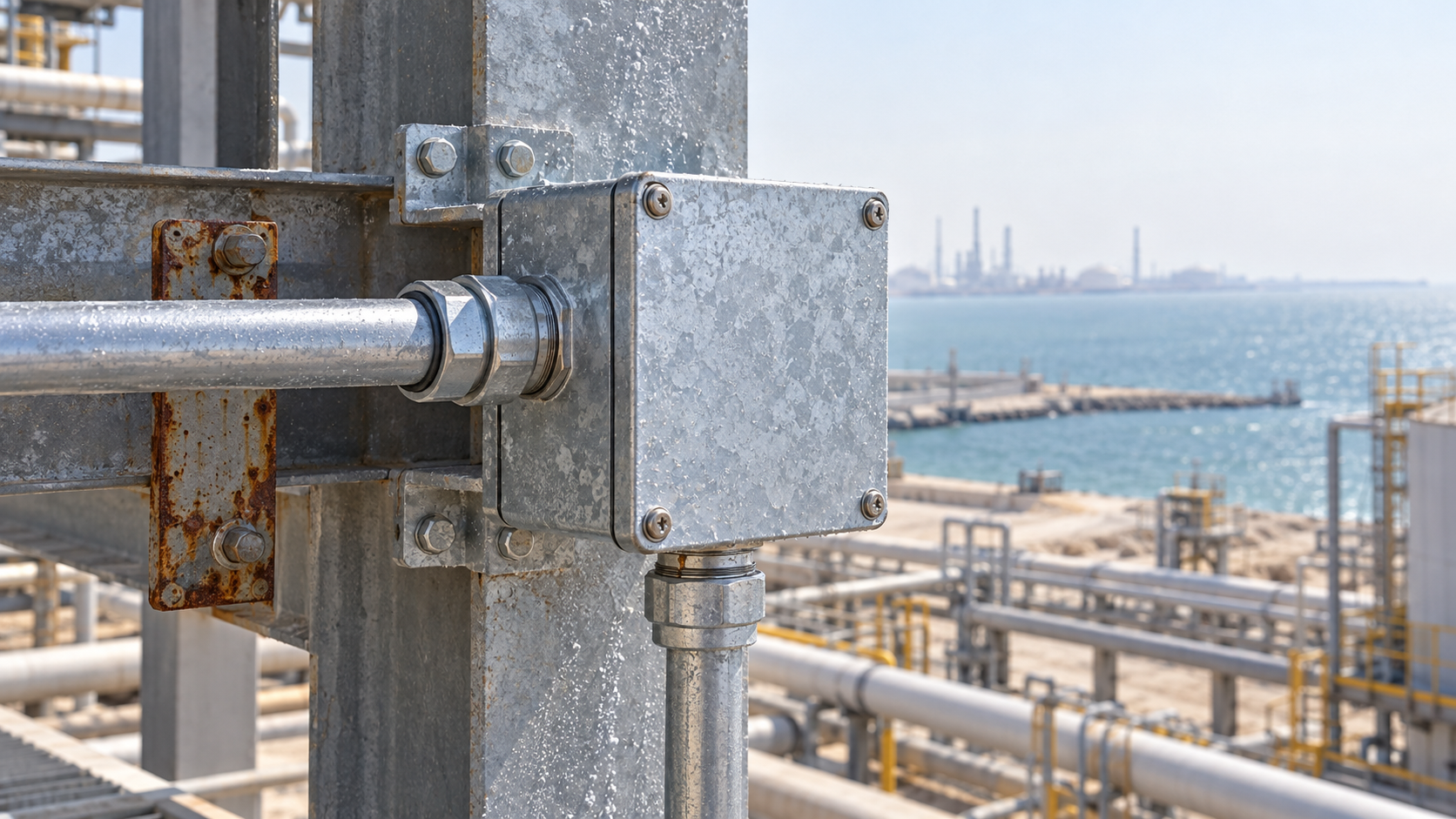
Selecting an outdoor junction box requires more than choosing a metal enclosure with a galvanized finish. Outdoor installations can expose the complete electrical system to rain, dust, humidity, condensation, temperature changes and corrosive contaminants.
Coastal projects require even closer evaluation. Locations such as Dammam, Khobar and Jubail can expose electrical installations to humid air and airborne salts that may accelerate corrosion if the enclosure, cover, fittings and installation method are unsuitable.
This guide explains what contractors, MEP engineers, consultants and procurement teams should check when selecting junction boxes for outdoor and coastal Saudi projects.
What Is an Outdoor Junction Box?
An outdoor junction box is an enclosure designed and documented for installation in the environmental conditions specified by the manufacturer.
It may be used to protect:
- Conductor connections.
- Circuit branches.
- Terminals.
- Cable entries.
- Conduit entries.
- Earthing connections.
- Selected electrical components.
A box should only be described as suitable for outdoor use when its documentation confirms the conditions it can withstand.
Material alone does not determine whether an enclosure is suitable for outdoor installation. The complete assembly must be considered, including:
- Box body.
- Cover.
- Gasket.
- Fasteners.
- Conduit entries.
- Cable glands.
- Connectors.
- Seals.
- Earthing components.
- Site modifications.
Why Coastal Environments Require Special Attention
Coastal installations can face several conditions that influence corrosion risk.
High humidity
Moist air can increase the time that metal surfaces remain damp. Persistent moisture can accelerate corrosion, particularly at damaged edges, fasteners and poorly protected entry points.
Airborne salts
Salt carried in the air may settle on exposed surfaces. When combined with moisture, these deposits can create a more aggressive environment for metal components.
Condensation
Temperature differences between the inside and outside of an enclosure can cause condensation. Moisture may form internally even when direct rain does not enter the box.
Wind-driven rain and dust
Outdoor enclosures may be exposed to water and dust approaching from different directions. Protection depends on the complete enclosure assembly and its verified rating.
Temperature changes
Daily and seasonal temperature changes can affect seals, gaskets, fittings and internal condensation.
For these reasons, a standard indoor junction box should not automatically be specified for an exposed coastal location.
Does Galvanized Steel Mean a Junction Box Is Weatherproof?
No.
Galvanization is a protective treatment applied to steel, but the word “galvanized” does not automatically confirm:
- An IP rating.
- Waterproof performance.
- Suitability for direct rain.
- Suitability for permanent outdoor exposure.
- Resistance to every coastal environment.
- A specific corrosion-resistance period.
- Compatibility with every fitting or gasket.
The protective performance depends on factors such as:
- Type of galvanized coating.
- Coating thickness.
- Surface condition.
- Cut edges.
- Drilled openings.
- Fasteners.
- Box design.
- Cover design.
- Environmental exposure.
- Installation quality.
A galvanized indoor box and an outdoor-rated enclosure can both contain galvanized steel, but they are not automatically equivalent products.
What Does an IP Rating Tell You?
An ingress-protection rating describes a verified level of protection against the entry of solid objects and water under defined test conditions.
An IP rating applies to the tested product or complete assembled enclosure—not simply to the box material.
For an IP-rated installation, verify that the rating covers:
- The box.
- The cover.
- The gasket.
- Entry fittings.
- Cable glands.
- Plugs closing unused openings.
- Fasteners.
- Any other component included in the tested assembly.
Do not create or publish an IP claim by combining separately sourced components unless the complete arrangement has supporting documentation.
The available information reviewed for Alrouf’s standard junction-box models does not confirm a specific IP rating. Therefore, these models should not be promoted as outdoor or waterproof boxes without additional product evidence.
Outdoor vs Indoor Junction Boxes
| Selection factor | Typical indoor junction box | Documented outdoor junction box |
|---|---|---|
| Primary environment | Protected building interior | Exposed or semi-exposed location |
| Rain exposure | Not normally intended for direct rain | Defined by the verified enclosure rating |
| Cover | Standard compatible cover | Cover forming part of the rated assembly |
| Gasket | May not be included | May be required by the tested design |
| Conduit entries | Standard knockouts or entries | Entries must maintain required protection |
| Unused openings | Closed using compatible components | Must be sealed using approved components |
| Corrosion protection | Selected for indoor conditions | Selected for documented environmental exposure |
| Documentation | Standard product data | Environmental and ingress-protection evidence |
This is general guidance. The actual product documentation determines the approved application.
How to Select a Junction Box for Outdoor Use
1. Define the Exact Installation Location
The word “outdoor” covers many different conditions.
Determine whether the box will be installed:
- Under a roof.
- Behind a screened façade.
- In a covered service area.
- On an external wall.
- On a rooftop.
- Near irrigation equipment.
- In a washdown area.
- Close to the coast.
- In an industrial environment.
- In direct sunlight.
- In an area exposed to wind-driven rain.
The level of exposure influences the required enclosure characteristics.
2. Identify the Environmental Risks
Prepare a list of expected conditions, including:
- Rain.
- Water spray.
- Dust.
- Humidity.
- Condensation.
- Salt exposure.
- Chemicals.
- Temperature range.
- UV exposure.
- Mechanical impact.
- Cleaning activities.
The enclosure should be selected against the actual risks rather than a generic statement that the project is “outdoor.”
3. Confirm the Required Enclosure Rating
The project specification should state the required environmental or ingress-protection classification where applicable.
Procurement teams should request documentation identifying:
- Exact product model.
- Declared rating.
- Applicable test standard.
- Tested configuration.
- Required cover.
- Required gasket.
- Approved entries or glands.
- Installation limitations.
A rating shown for a different model or product family should not be applied to the selected box.
4. Review the Base Material and Protective Finish
For a metal enclosure, confirm:
- Base metal.
- Protective coating or finish.
- Coating specification.
- Surface treatment.
- Fastener material.
- Treatment of edges.
- Repair procedure for damaged areas.
- Environmental limitations.
Do not rely only on the words “steel” or “galvanized steel.”
5. Check the Cover and Gasket
The cover is a critical part of the enclosure.
Verify:
- Exact compatibility with the box.
- Fixing-hole positions.
- Fastener quantity.
- Gasket material.
- Gasket position.
- Compression around the complete perimeter.
- Replacement requirements.
- Manufacturer’s installation instructions.
A loose, damaged or incorrectly positioned gasket can affect enclosure performance.
For general cover selection, read our electrical box covers and cover plates guide.
6. Evaluate Conduit and Cable Entries
Every entry can become a potential path for moisture or dust.
Check:
- Conduit diameter.
- Connector type.
- Cable-gland type.
- Entry orientation.
- Sealing method.
- Compatibility with the enclosure.
- Suitability for the environment.
- Treatment of unused openings.
The entry fitting must be documented for the intended application. A standard indoor connector should not be assumed to maintain an outdoor enclosure rating.
For metallic conduit installations, review our guide to connecting EMT conduit to a junction box.
7. Consider Entry Orientation
The location and direction of entries can influence water exposure and internal condensation.
The design team should review:
- Top entries.
- Side entries.
- Bottom entries.
- Conduit slope.
- Water collection points.
- Cable loops.
- Drainage strategy where applicable.
Top entries may require particular attention because water can collect around or travel along the conduit and fitting.
The final arrangement should follow the product instructions and approved design.
8. Allow for Condensation Management
A sealed enclosure can still experience internal condensation due to temperature changes.
Possible design considerations may include:
- Enclosure location.
- Thermal exposure.
- Approved ventilation components.
- Approved drain components.
- Internal heaters for specialized applications.
- Moisture-control devices.
- Conduit routing.
- Inspection and maintenance intervals.
These measures should only be used when specified and compatible with the enclosure rating.
Drilling an uncontrolled drain hole can invalidate the enclosure’s documented protection.
9. Verify Junction-Box Size
Outdoor suitability does not remove the normal sizing requirements.
The box must still provide adequate space for:
- Conductors.
- Connections.
- Terminals.
- Cable glands.
- Conduit fittings.
- Earthing conductors.
- Bending.
- Inspection and maintenance.
Available Alrouf standard junction-box dimensions are discussed in our junction box sizes guide.
Do not select a smaller box simply because the required outdoor-rated model has a higher cost.
10. Maintain Accessibility
Outdoor junction boxes must remain accessible for:
- Inspection.
- Cleaning.
- Testing.
- Tightening.
- Gasket checks.
- Corrosion monitoring.
- Maintenance.
- Replacement.
Avoid locating a box where it will be:
- Permanently covered.
- Difficult to open safely.
- Exposed to standing water.
- Blocked by equipment.
- Positioned where the cover cannot be removed.
- Vulnerable to repeated physical impact.
Corrosion Risks at Junction-Box Details
Corrosion often begins at specific details rather than across the entire box surface.
Cut edges
Cutting or drilling can expose base metal or damage the protective coating.
Scratches
Tools, transport and installation work can scratch the finished surface.
Fasteners
Incompatible or unsuitable fasteners may corrode differently from the enclosure body.
Knockouts
Partially removed or damaged knockouts can create weak points.
Conduit connections
Water and contaminants can collect around improperly installed fittings.
Cover joints
Damaged gaskets, loose fasteners or uneven cover pressure can allow contaminants to reach internal surfaces.
Mounting points
Water may collect behind an enclosure or around fixing points if the mounting arrangement is unsuitable.
Each detail should be inspected during installation and maintenance.
Preventing Corrosion During Installation
Contractors can reduce avoidable corrosion risks by following the approved installation method.
Store boxes correctly
Before installation:
- Keep boxes in a dry location.
- Protect them from construction chemicals.
- Avoid contact with wet concrete or standing water.
- Keep covers and fasteners with their matching boxes.
- Avoid stacking that damages the finish.
Use the correct tools
Appropriate tools help prevent:
- Distorted knockouts.
- Rough openings.
- Deep scratches.
- Damaged fasteners.
- Uneven covers.
Protect modified areas
Where site modification is permitted, follow the approved repair procedure for affected surfaces and edges.
Do not apply an unidentified paint or coating as an improvised repair.
Use compatible fittings
Confirm that connectors, glands, plugs, fasteners and earthing components are compatible with:
- The enclosure material.
- The environmental exposure.
- The approved protection rating.
- The selected conduit or cable.
Keep the cover closed
After completing and inspecting the internal connections, install the compatible cover correctly.
Do not leave open junction boxes exposed to construction dust, humidity or water.
Junction Boxes in Coastal Saudi Cities
Coastal projects in cities such as Dammam, Khobar and Jubail may require additional attention to:
- Airborne salts.
- High humidity.
- Industrial contaminants.
- Condensation.
- Exposure duration.
- Maintenance access.
- Protective coating documentation.
The distance from the shoreline alone does not determine the required protection. Local site conditions, surrounding industry, orientation and shelter can all affect exposure.
Project teams should define the environmental category or performance requirement in the specification instead of relying only on the phrase “coastal project.”
Outdoor Junction Boxes and EMT Conduit
When EMT conduit connects to an outdoor junction box, assess the entire connection.
Verify:
- EMT suitability for the location.
- Connector suitability.
- Entry sealing.
- Conduit support.
- Conduit slope.
- Earthing and bonding.
- Material compatibility.
- Treatment of unused entries.
- Protection of cut conduit ends.
- Accessibility.
Using an outdoor-rated box with an unsuitable connector can weaken the performance of the complete assembly.
Outdoor Junction Box vs Pull Box
A box used outdoors must still be correctly classified by function.
A junction box contains connections or circuit branches. A pull box primarily provides access along a conductor-pulling route.
Environmental protection does not change that distinction.
If the enclosure is needed for a long or complex conduit run, read our guide to pull boxes vs junction boxes before specifying the product.
Alrouf Junction Boxes and Outdoor Applications
Alrouf Electrical Accessories provides documented steel junction boxes in several dimensions for project applications.
However, the currently available product information does not confirm that the standard BB8, BB9 or BB10 junction boxes have a specific IP rating or are approved for direct outdoor or coastal exposure.
For that reason:
- Do not describe these models as waterproof.
- Do not assign an IP rating without evidence.
- Do not promise coastal corrosion resistance.
- Do not use a standard-box datasheet as proof of outdoor performance.
- Request written technical confirmation for the proposed environment.
If the project requires a rated outdoor enclosure, confirm whether an appropriate documented product is available before including Alrouf in the specification.
Outdoor Junction-Box Selection Table
| Installation condition | Main requirement to verify |
|---|---|
| Covered external area | Humidity, condensation and indirect water exposure |
| Direct rain exposure | Verified complete-enclosure rating |
| Coastal environment | Material and corrosion-protection documentation |
| Dusty site | Verified protection against solid ingress |
| Rooftop installation | Sun, temperature, water and maintenance access |
| Industrial location | Chemicals, contaminants and mechanical exposure |
| EMT conduit connection | Compatible rated connector and entry |
| Cable entry | Suitable gland and sealing arrangement |
| Washdown area | Verified water-exposure performance |
| Concealed damp space | Condensation and future access |
Procurement Checklist
Before ordering an outdoor or coastal junction box, request:
- Manufacturer name.
- Exact product model.
- Box dimensions.
- Base material.
- Protective finish.
- Coating specification.
- Declared IP or environmental rating.
- Test documentation.
- Cover model.
- Gasket details.
- Fastener material.
- Compatible connectors or glands.
- Approved method for unused openings.
- Earthing provision.
- Temperature range.
- Installation instructions.
- Maintenance requirements.
- Warranty conditions.
- Packing quantity.
- Project approval requirements.
The purchase order should identify the full assembled configuration, not only the box body.
Technical Submittal Checklist
The consultant or reviewing engineer should receive:
- Product datasheet.
- Model-specific dimensional drawing.
- Material specification.
- Environmental-rating evidence.
- Test certificate where required.
- Cover and gasket information.
- Entry-fitting information.
- Installation instructions.
- Earthing details.
- Proposed application and location.
- Compliance statement against the project specification.
A general company catalogue should not replace product-specific evidence where a defined environmental rating is required.
Inspection and Maintenance Checklist
Outdoor boxes should be inspected periodically for:
- Rust or discoloration.
- Coating damage.
- Loose cover fasteners.
- Gasket deterioration.
- Water marks.
- Internal condensation.
- Contaminant deposits.
- Damaged entries.
- Loose connectors.
- Earthing continuity.
- Blocked drains where approved drainage components exist.
- Physical impact damage.
The inspection frequency should reflect the environment and project maintenance plan.
Common Specification Mistakes
Avoid these frequent errors:
- Treating every galvanized box as an outdoor box.
- Assigning an IP rating without documentation.
- Checking the box but ignoring connectors and glands.
- Using indoor fittings on an exposed enclosure.
- Drilling additional openings without approval.
- Leaving unused knockouts open.
- Ignoring condensation.
- Mixing incompatible metals.
- Using unsuitable fasteners.
- Failing to coordinate entry direction.
- Selecting a box that is too small for the fittings and conductors.
- Hiding a box that requires maintenance.
- Promising a fixed corrosion life without supporting evidence.
- Using a rating from another model or manufacturer.
- Assuming every coastal location has identical exposure.
Frequently Asked Questions
Can galvanized junction boxes be used outdoors?
Only when the exact product documentation confirms suitability for the intended outdoor conditions. Galvanization alone does not establish an outdoor or waterproof rating.
Are Alrouf junction boxes IP65?
The available product information reviewed for the standard Alrouf junction boxes does not confirm an IP65 rating. Do not publish or specify this rating without model-specific documentation.
What junction-box material is best for coastal projects?
There is no universal answer. The material and protective system must be selected according to salt exposure, humidity, industrial contaminants, temperature, mechanical conditions and project requirements.
Does a gasket make a junction box waterproof?
Not by itself. The box, cover, gasket, fasteners, entries and fittings must form a documented complete enclosure assembly.
Can I drill extra conduit entries into an outdoor junction box?
Only where permitted by the manufacturer and project method. Additional openings can affect the coating, sealing and verified enclosure performance.
How do I select an outdoor junction-box size?
Consider the conductors, terminals, conduit or cable entries, glands, bending requirements and maintenance access. Review our junction box sizes chart for documented Alrouf dimensions.
Can EMT conduit connect to an outdoor junction box?
It may be possible when the conduit, connector, enclosure entry and complete installation are approved for the location. Read our EMT-to-junction-box installation guide for the general connection process.
How often should coastal junction boxes be inspected?
The project maintenance plan should determine the frequency based on environmental severity, enclosure material, product documentation and operating conditions.
Conclusion
Selecting an outdoor junction box for a Saudi coastal project requires evaluation of the complete enclosure system—not only the material of the box body.
The engineer and procurement team should verify:
- Installation location.
- Rain, dust and humidity exposure.
- Salt and chemical exposure.
- Base material.
- Protective finish.
- Model-specific environmental rating.
- Cover and gasket.
- Connectors and cable glands.
- Unused openings.
- Condensation strategy.
- Junction-box size.
- Maintenance access.
- Supporting documentation.
Standard Alrouf steel junction boxes should not be promoted as IP-rated, waterproof or approved for coastal exposure unless the exact product model has supporting technical evidence.
Contact Alrouf Electrical Accessories to request the current product documentation and confirm whether a suitable junction-box configuration is available for your project environment.


