


Pull Box vs Junction Box: What Is the Difference?
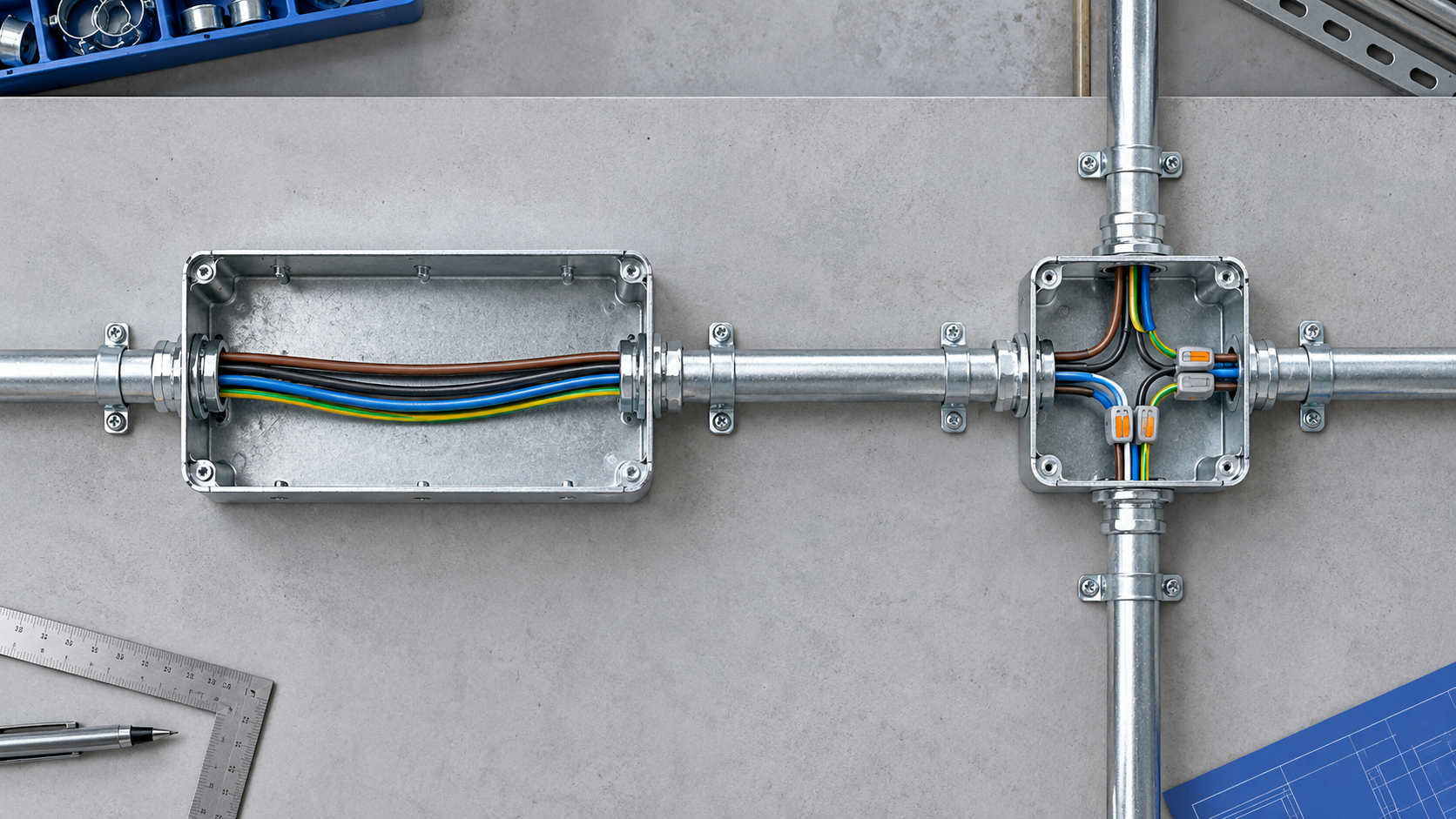
Pull boxes and junction boxes are both used in electrical conduit systems, and their physical appearance can sometimes be similar. However, they do not necessarily perform the same function.
A junction box is primarily used to contain conductor connections, splices or circuit branches. A pull box is primarily installed to make it easier to pull conductors through long or complex conduit routes.
Understanding the difference between a pull box vs junction box helps MEP engineers, contractors and procurement teams select the correct enclosure, prepare accurate material schedules and avoid installation problems on Saudi construction projects.
What Is a Junction Box?
A junction box is an electrical enclosure that provides a protected and accessible location for conductor connections.
Inside a junction box, conductors may be:
- Joined.
- Spliced.
- Branched.
- Terminated.
- Redirected toward different circuits.
- Connected using approved terminals or connectors.
Junction boxes are frequently used in:
- Lighting circuits.
- Power-distribution routes.
- Commercial ceiling spaces.
- Residential buildings.
- Warehouses.
- Plant rooms.
- Industrial conduit systems.
- Maintenance and inspection points.
The junction box protects the contained connections while keeping them accessible where inspection or future maintenance is required.
What Is a Pull Box?
A pull box is an enclosure installed along a conduit route to provide access during conductor installation.
Its principal purpose is to reduce the difficulty of pulling conductors through:
- Long conduit runs.
- Routes containing several bends.
- Changes in conduit direction.
- Systems using larger conductors.
- Areas where one continuous pull would be impractical.
- Conduit networks requiring intermediate access.
Conductors normally pass through a pull box rather than being joined inside it. Whether splices are allowed or intended depends on the design, enclosure size and project requirements.
A box should not be treated as a pull box simply because conductors can pass through it. Its dimensions and arrangement must suit the actual conduit and conductor layout.
Pull Box vs Junction Box: Quick Comparison
| Selection factor | Pull box | Junction box |
|---|---|---|
| Main function | Assists conductor pulling and routing | Contains conductor connections and branches |
| Typical conductor arrangement | Conductors normally pass through | Conductors may be joined or terminated |
| Common location | Long or complex conduit route | Circuit junction or branching point |
| Main sizing consideration | Conduit entries, pull direction and conductor bending | Conductors, connectors, entries and working space |
| Accessibility | Required for conductor installation and maintenance | Required for inspection and maintenance of connections |
| Typical shape | Depends on conduit arrangement | Square, rectangular, octagonal or specialized |
| Cover | Removable and compatible with the box | Removable and compatible with the box |
| Can it contain splices? | Only when the design and applicable requirements permit | Commonly intended for connections and splices |
The final selection and sizing method must follow the approved electrical design and the requirements governing the project.
The Main Difference Between a Pull Box and Junction Box
The principal difference is the reason the enclosure is installed.
A pull box supports conductor installation
A pull box divides a long or complicated conduit route into manageable pulling sections. It gives installers access to the conductors at an intermediate location.
A junction box supports conductor connection
A junction box provides a protected location where conductors can be connected, divided into branches or terminated.
One enclosure may sometimes appear capable of performing both functions, but the designer should define its intended purpose clearly. That purpose affects:
- Required dimensions.
- Entry positions.
- Internal conductor arrangement.
- Cover accessibility.
- Inspection requirements.
- Information shown on drawings and schedules.
When Is a Pull Box Needed?
A pull box may be considered when a conduit route includes one or more of the following conditions.
Long conduit runs
Pulling conductors through a very long continuous conduit can create excessive pulling difficulty. An intermediate pull point can divide the route into more manageable sections.
Multiple bends
Each bend increases resistance during conductor pulling. Where a route contains several changes in direction, a pull box can provide an intermediate access point.
Large conductors
Larger conductors can require more space for pulling, handling and bending. The enclosure must be sized for the conductor and conduit arrangement.
Changes in conduit direction
A pull box may be placed where the route changes direction and adequate space is needed to guide conductors through the turn.
Difficult installation access
Congested ceiling spaces, service corridors and industrial areas may make a single conductor pull impractical. Correctly positioned pull boxes can improve installation access.
The designer should determine whether a pull box is required and where it should be located before construction begins.
When Is a Junction Box Needed?
A junction box may be required where:
- One circuit divides into multiple branches.
- Two or more conductors are connected.
- A circuit changes direction at a termination point.
- Conductors of an approved system are joined.
- An accessible connection point is needed.
- Equipment wiring connects to the building wiring system.
- Lighting or power circuits branch toward several locations.
The junction box must provide sufficient space for the conductors, terminals, connectors and conduit fittings.
Can a Junction Box Be Used as a Pull Box?
A junction box should not automatically be used as a pull box simply because it is available on site.
Before using any enclosure as a pulling point, the engineer should verify:
- Internal dimensions.
- Box depth.
- Conduit-entry positions.
- Conductor sizes.
- Required bending space.
- Pulling direction.
- Accessibility.
- Cover arrangement.
- Applicable project requirements.
A small junction box intended for conductor connections may not provide the dimensions needed for a pull-box application.
Can a Pull Box Be Used as a Junction Box?
A pull box should not automatically be used for conductor splices or terminals.
If connections are to be installed inside it, the engineer must confirm that:
- The enclosure has adequate usable space.
- The conductor connections are permitted.
- The terminals or connectors are approved.
- The cover remains accessible.
- The conductor arrangement is maintainable.
- The drawings and material schedule identify the correct function.
Using a larger enclosure does not remove the need for correct design and approval.
How Are Pull Boxes Sized?
Pull-box sizing depends strongly on the conduit and conductor arrangement.
The designer should consider:
- Conduit diameter.
- Number of conduits.
- Entry and exit positions.
- Whether the pull is straight or angled.
- Conductor size.
- Required bending space.
- Pulling method.
- Fittings inside the box.
- Space required to handle the conductors.
A box that appears large from the outside may still be unsuitable if the conduits enter too close together or the depth does not support the intended pulling arrangement.
Pull-box dimensions should be established by the responsible engineer using the applicable project requirements.
How Are Junction Boxes Sized?
Junction-box sizing considers:
- Number of conductors.
- Conductor cross-sectional area.
- Number and diameter of conduits.
- Entry direction.
- Connector or terminal dimensions.
- Earthing conductors.
- Required working space.
- Box depth.
- Cover accessibility.
External dimensions alone do not establish how many conductors can be installed inside a box.
For available Alrouf dimensions and model information, review our junction box sizes guide.
Pull-Box and Junction-Box Conduit Arrangements
The conduit arrangement affects both box types.
Straight pulls
In a straight pull, the conductor enters one side of the box and exits through the opposite side.
The enclosure must provide sufficient distance and working space for conductors to pass through without unsuitable bending or damage.
Angle pulls
In an angle pull, the conduit exits through an adjacent wall or changes direction inside the box.
Angle pulls often require more careful evaluation because the conductor must turn within the enclosure.
U-pulls
A U-pull occurs when conductors enter and leave through the same wall of the box.
The positions and spacing of the conduit entries become particularly important.
Junction and branching arrangements
In a junction box, conduits may enter from several sides while conductors are joined or divided into branches.
The installer must have enough space to arrange connections without creating sharp bends, overcrowding or inaccessible terminals.
Size Is Not the Only Selection Factor
A suitable enclosure must meet more than dimensional requirements.
Material
Confirm whether the project requires steel, galvanized steel or another approved enclosure material.
Steel thickness
Where a particular steel thickness is specified, include it in the material schedule and purchase order.
Cover compatibility
The box and cover must have matching:
- Dimensions.
- Fixing points.
- Material.
- Intended application.
- Required opening or blank configuration.
Conduit entries
Review the number, diameter and location of the available knockouts or entries.
Earthing provision
Metal boxes must be incorporated into the project’s earthing and bonding arrangement where required.
Installation environment
Indoor, outdoor, dusty, humid and corrosive areas may require different enclosure characteristics.
A galvanized finish alone does not establish an IP rating or confirm suitability for every exposed environment.
Pull Boxes and Junction Boxes in Saudi Projects
Saudi construction projects range from residential developments to commercial towers, warehouses, hospitals and industrial facilities.
Residential projects
Junction boxes may be used at lighting and circuit-branching points. Pull boxes may be required where conduit routes between distribution points are long or difficult.
Commercial buildings
Suspended ceilings and service areas can contain large conduit networks. The locations of junction and pull boxes must be coordinated with access panels and other building services.
Warehouses
Long electrical routes across large warehouse spaces may require intermediate pulling access. Junction boxes may also be installed where circuits branch toward lighting, equipment or service areas.
Industrial projects
Industrial conduit systems can involve larger conductors, more challenging routes and frequent changes in direction. The enclosure type, dimensions and material should be selected through the project’s engineering process.
Coastal projects
Projects in Dammam, Khobar, Jubail and other coastal areas require careful material and environmental review.
Do not describe a box as outdoor-rated, waterproof or corrosion-proof unless the exact product documentation supports that claim.
Alrouf Steel Junction Boxes
Alrouf Electrical Accessories provides documented steel junction-box models for electrical projects.
Available dimensions covered in the current junction-box guide include:
- 10 × 10 × 5.5 cm.
- 15 × 15 × 5.5 cm.
- 15 × 15 × 10 cm.
- 20 × 20 × 5.5 cm.
These products should be specified as junction boxes unless another intended function is confirmed by the project engineer and supported by the product documentation.
The available information does not confirm a dedicated Alrouf pull-box product range. Therefore, purchase enquiries should not assume that standard Alrouf junction boxes are approved pull boxes.
Selection Table
| Project situation | Box to evaluate | Main consideration |
|---|---|---|
| Conductors need to be joined | Junction box | Connections, terminals and working space |
| Circuit divides into branches | Junction box | Number of conductors and conduit entries |
| Long conduit route | Pull box | Pulling distance and accessibility |
| Several conduit bends | Pull box | Direction changes and conductor handling |
| Large conductor pulling | Pull box | Conductor size and bending space |
| Conductors change direction and are spliced | Engineer-defined enclosure | Both pulling and connection requirements |
| Compact lighting junction | Junction box | Available dimensions and conductor arrangement |
| Main conduit route through a service area | Pull box | Conduit layout and maintenance access |
Installation Requirements
Whether installing a pull box or junction box, contractors should:
- Follow approved drawings.
- Install the box in an accessible location.
- Use compatible conduit connectors.
- Protect conductors from sharp edges.
- Secure the enclosure correctly.
- Maintain the required earthing and bonding arrangement.
- Use the compatible cover.
- Avoid uncontrolled site modifications.
- Coordinate with ceiling and wall finishes.
- Keep required access points visible and reachable.
- Request approval before changing box dimensions or locations.
Procurement Checklist
The material request should identify:
- Pull box or junction box.
- Intended application.
- Manufacturer.
- Model number.
- Length, width and depth.
- Measurement unit.
- Material and finish.
- Steel thickness.
- Number and size of conduit entries.
- Entry positions.
- Cover requirements.
- Earthing provision.
- Packing quantity.
- Required technical documents.
- Project drawing reference.
- Total quantity.
Avoid vague descriptions such as:
- “Metal box.”
- “Large junction box.”
- “4×4 box.”
- “Pulling box.”
These descriptions do not provide enough information for accurate supply.
Common Selection Mistakes
Frequent mistakes include:
- Treating pull boxes and junction boxes as identical.
- Using a small junction box as an intermediate pulling point.
- Installing conductor splices in a pull box without design approval.
- Selecting a box based only on external dimensions.
- Ignoring conduit-entry positions.
- Failing to consider conductor bending space.
- Ordering boxes without compatible covers.
- Concealing boxes that must remain accessible.
- Using unverified outdoor or IP-rating claims.
- Changing the box location without coordinating the conduit route.
- Omitting the measurement unit from the purchase order.
Frequently Asked Questions
What is the main difference between a pull box and a junction box?
A pull box primarily provides access for pulling conductors through a long or complex conduit route. A junction box primarily contains conductor connections, splices or circuit branches.
Can conductors be spliced inside a pull box?
That depends on the enclosure design and the requirements governing the project. Do not assume that a pull box is intended for splices without engineering approval.
Can I use a junction box to pull wires?
Only if its dimensions, conduit arrangement and approved application make it suitable. A standard compact junction box may not provide sufficient pulling or bending space.
Are pull boxes larger than junction boxes?
Pull boxes are often large because they must accommodate conduit entries and conductor bending, but size alone does not define the box type.
How do I choose a junction-box size?
Consider conductor quantity, conductor size, conduit entries, connector dimensions, required working space and box depth. Compare the available models in our junction box sizes chart.
Does Alrouf manufacture pull boxes?
The available product information confirms steel junction-box models. A dedicated pull-box range should be confirmed directly through the current Alrouf catalogue or sales team before it is specified.
Can pull boxes and junction boxes be hidden above ceilings?
They may be positioned within ceiling spaces, but required access must be maintained for installation, inspection and maintenance. Their locations should be coordinated with access panels and other services.
Conclusion
The pull box vs junction box decision starts with the purpose of the enclosure.
Choose or evaluate a junction box when conductors need to be joined, branched or terminated. Evaluate a pull box when installers need intermediate access along a long or complex conduit route.
The final selection must also consider:
- Conductor size.
- Conduit diameter.
- Entry direction.
- Required bending space.
- Internal working space.
- Cover accessibility.
- Material and environmental conditions.
- Project specifications.
Alrouf Electrical Accessories provides steel junction boxes in several documented dimensions. These models should be selected using their exact product information and should not automatically be treated as pull boxes.
Contact Alrouf Electrical Accessories to request the current junction-box catalogue and verified technical information for your material schedule or project submittal.


