


Junction Box Sizes: 4×4, 20×20 and Other Sizes
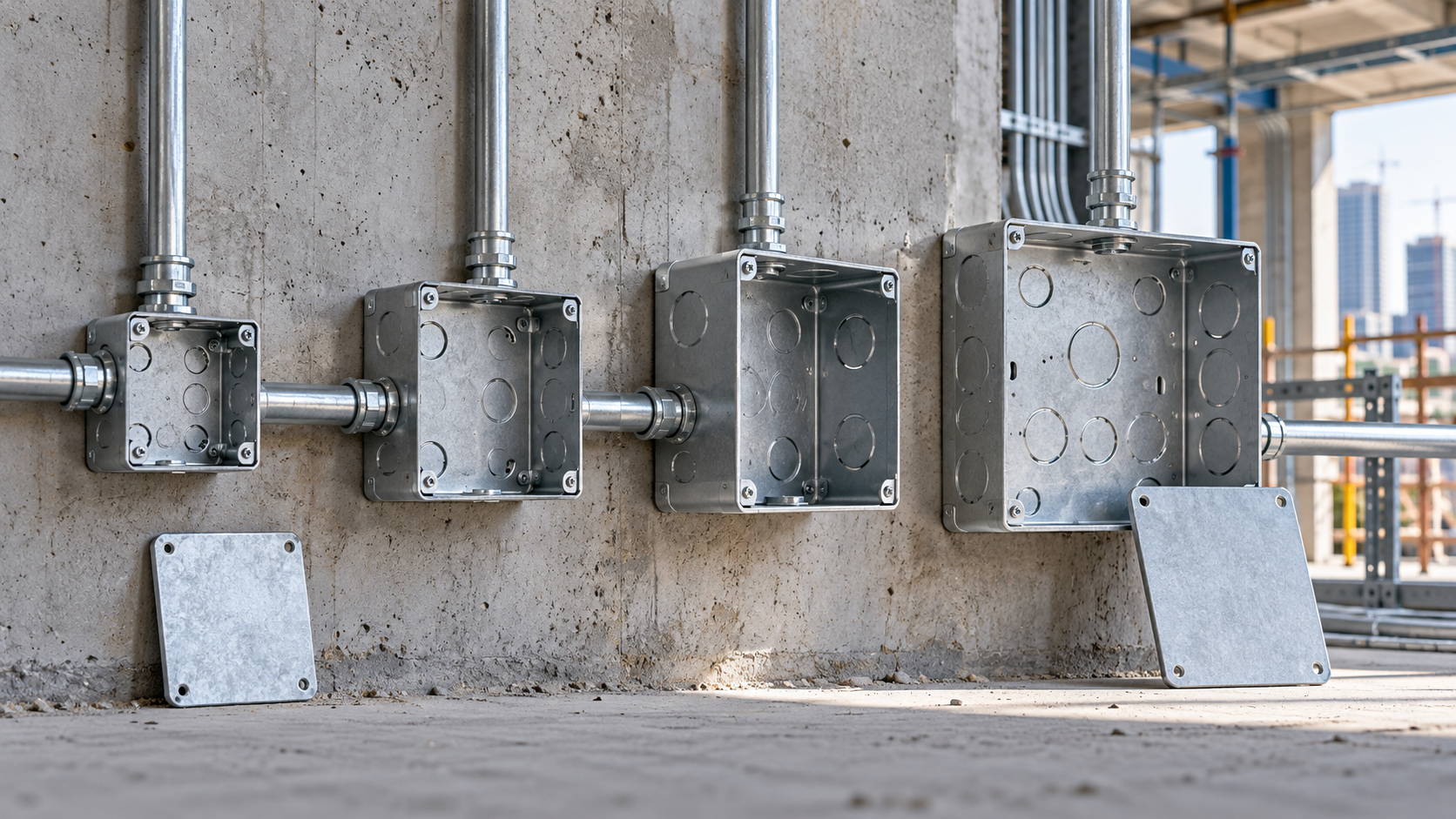
Choosing the correct junction box size is essential for safe conductor routing, accessible terminations and efficient installation. A box that is too small can make conductor arrangement and maintenance difficult, while an unnecessarily large box may increase material costs and create coordination problems with walls, ceilings and other building services.
Common descriptions such as “4×4 junction box” can also cause confusion because some suppliers use inches while others list dimensions in centimetres. Contractors and procurement teams must therefore confirm the measurement unit, depth, model number and conduit-entry arrangement before placing an order.
This guide explains the common junction-box sizes used in Saudi projects and presents the available Alrouf steel junction-box models, including 10×10, 15×15 and 20×20 cm options.
If you need to compare junction boxes with other box categories first, read our guide to the types of electrical boxes used in Saudi projects.
What Is a Junction Box?
A junction box is an enclosure that provides a protected and accessible location for electrical conductors to be joined, branched or redirected.
Junction boxes are commonly used in:
- Lighting circuits.
- Power distribution routes.
- Commercial ceiling spaces.
- Residential electrical installations.
- Warehouses and service areas.
- Industrial conduit systems.
- Circuit branching points.
- Maintenance and inspection locations.
The box protects the contained connections and keeps them accessible where future inspection or maintenance is required.
A junction box is different from a switch or socket box. Switch and socket boxes are primarily designed to support wiring devices, while junction boxes are generally selected according to the conductor and conduit arrangement.
How Are Junction Box Sizes Measured?
Junction-box dimensions are normally expressed as:
Length × width × depth
For example, a box measuring 15 × 15 × 10 cm has:
- A length of 15 cm.
- A width of 15 cm.
- A depth of 10 cm.
All three measurements matter.
Length and width determine the available working face, while depth affects conductor bending, connector placement and the overall usable space inside the box.
Two boxes with the same length and width may perform differently if one is considerably deeper.
What Does a 4×4 Junction Box Mean?
The term 4×4 junction box commonly refers to a square box measuring approximately four inches by four inches.
Four inches equals approximately 10.16 cm. Therefore, a 4×4-inch box is close in nominal size to a 10×10 cm box, but these descriptions should not automatically be treated as identical.
There may be differences in:
- Exact external dimensions.
- Internal usable dimensions.
- Box depth.
- Cover dimensions.
- Fixing-hole positions.
- Knockout layout.
- Steel thickness.
- Manufacturing tolerances.
When a bill of quantities or enquiry specifies a “4×4 junction box,” the supplier should confirm whether the requirement is:
- Four inches by four inches.
- A nominal 100×100 mm box.
- A specific manufacturer’s model.
- A box matching an approved cover or fitting.
The measurement unit should always appear in the purchase order.
Common Junction Box Sizes
Junction boxes are available in different dimensions to suit different conductor and conduit arrangements.
Common sizes in the Alrouf range covered by this guide include:
- 10 × 10 × 5.5 cm.
- 15 × 15 × 5.5 cm.
- 15 × 15 × 10 cm.
- 20 × 20 × 5.5 cm.
These dimensions provide a progression from compact junction points to larger boxes with more working area or depth.
The correct size cannot be selected solely from the number of conduits. Conductor sizes, bending requirements, connectors and the direction of entry must also be considered.
Alrouf Junction Box Size Chart
| Model | Dimensions | Steel thickness | Unit weight | Packing quantity |
|---|---|---|---|---|
| BB8-001 | 10 × 10 × 5.5 cm | 0.9 mm | 298 g | 50 pieces |
| BB8-002 | 10 × 10 × 5.5 cm | 0.9 mm | 298 g | 50 pieces |
| BB9-001 | 15 × 15 × 5.5 cm | 0.9 mm | 620 g | 20 pieces |
| BB9-002 | 15 × 15 × 10 cm | 0.9 mm | 825 g | 12 pieces |
| BB10-001 | 20 × 20 × 5.5 cm | Confirm before ordering | 952 g | Confirm before ordering |
The latest Alrouf catalogue or approved technical submittal should be checked before issuing a purchase order.
For a wider table covering switch boxes as well as junction boxes, see our electrical metal box sizes chart.
10×10 cm Junction Boxes
The Alrouf BB8 junction-box family measures:
10 × 10 × 5.5 cm
This compact square size may be considered for smaller conductor-junction and circuit-branching points where the planned conduits, conductors and connectors can be accommodated correctly.
BB8-001
- Dimensions: 10 × 10 × 5.5 cm.
- Steel thickness: 0.9 mm.
- Unit weight: 298 g.
- Packing quantity: 50 pieces.
BB8-002
- Dimensions: 10 × 10 × 5.5 cm.
- Steel thickness: 0.9 mm.
- Unit weight: 298 g.
- Packing quantity: 50 pieces.
- Earthing provision: confirm the exact configuration from the approved submittal.
The 10×10 cm box is close to what some project teams may informally call a 4×4 box. However, the model and exact dimensions should still be confirmed rather than treating the names as interchangeable.
When could a 10×10 cm box be considered?
It may be suitable for:
- Compact lighting-circuit junctions.
- Limited circuit branching.
- Smaller conduit arrangements.
- Accessible ceiling junction points.
- Installations with a modest number of conductors.
Suitability depends on the actual installation. The box should not be approved based on these examples alone.
15×15 cm Junction Boxes
The Alrouf BB9 family includes two depth options:
- 15 × 15 × 5.5 cm.
- 15 × 15 × 10 cm.
This allows the project team to choose between a standard-depth box and a deeper box while retaining the same length and width.
BB9-001: 15×15×5.5 cm
The BB9-001 model has:
- Dimensions: 15 × 15 × 5.5 cm.
- Steel thickness: 0.9 mm.
- Unit weight: 620 g.
- Packing quantity: 20 pieces.
Its larger face area can make conductor arrangement and access easier than in a 10×10 cm box, depending on the conduit-entry layout.
BB9-002: 15×15×10 cm
The BB9-002 model has:
- Dimensions: 15 × 15 × 10 cm.
- Steel thickness: 0.9 mm.
- Unit weight: 825 g.
- Packing quantity: 12 pieces.
The 10 cm depth provides additional internal space compared with BB9-001.
A deeper box may be considered when:
- Larger conductors are used.
- More working depth is needed.
- Multiple conduits enter from different directions.
- Connectors or terminals occupy additional space.
- The conductor arrangement cannot be completed comfortably in a shallow box.
The deeper model should still be assessed against the actual installation requirements rather than chosen automatically.
20×20 cm Junction Boxes
The Alrouf BB10-001 junction box measures:
20 × 20 × 5.5 cm
Its documented unit weight is:
952 g
This size provides a larger working face and may suit applications involving more conduit entries or a wider conductor arrangement.
Before specifying BB10-001, confirm:
- Number of incoming and outgoing conduits.
- Conduit diameters.
- Conductor sizes and quantities.
- Required cover.
- Entry positions.
- Installation space.
- Steel thickness.
- Packing quantity.
- Approved technical documentation.
The current catalogue should be consulted for any information not shown in the available product schedule.
Does a Larger Junction Box Have More Capacity?
Generally, a physically larger box provides more internal space, but external dimensions alone do not establish its permitted conductor capacity.
Usable space may be affected by:
- Wall thickness.
- Knockouts.
- Internal brackets.
- Earthing points.
- Conduit fittings.
- Terminals.
- Covers.
- Direction of conductor entry.
- Required bending space.
Avoid making unsupported claims such as stating that a specific box can contain an exact number of conductors unless this is confirmed through the applicable calculation and approved technical documentation.
The engineer should calculate or verify the required capacity according to the project’s governing requirements.
How to Choose the Correct Junction Box Size
1. Identify the box function
Establish whether the box will be used for:
- Joining conductors.
- Branching a circuit.
- Changing conduit direction.
- Providing an accessible maintenance point.
- Supporting conductor pulling.
- Housing terminals or connectors.
A box used mainly for pulling conductors may have different sizing considerations from one containing several splices.
2. Count the conduits
Record:
- Number of conduits.
- Nominal conduit diameter.
- Entry direction.
- Entry location.
- Required fittings.
- Distance between entries.
A box may appear large enough but still have an unsuitable knockout arrangement.
3. Review conductor requirements
Check:
- Number of conductors.
- Conductor cross-sectional area.
- Insulation thickness.
- Minimum bending requirements.
- Connector or terminal dimensions.
- Earthing conductors.
- Required separation.
Do not force conductors into a box or create sharp bends simply because a particular size is already available on site.
4. Compare box depth
Depth is especially important where several conductors or large connectors must be arranged inside the box.
For example:
- BB9-001 is 5.5 cm deep.
- BB9-002 is 10 cm deep.
Both models have a 15×15 cm face, but they do not provide the same internal depth.
5. Check conduit entries and knockouts
Confirm that the factory entries match the conduit system.
Check:
- Knockout diameters.
- Number of knockouts.
- Side and bottom positions.
- Compatibility with connectors.
- Space between adjacent fittings.
Uncontrolled site cutting can damage the protective finish or leave unsafe edges.
6. Confirm installation space
The selected box must fit within the planned:
- Wall cavity.
- Concrete or blockwork opening.
- Ceiling space.
- Service riser.
- Equipment area.
- Surface-mounted conduit route.
Coordinate the box with architectural, mechanical and structural services.
7. Verify the cover
The cover must match:
- Box model.
- External dimensions.
- Fixing-hole positions.
- Intended level of access.
- Environmental requirements.
Read our electrical box covers and cover plates guide before ordering boxes and covers separately.
Junction Box Size Selection Table
| Project requirement | Size to evaluate | What must be checked |
|---|---|---|
| Compact junction point | 10 × 10 × 5.5 cm | Conductors, fittings and entry positions |
| More working face required | 15 × 15 × 5.5 cm | Conduit layout and cover access |
| Additional internal depth required | 15 × 15 × 10 cm | Bending space and connector arrangement |
| Larger conduit and conductor layout | 20 × 20 × 5.5 cm | Full entry configuration and usable depth |
This table helps identify which size to evaluate. It is not a substitute for the project’s electrical calculation or approved material schedule.
Junction Boxes for Saudi Projects
Saudi projects can include different building types and environmental conditions.
Residential projects
Residential developments may use junction boxes for:
- Lighting circuits.
- Apartment distribution routes.
- Ceiling connections.
- Common-area services.
Standardizing a small number of approved models can simplify procurement across repeated units.
Commercial buildings
Offices, hotels, hospitals and retail projects may require more junction points due to:
- Larger floor areas.
- Suspended ceiling services.
- Multiple circuit branches.
- Maintenance requirements.
- Greater coordination with other systems.
Accessibility should be considered before the ceiling or wall finish is completed.
Industrial and service areas
Industrial installations may involve:
- Larger conduits.
- More conductors.
- Surface-mounted systems.
- Greater mechanical exposure.
- More frequent maintenance.
The project engineer must determine whether a standard junction box is suitable or whether a specialized enclosure is required.
Coastal areas
Projects in Dammam, Khobar, Jubail and other coastal locations require careful review of material and environmental exposure.
A galvanized finish alone does not establish:
- An IP rating.
- Waterproof performance.
- Suitability for every outdoor location.
- Resistance to every corrosive environment.
Any environmental-performance claim should be confirmed through product-specific technical documentation.
What Should Be Included in a Junction Box Purchase Order?
The purchase order should state:
- Manufacturer.
- Complete model code.
- Box dimensions.
- Measurement unit.
- Steel thickness.
- Unit weight where required.
- Earthing provision.
- Knockout sizes and quantities.
- Cover requirements.
- Packing quantity.
- Total quantity.
- Project and drawing reference.
- Required technical documents.
- Delivery location and schedule.
Example
Alrouf BB9-002 steel junction box, 15 × 15 × 10 cm, 0.9 mm thickness, 825 g unit weight, 12 pieces per pack—quantity according to the approved project schedule.
This level of detail reduces confusion between boxes with similar face dimensions but different depths.
Common Junction Box Sizing Mistakes
Avoid these frequent errors:
- Confusing inches with centimetres.
- Ordering a “4×4 box” without stating the measurement unit.
- Selecting only by length and width while ignoring depth.
- Assuming a larger box automatically meets conductor-capacity requirements.
- Ignoring conduit-entry directions.
- Failing to coordinate connectors and terminals.
- Ordering boxes without compatible covers.
- Treating all 15×15 cm boxes as the same model.
- Using an indoor box for exposed conditions without supporting documentation.
- Modifying knockouts without an approved method.
- Failing to keep required junctions accessible.
Frequently Asked Questions
What is the standard junction box size?
There is no single size suitable for every installation. Common options in the Alrouf range include 10×10×5.5 cm, 15×15×5.5 cm, 15×15×10 cm and 20×20×5.5 cm.
Is a 4×4 junction box the same as a 10×10 cm box?
Not exactly. A four-inch dimension equals approximately 10.16 cm. A nominal 4×4-inch box may be similar to a 10×10 cm box, but exact dimensions, covers, fixing points and knockout layouts can differ.
How deep should a junction box be?
The required depth depends on conductor size, conductor quantity, conduit entries, connectors and bending space. Alrouf models in this guide include depths of 5.5 cm and 10 cm.
Which Alrouf junction box is the deepest?
Among the models listed here, BB9-002 is the deepest at 10 cm.
What is the largest Alrouf junction box listed in this guide?
BB10-001 has the largest face dimensions at 20×20 cm and a depth of 5.5 cm.
Can I choose a junction box based only on the number of conduits?
No. Conductor sizes, entry direction, bending space, connectors and usable internal dimensions must also be considered.
Are Alrouf junction boxes suitable for outdoor use?
Outdoor suitability should be confirmed through the product-specific technical documentation and project requirements. Do not assume an IP rating or outdoor classification from the material alone.
Conclusion
Selecting the correct junction box size requires a clear understanding of the box dimensions, depth, conductor arrangement, conduit entries and installation environment.
The Alrouf range covered in this guide includes:
- BB8 models at 10 × 10 × 5.5 cm.
- BB9-001 at 15 × 15 × 5.5 cm.
- BB9-002 at 15 × 15 × 10 cm.
- BB10-001 at 20 × 20 × 5.5 cm.
Contractors and procurement teams should avoid ambiguous descriptions such as “4×4 junction box” unless the unit and exact model are clearly identified.
Contact Alrouf Electrical Accessories to request the current junction-box catalogue and verified technical information for your project’s material schedule or submittal.


