


Types of Electrical Boxes Used in Saudi Projects
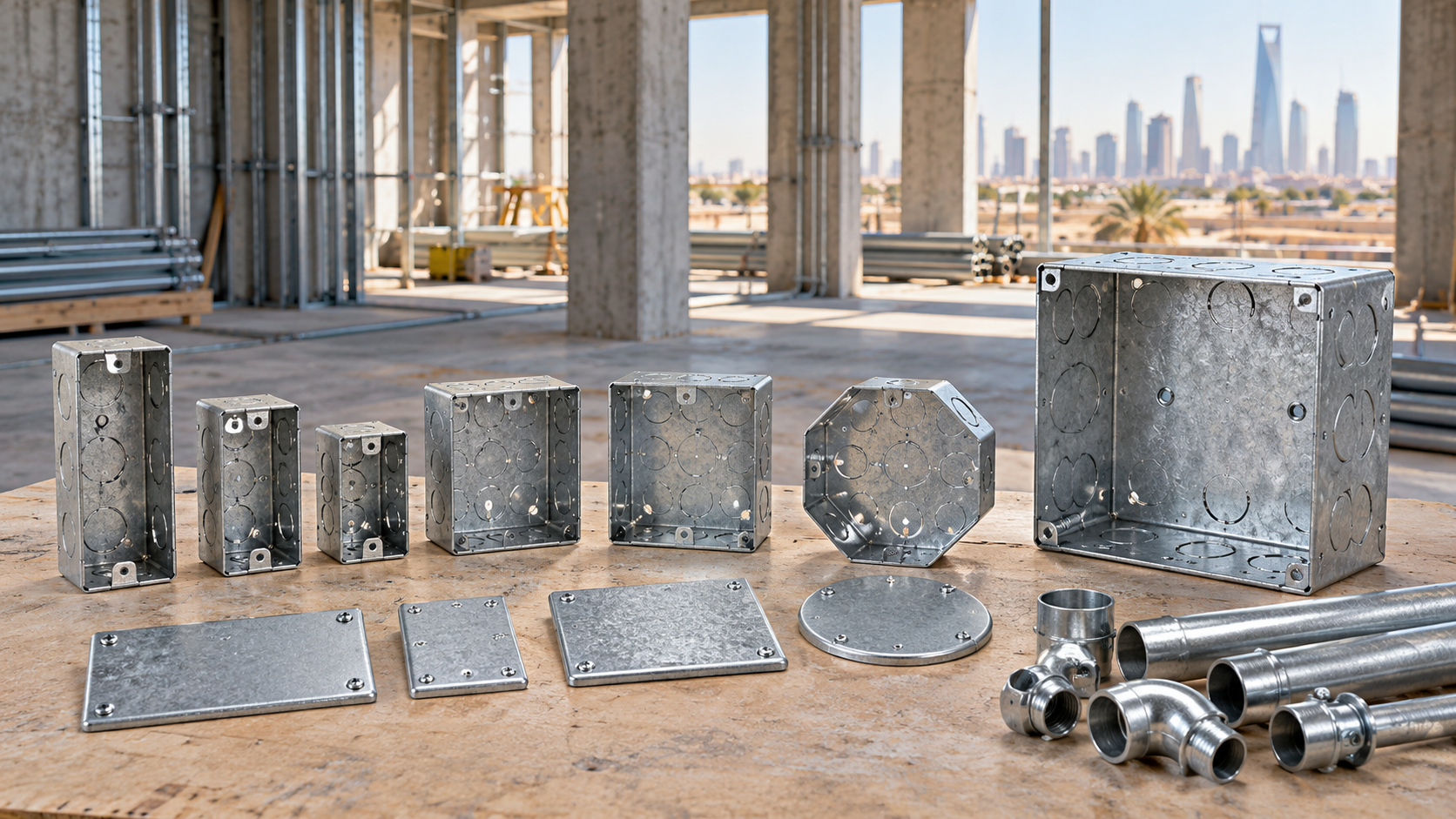
Electrical boxes are essential components in every electrical installation. They protect wiring connections, support switches and sockets, provide accessible points for maintenance and help create an organized conduit system.
However, not all electrical boxes serve the same purpose. A switch box installed behind a wiring device is different from a junction box used to join conductors. Likewise, an octagonal ceiling box has a different application from a pull box used along a long conduit route.
For contractors, MEP engineers, consultants and procurement teams in Saudi Arabia, understanding the main electrical box types makes it easier to prepare accurate material schedules, review technical submittals and avoid installation problems on site.
This guide explains the most common types of electrical boxes used in Saudi projects, their typical applications and the factors that should be checked before ordering.
What Is an Electrical Box?
An electrical box is an enclosure installed at a connection, termination or device point within an electrical wiring system.
Depending on its design, an electrical box may be used to:
- House wiring connections and splices.
- Support switches, sockets and other wiring devices.
- Provide entry points for electrical conduits.
- Protect conductors from accidental physical contact.
- Keep connections accessible for inspection and maintenance.
- Support ceiling-mounted electrical accessories where the box is approved for the intended application.
The expression “electrical box” is a broad term. It can refer to switch boxes, socket boxes, junction boxes, octagonal boxes, pull boxes and other specialized enclosures.
The correct type should therefore be selected according to its function—not simply by choosing a box that appears large enough.
What Are the Main Types of Electrical Boxes?
The principal types found in residential, commercial and industrial projects include:
- Switch boxes
- Socket or outlet boxes
- Junction boxes
- Octagonal or ceiling boxes
- Pull boxes
- Electrical box covers and cover plates
Each category has a specific role within the electrical installation.
1. Switch Boxes
A switch box is installed behind an electrical switch or control device. It provides space for the device body, conductors and cable or conduit entries.
Switch boxes are commonly used for:
- Lighting switches.
- Multi-gang switch arrangements.
- Dimmers and control devices.
- Local equipment-control points.
- Selected low-voltage wiring devices where approved by the project design.
When selecting a switch box, check:
- The number of devices or modules.
- The dimensions of the wiring device.
- The required box depth.
- The available space for conductors.
- The position and size of conduit entries.
- The device mounting arrangement.
- The wall construction and installation method.
A deeper box may be required when the device has a large body or when several conductors enter the same point. Device compatibility must always be checked against the approved product drawings rather than assumed from the external dimensions alone.
2. Socket or Outlet Boxes
Socket boxes are used to mount electrical outlets and similar wiring accessories. They may look similar to switch boxes, but the internal space and mounting arrangement must suit the intended socket.
Typical applications include:
- Standard power outlets.
- Dedicated equipment outlets.
- Data or communication outlets.
- Combined wiring-device arrangements.
- Multi-module socket configurations.
The number of modules or gangs does not always tell the buyer the complete physical size of the box. Products from different device systems can use different mounting dimensions.
Before placing an order, confirm:
- Device type and manufacturer.
- Number of modules or gangs.
- Box width, height and depth.
- Mounting-hole positions.
- Conduit size and entry direction.
- Earthing requirements.
- Wall finish and installation depth.
This verification is particularly important when the electrical boxes and wiring devices are supplied by different manufacturers.
3. Junction Boxes
A junction box is used at a point where electrical conductors are joined, divided or redirected.
Unlike a switch or socket box, its primary purpose is not to support a wiring device. It provides a protected and accessible location for conductor connections.
Junction boxes are commonly installed in:
- Lighting circuits.
- Power distribution routes.
- Branch conduit systems.
- Service and maintenance points.
- Commercial ceiling spaces.
- Industrial electrical installations.
The appropriate junction-box size depends on several factors, including:
- Number of conductors.
- Conductor size.
- Number and diameter of conduits.
- Direction of conduit entries.
- Space required for safe termination.
- Type of connectors or terminals.
- Accessibility after installation.
A box should not be selected using external dimensions alone. The engineer must consider the usable internal space after conductor entries, fittings and terminals are installed.
For a detailed comparison of available dimensions, see our planned electrical box sizes guide.
4. Octagonal and Ceiling Boxes
Octagonal boxes are commonly associated with ceiling electrical points and lighting connections. Their shape can provide convenient entry positions for conduits approaching from different directions.
Typical uses may include:
- Ceiling lighting connection points.
- Wall-mounted lighting points.
- Accessible conductor junctions.
- Selected signaling or low-voltage devices.
It is important not to assume that every octagonal box can support every ceiling-mounted product. The installer must check:
- The weight of the intended fixture.
- The approved mounting arrangement.
- The box material and construction.
- The fixing method.
- The supporting structure.
- The manufacturer’s installation instructions.
Heavy luminaires, ceiling fans and other suspended equipment may require an independent support system or a specially approved box. The electrical box should never be treated as a structural support unless its documentation confirms that application.
5. Pull Boxes
A pull box provides an accessible location that helps installers pull and route conductors through a conduit system.
It is particularly useful where a conduit route contains:
- Long cable runs.
- Multiple bends.
- Changes in direction.
- Large conductors.
- Difficult pulling conditions.
A pull box is not automatically the same as a junction box. A junction box is commonly used where conductors are connected or branched, while a pull box is primarily intended to assist conductor installation and routing.
The required dimensions depend on the conduit arrangement, conductor size, entry positions and applicable project requirements.
Read our detailed comparison: Pull Box vs Junction Box: What Is the Difference?.
6. Electrical Box Covers and Cover Plates
A box cover closes an electrical box or provides an opening for an installed device. It protects the contents while maintaining access where required.
Common forms include:
- Blank covers.
- Device covers.
- Raised covers.
- Covers with specified openings.
- Covers designed for particular box shapes and dimensions.
The cover must match the box’s dimensions, fixing points and intended application. A cover that approximately fits should not be accepted as a substitute for a compatible component.
Our electrical box covers guide explains the principal cover types and the information procurement teams should confirm before ordering.
Flush-Mounted vs Surface-Mounted Electrical Boxes
Electrical boxes may also be classified according to how they are installed.
Flush-mounted boxes
A flush-mounted box is recessed into a wall or ceiling so that the device or cover aligns with the finished surface.
This installation method is frequently used in:
- Residential buildings.
- Hotels.
- Offices.
- Commercial interiors.
- Finished public spaces.
The installer must coordinate the box position with the wall construction, plaster depth, cladding and final finish.
Surface-mounted boxes
A surface-mounted box is installed directly on the finished wall, ceiling or supporting structure.
It is often selected for:
- Service areas.
- Plant rooms.
- Workshops.
- Warehouses.
- Accessible industrial installations.
The choice between flush and surface mounting should be established by the drawings and project specifications. It should not be decided only according to what is easier to install on site.
Metal vs Plastic Electrical Boxes
Metal and plastic boxes are both used in electrical construction, but their suitability depends on the installation requirements.
Metal boxes are often specified where mechanical strength, conduit continuity or a robust installation is important. Plastic boxes may be used in other applications where the approved wiring system and project specification permit them.
The comparison should consider:
- Installation environment.
- Wiring method.
- Mechanical exposure.
- Earthing and bonding requirements.
- Fire strategy.
- Device compatibility.
- Project and consultant specifications.
- Applicable electrical regulations.
Material choice should not be based on a general statement that one option is always better. The correct selection depends on the complete electrical system.
For a deeper comparison, read Steel vs Plastic Electrical Boxes: Which Should You Specify?.
How to Choose the Correct Electrical Box
Selecting the right electrical box requires more than identifying its general category. The following information should be reviewed before approval or purchase.
1. Define the application
Start by identifying the box’s function:
- Will it hold a switch?
- Will it support a socket?
- Will conductors be joined inside it?
- Is it needed to facilitate cable pulling?
- Is it intended for a ceiling connection?
- Is it simply an access point?
This prevents a box designed for one purpose from being used incorrectly for another.
2. Check the dimensions
Confirm the width, height and depth. Internal space is especially important where the box will contain multiple conductors, connectors or a deep wiring device.
Do not rely only on descriptions such as “single gang,” “two gang” or “standard size.”
3. Review conduit entries
Check:
- Conduit diameter.
- Number of incoming and outgoing conduits.
- Entry direction.
- Knockout positions.
- Compatibility with the selected fittings.
A box with unsuitable entries may cause unnecessary cutting or modification on site.
4. Confirm the material
The specified material should suit the installation method and project requirements. For metal boxes, the technical submittal should clearly identify the base material, protective finish and earthing provisions.
5. Verify device compatibility
For switch and socket boxes, compare the box with the selected device’s technical drawing.
Verify:
- Mounting-hole spacing.
- Device depth.
- Faceplate dimensions.
- Number of modules.
- Required internal clearance.
6. Consider the installation environment
Indoor, outdoor, humid, dusty, corrosive and exposed locations can require different enclosure characteristics.
A metal or galvanized finish alone does not establish an environmental protection rating. Any required ingress-protection or weather-resistance classification must be confirmed by the specific product documentation.
7. Follow the approved project documents
The final selection must comply with:
- Approved electrical drawings.
- Project specifications.
- Material schedules.
- Consultant requirements.
- Applicable Saudi regulations.
- Manufacturer installation instructions.
Electrical-Box Selection Table
| Box type | Primary function | Typical application | Main selection checks |
|---|---|---|---|
| Switch box | Supports a switch or control device | Lighting and control points | Device dimensions, modules, depth and mounting |
| Socket box | Supports an outlet or wiring device | Power, data and equipment outlets | Device compatibility, depth and conduit entries |
| Junction box | Contains conductor connections | Circuit branching and distribution | Conductor quantity, dimensions and accessibility |
| Octagonal box | Provides a ceiling or wall connection point | Lighting and selected ceiling applications | Fixing method, entries and intended load |
| Pull box | Assists conductor pulling and routing | Long or complex conduit runs | Conduit arrangement, conductor size and bend layout |
| Cover or cover plate | Closes the box or supports an opening | Junction and device boxes | Box dimensions, fixing points and opening type |
Electrical Boxes for Saudi Projects
Saudi projects range from villas and apartment buildings to offices, retail developments, hospitals, warehouses and industrial facilities. Each project type presents different electrical requirements.
For example:
- Residential projects may require large quantities of coordinated switch and socket boxes.
- Commercial buildings may need multiple junction points above suspended ceilings.
- Warehouses and service areas may use more accessible surface-mounted systems.
- Industrial projects may require stronger coordination between boxes, conduits, fittings and equipment.
- Coastal and humid locations require careful evaluation of material and environmental suitability.
- Large developments require consistent product codes and complete technical submittals to reduce procurement errors.
Environmental conditions should be evaluated as part of the full system design. Temperature, humidity, dust, corrosion exposure and installation location may influence the appropriate box material and protection requirements.
Alrouf Electrical-Box Product Range
Alrouf Electrical Accessories manufactures electrical installation products for Saudi projects. Its documented product families include:
- Switch boxes.
- Junction boxes.
- EMT tubes.
- Conduit clips.
- Box covers.
When specifying an Alrouf electrical box, buyers should use the confirmed product code and technical data from the current catalogue or approved submittal.
The product schedule should identify:
- Product category.
- Model code.
- External dimensions.
- Box depth.
- Material and finish.
- Sheet thickness where documented.
- Knockout dimensions and quantities.
- Earthing arrangement where provided.
- Packing quantity.
- Total project quantity.
This approach is more reliable than submitting a purchase request using only a broad description such as “metal box” or “junction box.”
Procurement Checklist for Electrical Boxes
Before issuing a purchase order, confirm the following:
- Project name and location.
- Drawing and material-schedule reference.
- Box type and intended application.
- Manufacturer and model code.
- Width, height and depth.
- Material and protective finish.
- Sheet thickness where specified.
- Conduit-entry or knockout configuration.
- Earthing provision.
- Cover requirements.
- Device compatibility.
- Installation method.
- Quantity required.
- Packing quantity.
- Approved technical documentation.
- Required delivery schedule.
The material received on site should be checked against the approved submittal before installation begins.
Common Electrical-Box Selection Mistakes
Frequent mistakes include:
- Selecting a box only by its external dimensions.
- Confusing junction boxes with pull boxes.
- Assuming all switch devices fit the same back box.
- Ignoring the required depth behind the device.
- Ordering boxes without confirming conduit-entry sizes.
- Treating a galvanized finish as an automatic outdoor rating.
- Using ceiling boxes to support equipment without verifying load suitability.
- Mixing product codes in the purchase order.
- Publishing or submitting technical claims without supporting documentation.
Preventing these errors can reduce site modifications, rejected materials and delays during installation.
Frequently Asked Questions
What are the main types of electrical boxes?
The main types include switch boxes, socket or outlet boxes, junction boxes, octagonal ceiling boxes and pull boxes. Covers and cover plates are also required to close or complete many box installations.
What is the difference between a switch box and a junction box?
A switch box is designed to support a switch or another wiring device. A junction box provides an accessible enclosure where conductors can be joined, branched or redirected.
Which electrical box is used for ceiling lights?
Octagonal boxes are commonly used at ceiling-light connection points. However, the box and fixing system must be verified for the intended fixture and load. Heavy fixtures or ceiling fans may require independent support.
How do I choose the correct electrical-box size?
Consider the box’s function, conductor quantity, conductor size, number of conduit entries, device depth, terminal space and required working clearance. Use the approved drawings and applicable project requirements for the final selection.
Can the same box be used for switches and sockets?
Only when the dimensions, depth, mounting arrangement and device requirements are compatible. The wiring-device technical drawing should be checked before approval.
Are galvanized electrical boxes automatically suitable for outdoor use?
No. Galvanization alone does not confirm an ingress-protection rating or suitability for every outdoor environment. Outdoor use must be supported by the product’s verified technical documentation and the project specification.
Conclusion
Choosing between different electrical box types begins with understanding the function of each box. Switch and socket boxes support wiring devices, junction boxes contain conductor connections, octagonal boxes serve selected ceiling and wall applications, and pull boxes help route conductors through complex conduit systems.
For Saudi construction projects, the selection should also account for box dimensions, depth, conduit entries, device compatibility, installation method and environmental conditions.
Contractors and procurement teams should always order using verified model codes and approved technical information. This creates a clearer material schedule, reduces mistakes and helps ensure that the supplied electrical boxes match the project requirements.
Planning an electrical installation or preparing a material submittal? Contact Alrouf Electrical Accessories to request the current product catalogue and verified technical information for the required electrical boxes.


