


Electrical Box Covers and Cover Plates: Types and Selection Guide
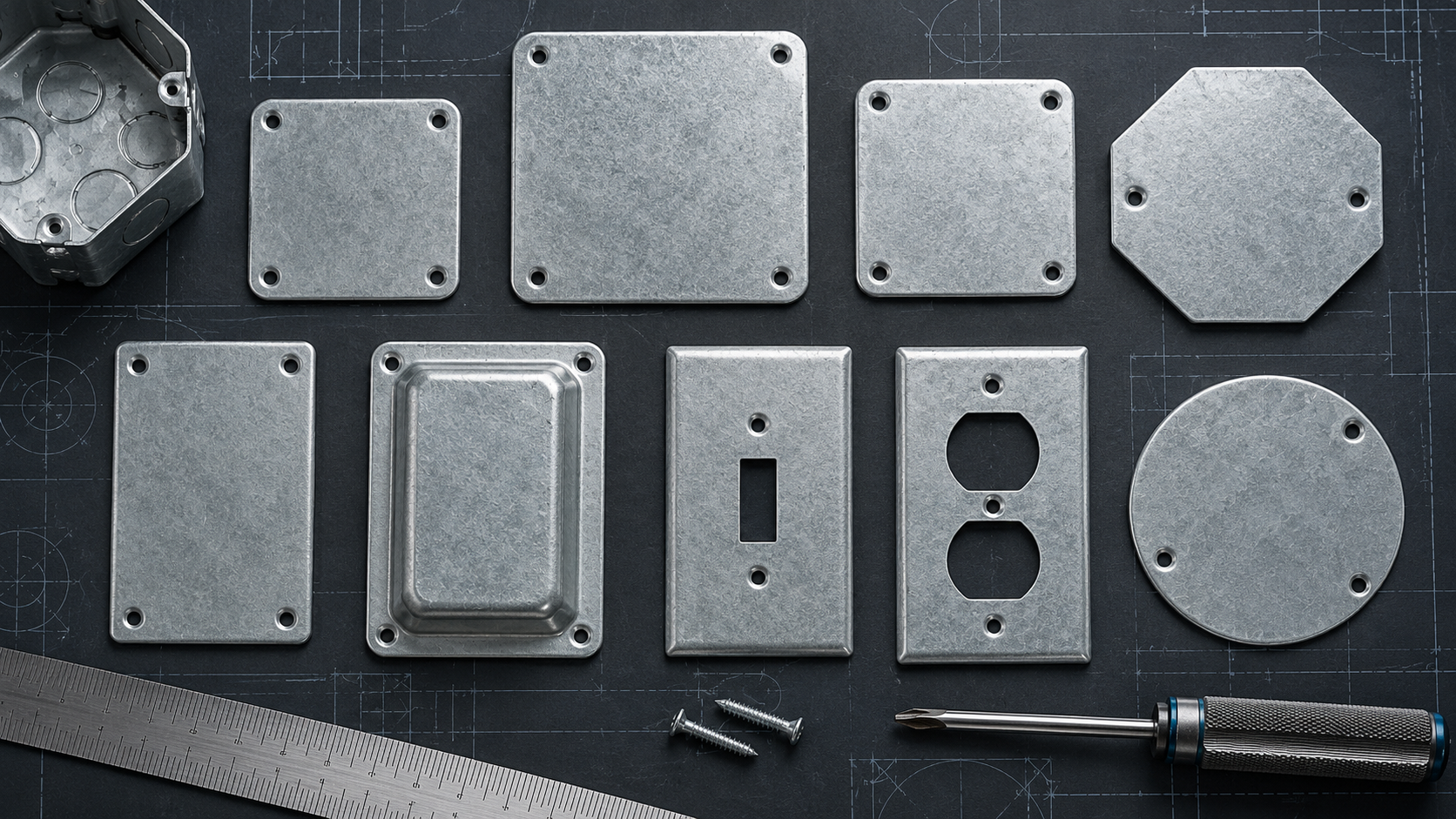
Electrical box covers are essential components of electrical installations. They close unused boxes, provide openings for switches or sockets and help keep wiring connections protected while maintaining the required access for inspection and maintenance.
Although covers may appear simple, choosing the wrong type can cause alignment problems, exposed openings, difficult maintenance or incompatibility with the installed electrical box.
This guide explains the main types of electrical box covers, how they differ from device faceplates and what contractors, MEP engineers and procurement teams should verify before ordering covers for Saudi construction projects.
If you are still determining which enclosure is required, begin with our guide to the types of electrical boxes used in Saudi projects.
What Is an Electrical Box Cover?
An electrical box cover is a component secured over the open face of an electrical box.
Depending on its design, it may:
- Close an unused junction box.
- Protect conductor connections.
- Provide an opening for a switch or socket.
- Support access to inspection and maintenance points.
- Complete a surface-mounted electrical-box installation.
- Help prevent accidental contact with contained wiring.
- Provide a finished interface between the box and a wiring device.
A cover must match the box’s shape, dimensions, fixing points and intended application.
A cover that approximately fits should not be accepted as a compatible component.
Electrical Box Cover vs Cover Plate
The expressions “box cover” and “cover plate” are sometimes used interchangeably, but they can describe different components.
Electrical box cover
A box cover normally closes the opening of a junction box, pull box or other electrical enclosure. It may be blank or contain a defined opening for a device.
Device cover or raised cover
A device cover attaches to a box and provides an opening or mounting arrangement for a switch, socket or another wiring device.
Faceplate or wall plate
A faceplate is the visible finished plate installed over a switch, socket or other device. It is normally selected as part of the wiring-device range rather than as a basic box component.
The procurement schedule should identify the required item clearly. Ordering a “cover plate” without stating its function, dimensions or compatible box can result in the wrong product being supplied.
Main Types of Electrical Box Covers
Common electrical box cover categories include:
- Blank box covers.
- Flat device covers.
- Raised device covers.
- Switch and socket covers.
- Junction-box covers.
- Octagonal-box covers.
- Covers with access openings.
- Gasketed or specialized enclosure covers.
The availability and specification of each type must be confirmed from the current manufacturer catalogue.
1. Blank Electrical Box Covers
A blank cover completely closes the open face of an electrical box without providing an opening for a wiring device.
Blank covers are commonly used for:
- Junction boxes containing conductor connections.
- Future electrical points.
- Inspection points.
- Boxes that must remain accessible.
- Temporary or reserved circuit locations.
- Conduit junctions without a switch or socket.
The cover should be securely fixed using the correct fasteners and mounting points.
A blank cover should not be permanently concealed when access to the connections inside the box is required.
2. Flat Device Covers
A flat device cover provides an opening for a switch, socket or other wiring device while remaining close to the front edge of the box.
It may be used where:
- The device-mounting arrangement matches the box.
- The final installation does not require additional projection.
- The box is correctly aligned with the finished surface.
- The cover is compatible with the wiring-device dimensions.
Before approval, compare the box, cover and device drawings. Similar-looking components from different systems may use different mounting positions.
3. Raised Electrical Box Covers
A raised cover projects outward from the box face. It may create additional space or position a wiring device correctly relative to the finished surface.
Raised covers can be considered for:
- Surface-mounted installations.
- Boxes positioned behind a finished surface.
- Applications requiring additional clearance.
- Selected switch or socket installations.
- Installations where the device must sit forward of the box.
The required raised depth must be coordinated with the device, box and final wall or ceiling finish.
Using a raised cover should not replace selecting a box with adequate internal space.
4. Switch and Socket Covers
Switch and socket covers provide openings that match specific wiring-device arrangements.
The cover may need to accommodate:
- One switch.
- Multiple switches.
- A power socket.
- A combined device arrangement.
- A specified module configuration.
- A particular faceplate or device family.
The description “single,” “double” or “multi-gang” may not provide enough information by itself. Procurement teams should also confirm:
- Opening dimensions.
- Mounting-hole spacing.
- Cover orientation.
- Device depth.
- Faceplate dimensions.
- Compatible box model.
- Number of modules.
For guidance on selecting the box behind the device, review our electrical metal box sizes chart.
5. Junction-Box Covers
Junction-box covers close boxes containing conductor connections or circuit-branching points.
A junction-box cover should provide:
- Compatibility with the box dimensions.
- Correct fixing-hole positions.
- Secure mechanical attachment.
- Access where inspection or maintenance is required.
- Suitable material and finish for the installation.
The cover dimensions should correspond to the exact box model rather than only the nominal box size.
For example, two boxes may both be described as 10 × 10 cm while using different corner details, screw positions or cover designs.
6. Octagonal-Box Covers
Octagonal covers are designed for compatible octagonal or ceiling boxes.
They may be:
- Completely blank.
- Supplied with a central opening.
- Designed for a particular accessory.
- Intended to provide access to ceiling connections.
An octagonal cover should not be assumed to support a luminaire or ceiling fan. Load support depends on the box, cover, fasteners and building structure.
Where a fixture is mounted at the box location, verify:
- Fixture weight.
- Mounting arrangement.
- Supporting structure.
- Manufacturer instructions.
- Project requirements.
Heavy equipment may require independent structural support.
7. Covers with Access Openings
Some covers include openings for conduit, terminals, cables or inspection access.
The opening must be designed for the intended component. Site-made openings can create problems such as:
- Sharp metal edges.
- Poor cable protection.
- Incorrect entry dimensions.
- Damage to the protective finish.
- Incompatible fittings.
- Unsealed gaps.
Where an additional entry is necessary, the contractor should use an approved method and suitable fittings rather than uncontrolled site modification.
8. Gasketed and Specialized Covers
Some environments require covers with gaskets, seals or specialized fastening arrangements.
These may be specified where the enclosure requires documented protection against:
- Dust.
- Water.
- Humidity.
- Corrosive contaminants.
- Outdoor exposure.
- Industrial operating conditions.
A gasket alone does not establish the protection rating of the complete enclosure.
Any IP rating, weather-resistance claim or environmental classification must apply to the complete assembled product—including the box, cover, gasket, entries and fittings—and must be supported by technical documentation.
Electrical Box Cover Materials
Electrical box covers can be manufactured from different materials.
Steel covers
Steel covers are commonly used with steel electrical boxes. They can provide a robust mechanical closure and maintain a consistent metal-box system.
The technical specification should identify:
- Base material.
- Protective finish.
- Steel thickness.
- Fixing arrangement.
- Compatible box model.
- Earthing considerations where applicable.
Plastic covers
Plastic covers may be used with compatible plastic boxes or selected wiring-device systems.
Their suitability depends on:
- Material formulation.
- Mechanical strength.
- Temperature performance.
- UV exposure.
- Flame-performance documentation.
- Compatibility with the box and device.
Do not mix cover and box materials unless the complete assembly is approved for the intended application.
For a broader comparison of enclosure materials, read Steel vs Plastic Electrical Boxes: Which Should You Specify?.
How to Measure an Electrical Box Cover
Before ordering a replacement or separate cover, record the following:
1. Box length and width
Measure the box opening and confirm its nominal external dimensions.
2. Box shape
Identify whether the box is:
- Rectangular.
- Square.
- Octagonal.
- Round.
- Another specialized form.
3. Fixing-hole positions
Measure the spacing and location of the cover screws. A matching outer dimension does not guarantee that the fixing points will align.
4. Opening requirements
Confirm whether the cover should be:
- Blank.
- Single-device.
- Multi-device.
- Raised.
- Fitted with a central opening.
- Designed for another accessory.
5. Required cover depth
If a raised cover is needed, state the required projection or depth.
6. Box model number
The most reliable method is to identify the exact manufacturer and box model, then order the compatible cover listed in the current catalogue.
Electrical Box Cover Selection Table
| Cover type | Primary function | Typical application | Main checks |
|---|---|---|---|
| Blank cover | Completely closes the box | Junction and future-use boxes | Dimensions, fixing points and accessibility |
| Flat device cover | Provides a device opening | Switches and sockets | Device opening and mounting compatibility |
| Raised cover | Provides projection or additional clearance | Surface-mounted device installations | Raised depth, box size and device position |
| Junction-box cover | Closes conductor junctions | Circuit branching and termination points | Exact box model and screw positions |
| Octagonal cover | Closes an octagonal box | Ceiling and wall connection points | Shape, central opening and fixture arrangement |
| Gasketed cover | Forms part of a sealed assembly | Selected exposed environments | Complete enclosure rating and gasket compatibility |
How to Choose the Correct Electrical Box Cover
Match the exact box
Start with the manufacturer, box model, dimensions and shape.
Avoid selecting the cover only because its nominal size appears similar.
Define the cover’s function
Determine whether the cover will:
- Close a junction box.
- Support a wiring device.
- Provide access.
- Create additional clearance.
- Complete a ceiling connection point.
Check the fixing arrangement
Confirm the number, diameter and position of fixing screws.
Loose, missing or incorrectly positioned screws can prevent the cover from closing securely.
Coordinate the wiring device
For switches and sockets, verify the complete assembly:
- Box.
- Device cover.
- Wiring device.
- Faceplate.
- Wall finish.
All components must fit without forcing, bending or uncontrolled modification.
Consider accessibility
Junctions and other connections that require inspection or maintenance must remain accessible after the cover is installed.
Coordinate access with:
- Suspended ceilings.
- Wall finishes.
- Furniture.
- Equipment.
- Mechanical services.
- Architectural panels.
Confirm environmental requirements
For humid, dusty, outdoor or industrial environments, request product-specific evidence for the complete enclosure assembly.
Do not assume that a steel cover, galvanized finish or added gasket automatically creates a weatherproof box.
Electrical Box Covers in Saudi Projects
Saudi construction projects can include a wide variety of applications, from residential developments to commercial towers, hotels, warehouses and industrial facilities.
Cover selection may be influenced by:
- Concealed or exposed wiring systems.
- Metallic or non-metallic conduit.
- Interior finishing requirements.
- Ceiling construction.
- Maintenance-access strategy.
- Humidity and dust exposure.
- Consultant specifications.
- Required material approvals.
- Project standardization.
Large projects benefit from using coordinated box-and-cover combinations. Standardizing compatible models can simplify:
- Material submittals.
- Procurement.
- Site storage.
- Installation.
- Inspection.
- Replacement and maintenance.
Alrouf Electrical Box Covers
Alrouf Electrical Accessories includes covers within its documented electrical-accessories product range.
When requesting an Alrouf cover, provide:
- Box product family.
- Exact box model.
- Box dimensions.
- Required cover type.
- Required opening.
- Quantity.
- Project reference.
- Required technical documents.
The latest Alrouf catalogue or approved submittal should be used to confirm compatibility, dimensions, material, thickness and packing quantity.
Do not order an Alrouf cover using only a generic description such as “metal cover” or “junction-box plate.”
Procurement Checklist
Include the following information in the material schedule or purchase order:
- Cover type.
- Manufacturer.
- Product or model code.
- Compatible box model.
- Length and width.
- Shape.
- Material.
- Finish.
- Thickness where specified.
- Flat or raised configuration.
- Device-opening details.
- Fixing-hole arrangement.
- Gasket requirement where applicable.
- Quantity per package.
- Total quantity.
- Required documentation.
- Delivery schedule.
Example purchase description
Blank galvanized-steel cover for the specified Alrouf junction-box model, with matching dimensions and factory fixing points—quantity according to the approved material schedule.
The exact model code and technical details should be added from the current catalogue.
Common Cover-Selection Mistakes
Avoid these frequent mistakes:
- Ordering by nominal size alone.
- Confusing a box cover with a device faceplate.
- Using a cover from a different box system.
- Ignoring fixing-hole positions.
- Selecting the wrong device opening.
- Failing to coordinate the raised depth.
- Permanently concealing a box that must remain accessible.
- Drilling uncontrolled openings on site.
- Assuming a gasket automatically provides an IP rating.
- Ordering boxes without their corresponding covers.
- Failing to include cover quantities in the material schedule.
Frequently Asked Questions
What is the purpose of an electrical box cover?
An electrical box cover closes the open face of a box, protects the contained connections and provides access where inspection or maintenance is required. Some covers also provide openings for switches, sockets or other devices.
Can I leave a junction box without a cover?
A junction box should be completed using the appropriate compatible cover. An open box leaves connections exposed and does not represent a finished installation.
Are all electrical box covers interchangeable?
No. Covers can differ in dimensions, shape, screw positions, raised depth and device openings. Use a cover confirmed as compatible with the exact box model.
What is the difference between a blank cover and a device cover?
A blank cover completely closes the box. A device cover contains an opening or mounting arrangement for a switch, socket or another electrical device.
How do I know which cover size I need?
Identify the manufacturer and box model, then confirm the cover listed for that product. If the model is unknown, measure the box dimensions, shape and fixing-hole positions.
Does a gasketed cover make an electrical box waterproof?
Not necessarily. Environmental protection applies to the complete assembled enclosure. The box, cover, gasket, entries and fittings must all be included in the verified rating.
Can I drill a box cover on site?
Site modification should only be completed using an approved method. Poorly made openings can leave sharp edges, damage the protective finish and create an unsuitable entry.
Does Alrouf manufacture electrical box covers?
Covers are included within Alrouf’s documented electrical-accessories product lines. The available types, dimensions and compatible box models should be confirmed using the current catalogue.
Conclusion
Selecting the correct electrical box cover requires more than matching the approximate box size.
The contractor or engineer must verify:
- Box model and dimensions.
- Cover shape.
- Fixing-hole positions.
- Blank or device-opening configuration.
- Required raised depth.
- Material and finish.
- Accessibility.
- Environmental requirements.
- Compatibility with the complete electrical assembly.
A coordinated box-and-cover system improves installation quality and helps procurement teams avoid receiving incompatible components.
Contact Alrouf Electrical Accessories to request the current catalogue and confirm the correct covers for your selected switch boxes, junction boxes and other electrical-box models.


