


Steel vs Plastic Electrical Boxes: Which Should You Specify?
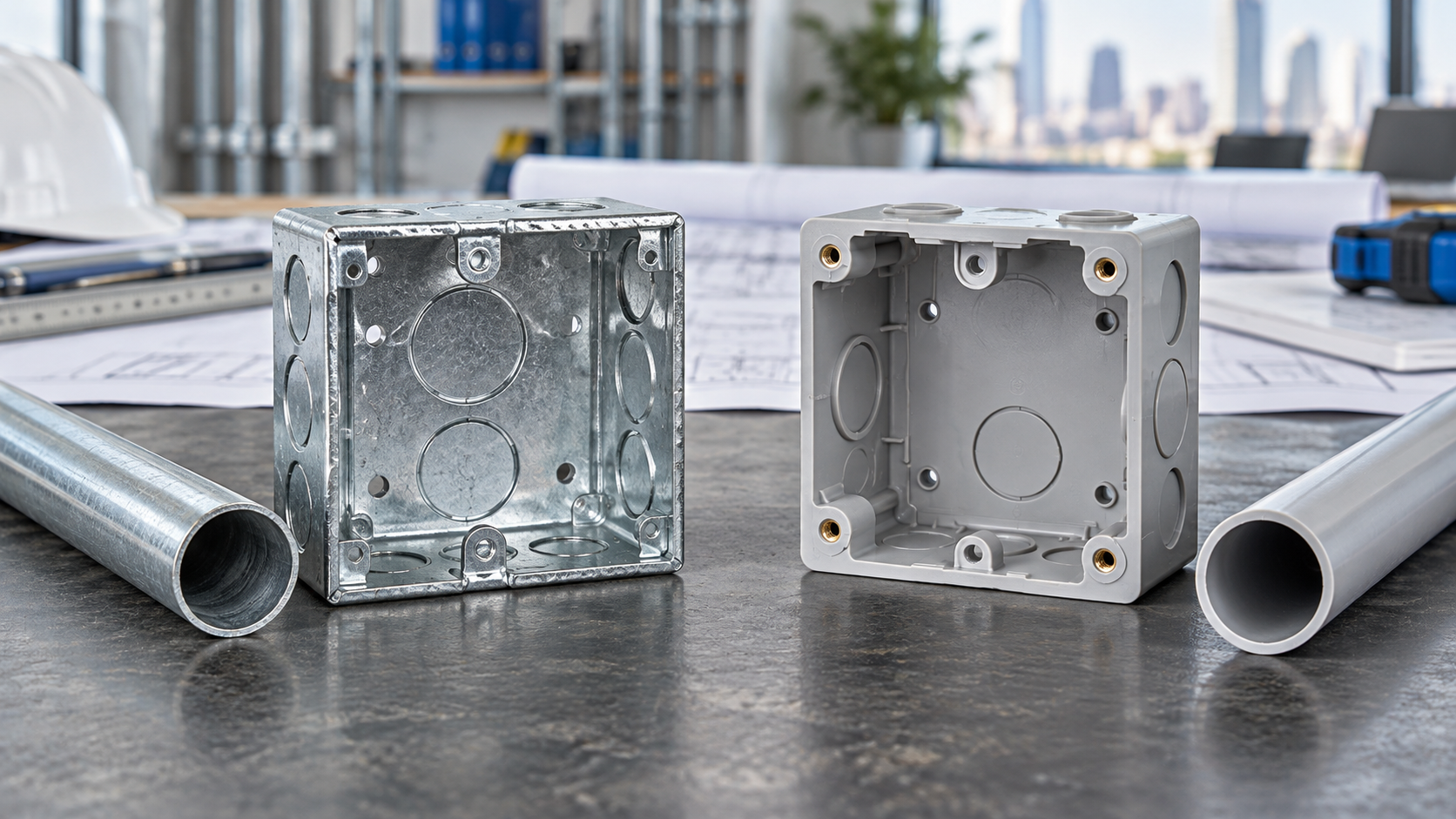
Choosing between a steel vs plastic electrical box is an important decision in electrical-system design. Both materials can be suitable when correctly specified, but they differ in mechanical strength, grounding requirements, conduit compatibility, installation method and response to project conditions.
The correct selection should not be based on price or habit alone. Contractors and MEP engineers must consider the complete installation, including the wiring method, wall construction, environmental exposure, type of electrical device and project specifications.
Before comparing materials, review the types of electrical boxes used in Saudi projects to understand the functions of switch boxes, socket boxes, junction boxes, octagonal boxes and pull boxes.
What Is a Steel Electrical Box?
A steel electrical box is a metal enclosure used to house electrical connections, support wiring devices or provide access within a conduit system.
Steel electrical boxes are commonly used in:
- Commercial buildings.
- Residential developments.
- Industrial facilities.
- Warehouses.
- Hospitals.
- Hotels.
- Offices.
- Service areas.
- Projects using metallic conduit systems.
Depending on the design, steel boxes may be used as switch boxes, socket boxes, junction boxes, ceiling boxes or pull boxes.
The product specification may also include a protective metallic coating intended to protect the steel surface. However, the coating type and suitability for the intended environment must be confirmed using the manufacturer’s technical documentation.
What Is a Plastic Electrical Box?
A plastic electrical box is a non-metallic enclosure manufactured from a polymer material selected for electrical-installation applications.
Plastic boxes are frequently associated with:
- Residential wiring systems.
- Non-metallic conduit systems.
- Lightweight partitions.
- Concealed installations.
- Selected indoor applications.
Different plastic materials can have different performance characteristics. The term “plastic box” alone does not confirm its mechanical strength, temperature resistance, flame performance or suitability for a particular environment.
The manufacturer’s declared product data must therefore be checked before specification.
Steel vs Plastic Electrical Boxes: Quick Comparison
| Selection factor | Steel electrical box | Plastic electrical box |
|---|---|---|
| Mechanical strength | Generally provides strong resistance to physical impact | Depends on material formulation and box construction |
| Weight | Heavier | Usually lighter |
| Earthing and bonding | Requires proper earthing and bonding as applicable | Non-conductive, but system requirements still apply |
| Metallic conduit integration | Commonly used with EMT and other metallic conduit systems | Often used with compatible non-metallic wiring systems |
| Installation | May require suitable tools and metal fittings | Can be quicker to handle in some installations |
| Corrosion considerations | Protective finish and exposure must be evaluated | Does not rust, but may be affected by heat, UV or chemicals |
| Device support | Suitable when dimensions and fixing points match | Suitable when approved for the device and installation |
| Impact resistance | Often preferred where greater mechanical protection is required | Product-dependent |
| Modification on site | Requires appropriate tools and edge protection | Some products are easier to modify, but only permitted entries should be used |
| Environmental suitability | Must be confirmed from product documentation | Must be confirmed from product documentation |
This table provides general guidance. The approved project specification and product documentation remain the basis for the final decision.
1. Mechanical Strength
Mechanical strength is one of the principal reasons steel electrical boxes are selected for commercial and industrial projects.
A correctly manufactured steel box can provide a rigid enclosure around electrical connections and wiring devices. This can be important in locations where the box may be exposed to:
- Construction activity.
- Maintenance work.
- Equipment movement.
- Accidental physical impact.
- Conduit forces.
- Demanding service conditions.
Plastic boxes can provide sufficient strength for their approved applications, particularly in concealed residential installations. However, their performance depends on the plastic material, wall thickness, product design and installation method.
Neither material should be selected without considering the level of mechanical exposure.
2. Earthing and Bonding
Steel is electrically conductive. Consequently, a steel electrical box must be incorporated into the earthing and bonding arrangement where required by the electrical design and applicable regulations.
The installer should verify:
- The specified earthing point.
- Continuity between the box and metallic conduit.
- Compatibility of connectors and fittings.
- Correct installation of the protective conductor.
- Accessibility of the earthing connection.
Some steel electrical-box models are supplied with a dedicated earthing provision. The model code and approved technical submittal should confirm whether this feature is included.
Plastic electrical boxes are non-conductive and do not require earthing of the box material itself. However, this does not remove the need to earth connected devices, conductors or other metal components where required.
The complete circuit design—not only the box material—determines the earthing arrangement.
3. Compatibility with Conduit Systems
The wiring method is a major factor when comparing steel and plastic boxes.
Steel boxes with metallic conduit
Steel electrical boxes are frequently paired with electrical metallic tubing and other metallic conduit systems.
This combination can provide:
- A coordinated metal wiring system.
- Robust connections between conduits and boxes.
- Mechanical protection at termination points.
- Familiar installation arrangements for commercial and industrial projects.
The conduit fittings, knockout sizes and box-entry positions must match the approved system.
Plastic boxes with non-metallic conduit
Plastic boxes are often used with compatible PVC or other non-metallic conduit systems. This can be appropriate in selected concealed installations where the project specification permits it.
Mixing box and conduit materials requires careful review. The contractor must ensure that all adapters, connectors, earthing provisions and installation methods are approved for the chosen combination.
4. Corrosion, Humidity and Environmental Exposure
Saudi projects can be exposed to different environmental conditions depending on their location and application.
Projects in Dammam, Khobar, Jubail and other coastal areas may require particular attention to humidity and corrosive exposure. Inland projects may face high temperatures, dust and demanding construction conditions.
Steel electrical boxes may use a protective finish to reduce exposure of the base metal. However:
- A metallic coating does not automatically confirm outdoor suitability.
- Galvanization alone does not establish an IP rating.
- Cut edges and site modifications may affect the protective surface.
- Different environmental conditions may require different protective systems.
Plastic does not rust, but that does not mean every plastic box is suitable for outdoor, high-temperature or UV-exposed installations. Some plastic materials can become brittle, deform or deteriorate when exposed to unsuitable conditions.
For both materials, verify:
- Installation location.
- Temperature range.
- Humidity and condensation.
- Dust and water exposure.
- Chemical exposure.
- UV exposure.
- Required ingress-protection rating.
- Manufacturer limitations.
5. Fire and Temperature Considerations
The material name alone does not establish the fire performance of an electrical box.
Steel is non-combustible as a base material, but the complete installation may include covers, gaskets, wiring devices, coatings and other components that must be considered.
Plastic products can have different flame-retardant and temperature characteristics depending on their formulation and certification.
Avoid broad claims such as:
- “All steel boxes are fire-rated.”
- “All plastic boxes are fireproof.”
- “Metal boxes automatically provide a fire barrier.”
Any required fire-resistance or flame-performance rating must be supported by product-specific test reports and included in the approved project documents.
6. Installation and Site Handling
Plastic boxes are generally lighter and may be easier to transport and position. Some products also include integrated clamps or molded entries intended for a particular wiring system.
Steel boxes may require:
- Appropriate cutting and drilling tools.
- Compatible metal fittings.
- Removal of selected knockouts.
- Attention to sharp or damaged edges.
- Proper earthing and bonding.
- Secure mechanical fixing.
Site workers should use the factory-provided entries whenever possible. Uncontrolled drilling or cutting can create sharp edges, reduce the quality of the protective finish or produce entries that do not suit the selected conduit fitting.
Installation speed should not be evaluated separately from long-term reliability and compliance.
7. Box Dimensions and Internal Space
Whether the box is steel or plastic, its dimensions must accommodate the electrical components installed inside it.
Important measurements include:
- Width.
- Height.
- Depth.
- Internal usable space.
- Mounting-hole spacing.
- Conduit-entry dimensions.
- Cover dimensions.
A steel box and plastic box with similar external measurements may not provide the same usable internal space because their wall construction, mounting features and entry arrangements may differ.
For confirmed Alrouf dimensions, model codes, thicknesses and weights, see the electrical metal box sizes chart.
8. Device Compatibility
A box cannot be approved for a switch or socket based only on its general description.
The engineer should compare the box drawing with the wiring-device drawing and verify:
- Device width and height.
- Device body depth.
- Mounting-screw positions.
- Number of modules or gangs.
- Faceplate dimensions.
- Space for conductors and terminals.
- Finished-wall alignment.
This applies to both steel and plastic electrical boxes.
If the boxes and wiring devices are supplied by different manufacturers, compatibility should be confirmed before bulk procurement.
9. Maintenance and Future Modifications
Maintenance requirements can influence the material choice.
Steel boxes may provide greater confidence in locations where covers are removed regularly or where the installation is exposed to physical activity. Threaded or mechanically secured fittings may also be preferred in some service areas.
Plastic boxes may be suitable where the installation remains concealed and is unlikely to experience repeated impact or modification.
In either case, the box must remain accessible where access is required. It should not be buried permanently behind finishes if the contained connections require inspection or maintenance.
Which Electrical Box Is Better for Residential Projects?
The answer depends on the project’s wiring method and approved specifications.
Plastic boxes may be considered for selected concealed residential systems using compatible non-metallic conduits and devices.
Steel electrical boxes may be preferred when:
- Metallic conduit is specified.
- Greater mechanical protection is required.
- The project uses a coordinated steel box system.
- The consultant requires metal boxes.
- Robust device mounting is a priority.
- The electrical design includes a defined bonding arrangement.
Large residential developments may also benefit from standardizing box models, dimensions and packing quantities across repeated units.
Which Electrical Box Is Better for Commercial Projects?
Steel boxes are commonly considered for commercial installations because these projects often involve:
- Metallic conduit systems.
- Suspended ceilings.
- Frequent junction points.
- Higher service activity.
- Larger quantities of conductors.
- More demanding coordination requirements.
- Consultant-controlled material submittals.
Nevertheless, the project specification may permit plastic boxes in selected locations. The appropriate material should be determined per application rather than using one rule for the entire building.
Which Electrical Box Is Better for Industrial Projects?
Industrial installations may expose electrical boxes to mechanical impact, vibration, dust, heat, humidity or chemicals.
Steel boxes can offer useful mechanical strength, but the exact enclosure type and protective finish must suit the environment. A standard indoor steel box should not automatically be specified for outdoor or corrosive industrial conditions.
In demanding environments, the engineer may require a specialized enclosure with a documented ingress-protection rating, corrosion resistance or other tested performance.
The distinction between a standard electrical box and a specialized industrial enclosure must remain clear.
Steel vs Plastic Boxes by Application
| Application | Typical selection consideration |
|---|---|
| Concealed residential switch point | Device compatibility, wall depth and approved conduit system |
| Commercial office wiring | Conduit coordination, accessibility and mechanical strength |
| Ceiling junction point | Conductor space, cover access and fixing method |
| Warehouse or service area | Impact exposure and surface-mounting requirements |
| Coastal project | Verified material and corrosion-protection data |
| Outdoor installation | Product-specific environmental and IP documentation |
| Industrial area | Mechanical, temperature, dust and chemical exposure |
| Lightweight partition | Box support, device alignment and partition-system compatibility |
When Should You Specify a Steel Electrical Box?
A steel electrical box may be appropriate when:
- The project uses metallic conduit.
- Mechanical protection is important.
- The box will be installed in a commercial or industrial area.
- The consultant’s specification requires a metal box.
- A robust device-mounting arrangement is required.
- The approved system includes suitable earthing and bonding.
- The required dimensions are available in the selected steel-box range.
The final decision must still be supported by the approved material submittal.
When Could a Plastic Electrical Box Be Considered?
A plastic box may be considered when:
- The project specification permits non-metallic boxes.
- It is compatible with the selected conduit system.
- It is approved for the wiring device.
- Its mechanical performance suits the location.
- Its temperature and environmental ratings meet project requirements.
- The installation method follows the manufacturer’s instructions.
Alrouf’s confirmed product range should be checked before suggesting that a particular plastic box is available from the company. Do not state that Alrouf manufactures plastic electrical boxes unless this is confirmed by current product documentation.
Specification Checklist
Before choosing between steel and plastic boxes, ask:
- What is the box’s function?
- Is the installation concealed or exposed?
- Which conduit system will be used?
- What are the box dimensions and depth?
- How many conductors will enter the box?
- Is mechanical impact likely?
- What earthing or bonding arrangement is required?
- Is the location humid, dusty, corrosive or exposed to water?
- Is a specific IP or fire-performance rating required?
- Is the box compatible with the selected wiring device?
- Does the product have supporting technical documentation?
- Has the consultant approved the material?
Procurement Checklist
The purchase order should identify:
- Box material.
- Box type.
- Manufacturer.
- Model code.
- Dimensions.
- Steel thickness or plastic material specification.
- Conduit-entry configuration.
- Earthing provision.
- Cover requirements.
- Packing quantity.
- Required test reports or certificates.
- Total project quantity.
- Delivery schedule.
A description such as “electrical box” is not sufficient for accurate procurement.
Frequently Asked Questions
Are steel electrical boxes better than plastic boxes?
Not in every application. Steel boxes generally offer strong mechanical protection and integrate well with metallic conduit systems. Plastic boxes can be appropriate for compatible non-metallic systems and selected concealed installations. The project requirements determine which material is suitable.
Do steel electrical boxes need to be earthed?
Steel boxes are conductive and must be included in the earthing and bonding arrangement where required by the electrical design and applicable regulations.
Can plastic boxes be used with metal conduit?
Only when the complete arrangement, including connectors, adapters and earthing provisions, is approved for that application. Material compatibility should not be assumed.
Are galvanized steel boxes waterproof?
No. A galvanized finish does not automatically make a box waterproof or establish an IP rating. Outdoor or wet-location suitability must be supported by product-specific documentation.
Which material is better for coastal Saudi projects?
Neither material should be selected using a general rule. Steel requires a verified protective system suitable for the exposure, while plastic requires confirmed resistance to temperature, UV and the relevant environmental conditions.
Are plastic boxes fireproof?
The term “plastic” does not establish fire performance. Any flame or fire-resistance requirement must be verified using the specific product’s test documentation.
How do I select the correct box size?
Review the intended function, conductor quantity, conduit entries, device dimensions and required depth. You can compare documented Alrouf models in our electrical box sizes chart.
Conclusion
The steel vs plastic electrical box decision depends on the complete electrical installation.
Steel boxes are often selected for their mechanical strength, compatibility with metallic conduit and suitability for robust commercial and industrial wiring systems. Plastic boxes may be appropriate for compatible non-metallic systems and selected concealed applications.
Neither material is automatically suitable for every environment. Contractors and engineers should evaluate:
- Wiring method.
- Mechanical exposure.
- Earthing requirements.
- Environmental conditions.
- Device compatibility.
- Dimensions and internal space.
- Required certifications.
- Approved project specifications.
Alrouf Electrical Accessories provides a documented range of steel switch boxes, junction boxes and related electrical-installation products for project requirements.
Contact Alrouf Electrical Accessories to request the current catalogue and verified technical information before preparing your material submittal or purchase order.


