


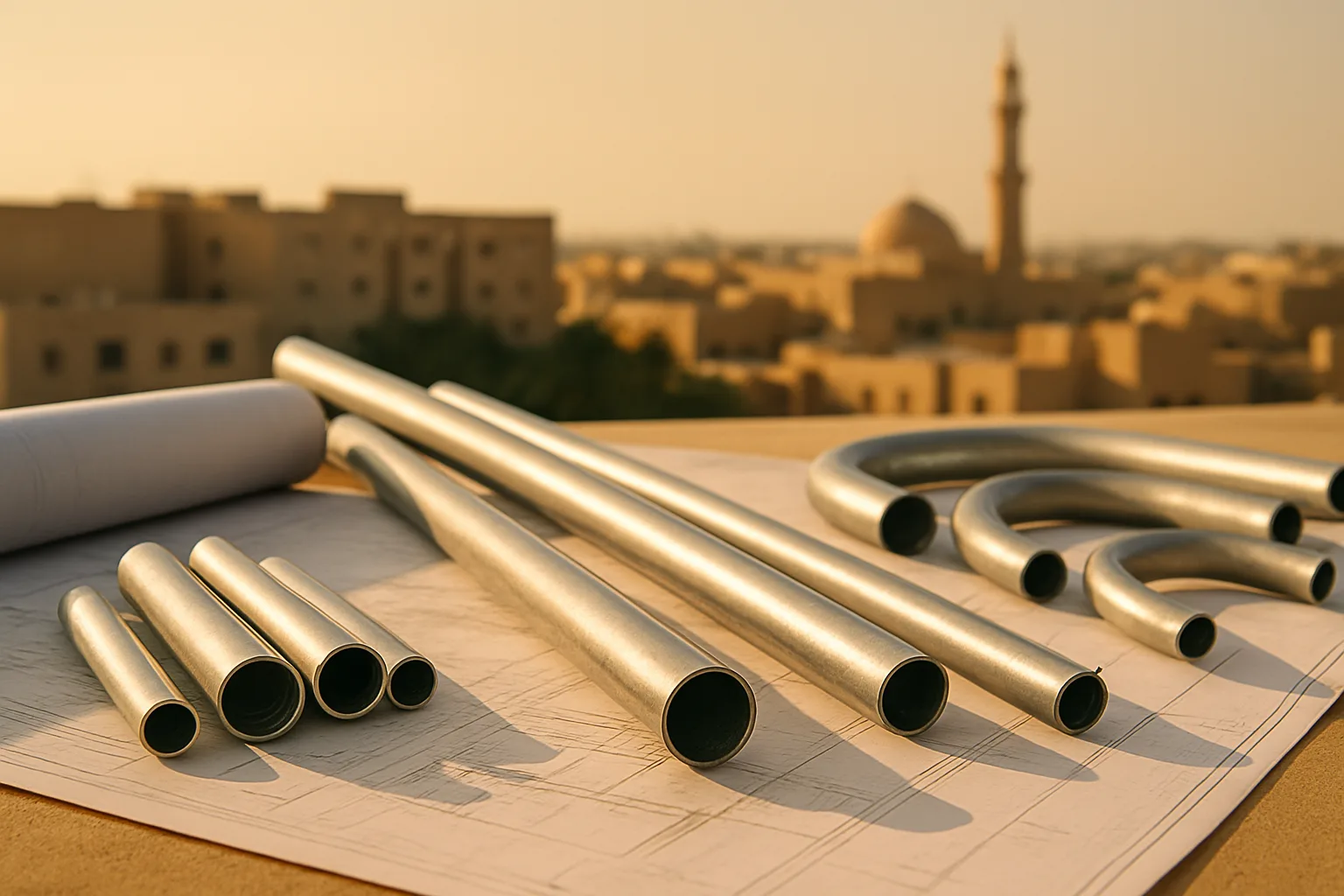
A practical, spec-focused comparison of EMT, rigid, and PVC conduit pipe for Saudi contractors and MEP engineers, emphasizing local availability and project-specific selection criteria.
What Is the Best Conduit Pipe for Saudi Construction Projects?
The best conduit pipe for a Saudi construction project depends on three decisive factors: the installation environment, the mechanical protection required, and the applicable Saudi Building Code (SBC) specifications. For most indoor commercial and residential applications in the Kingdom, EMT (Electrical Metallic Tubing) offers the optimal balance of cost, weight, and protection. For outdoor, underground, or high-impact areas, rigid galvanized steel conduit (RGC) is the mandated choice. PVC conduit, while limited to specific low-impact and buried applications, provides a corrosion-proof and economical alternative where permitted by local regulations. The correct answer is never a single product but a systematic match of conduit type to the specific demands of each project zone.
Saudi Arabia's construction sector, driven by Vision 2030 giga-projects and industrial expansion in the Eastern Province, demands conduit systems that perform reliably for decades under extreme conditions. The coastal environment of Dammam and the broader Gulf region presents a unique challenge: high humidity, salt-laden air, and temperature fluctuations that accelerate corrosion in improperly selected materials. This is why the selection process must begin with a micro-analysis of the installation site rather than a generic preference for one material over another.
Procurement teams and MEP engineers must also consider the total installed cost, which includes labor, fittings, supports, and maintenance over the asset's lifecycle. A cheaper conduit pipe that requires frequent replacement or causes system failures will ultimately cost far more than a premium product installed correctly. In the Saudi market, where project timelines are aggressive and quality standards are rising, the selection of conduit pipe is a strategic decision that impacts project handover, operational reliability, and long-term maintenance budgets.
At Alrouf, we manufacture galvanized steel electrical boxes and accessories that integrate with all major conduit systems. Our experience in Dammam's Second Industrial City has shown us that the most successful projects are those where the conduit pipe, boxes, and fittings are specified as a complete system, ensuring dimensional compatibility and consistent corrosion protection across every component. For a deeper comparison of material options, review our EMT vs rigid conduit selection guide for Saudi projects.
How Do EMT, Rigid Steel, and PVC Conduit Compare for MEP Applications?
EMT conduit, also known as thin-wall conduit, is manufactured from galvanized steel strip and formed into a lightweight tube. It is the most economical metallic option, offering excellent mechanical protection and inherent electromagnetic shielding. However, EMT uses compression or set-screw fittings rather than threaded connections, which means it is not suitable for hazardous locations or areas where the conduit may be subject to severe physical damage. In Saudi commercial towers and residential compounds, EMT is the default choice for concealed and exposed interior runs where the conduit is protected from impact. Learn more about why EMT is the best choice for wiring installations in many building types.
Rigid galvanized steel conduit (RGC) is the heavyweight champion of the conduit pipe category. With walls significantly thicker than EMT, RGC is threaded at both ends and joined with threaded couplings, creating a continuous, leak-tight, and mechanically robust pathway. This makes it the only metallic conduit acceptable for hazardous areas, outdoor installations exposed to physical damage, and underground runs where concrete encasement is not specified. In Saudi industrial facilities, including petrochemical plants in Jubail and Ras Al-Khair, RGC is the standard for all critical circuits.
PVC conduit offers a completely different value proposition. Being non-metallic, it is immune to corrosion and requires no grounding (though a separate ground wire is still required). PVC is lightweight, easy to cut, and joined with solvent cement, making it the fastest conduit pipe to install. However, it offers minimal mechanical protection, degrades under prolonged UV exposure, and releases toxic fumes if burned. In Saudi Arabia, PVC conduit is commonly used for underground installations, concrete encasement, and interior concealed work where building codes explicitly permit its use. The choice between these three types is not about which is 'best' in absolute terms, but which is best for each specific run in your project.
What Saudi-Specific Factors Should Drive Your Conduit Pipe Specification?
The Kingdom's climate is the first and most unforgiving factor. In the Eastern Province, where Alrouf is headquartered, ambient temperatures routinely exceed 45°C in summer, and relative humidity along the coast can approach 90%. This combination accelerates galvanic corrosion, especially where dissimilar metals meet. For outdoor installations within 10 kilometers of the Gulf coast, we recommend hot-dipped galvanized rigid conduit with a minimum zinc coating of 550 g/m², applied after threading to ensure thread protection. Standard EMT with mill-galvanized coating may fail prematurely in this environment.
Saudi Building Code (SBC) requirements, particularly SBC 401 (Electrical), dictate where each conduit type may be used. The code aligns closely with international standards like NEC but includes specific provisions for the Kingdom's environmental conditions. MEP contractors must verify the latest code edition and any amendments issued by the Saudi Standards, Metrology and Quality Organization (SASO). Non-compliant conduit installations risk failing inspection, causing project delays, and incurring costly rework.
Local content requirements under Vision 2030 are reshaping procurement strategies. The Kingdom's 'Made in Saudi' initiative encourages project owners and main contractors to prioritize locally manufactured materials. This is not merely a patriotic gesture; it is a practical supply chain advantage. Locally manufactured conduit pipe from suppliers like Alrouf reduces lead times from weeks to days, eliminates customs clearance delays, and ensures that products are tested for Saudi environmental conditions. For projects with aggressive schedules, this local availability can be the difference between on-time delivery and costly postponements.
Finally, consider the availability of matching accessories. A conduit system is only as reliable as its weakest component. When specifying conduit pipe, verify that the manufacturer or supplier can provide compatible couplings, connectors, bushings, and conduit bodies. In Saudi Arabia, where projects often require thousands of fittings, sourcing everything from a single local manufacturer simplifies logistics, ensures quality consistency, and provides a single point of accountability for system performance. Explore our full range of manufacturing services to see how we support complete system integration.
How Does Conduit Pipe Selection Impact Installation Speed and Labor Costs?
Labor costs in Saudi Arabia's construction sector are a significant portion of total project expenditure, and conduit installation is labor-intensive. EMT conduit is the fastest metallic option to install because it requires no threading. Skilled electricians can cut, bend, and couple EMT using simple hand tools or a mechanical bender. For large commercial projects with repetitive layouts, EMT installation rates can reach 30 to 40 linear meters per man-day, making it the preferred choice for interior rough-in work where speed is critical.
Rigid steel conduit, by contrast, demands significantly more labor. Each length must be cut, threaded, and reamed before installation. Threading machines add setup time, and the heavier weight of RGC increases physical strain on installers. A typical installation rate for RGC is 10 to 15 linear meters per man-day, roughly one-third the speed of EMT. However, this slower installation is justified in applications where the conduit must withstand severe physical abuse or where threaded connections are required for grounding continuity and explosion-proof sealing.
PVC conduit installation speed falls between EMT and RGC. Solvent welding is quick, but the conduit must be supported more frequently due to its lower mechanical strength. In Saudi Arabia, where summer temperatures soften PVC, support spacing must be reduced to prevent sagging. This additional support hardware increases material costs and installation time. For underground installations, however, PVC is exceptionally fast because long runs can be assembled on the surface and lowered into the trench in one operation.
When calculating total installed cost, procurement managers should use a comprehensive model that includes material, labor, fittings, supports, and inspection. A conduit pipe that costs 20% less per meter but requires 50% more installation time is rarely the economic winner. We advise our clients to request installation productivity data from their contractors and to factor in the availability of skilled labor for each conduit type. In the current Saudi market, where skilled MEP labor is in high demand, selecting a conduit system that maximizes installer productivity can significantly improve project profitability.
What Are the Long-Term Maintenance Implications of Each Conduit Type?
Maintenance costs over a building's lifecycle often exceed the initial installation cost by a factor of five or more. For conduit systems, the primary maintenance concern is corrosion. In Saudi Arabia's coastal and industrial environments, galvanized steel conduit will eventually show signs of zinc depletion, particularly at cut ends, thread areas, and locations where the conduit has been scratched during installation. A robust maintenance program should include periodic inspection of these vulnerable points and touch-up with zinc-rich paint where needed.
EMT conduit, with its thinner wall and lighter galvanization, has the shortest maintenance-free lifespan of the metallic options. In dry, air-conditioned indoor environments, EMT can last the life of the building without intervention. But in unconditioned spaces, on rooftops, or in coastal exposure, EMT may require repainting or replacement within 10 to 15 years. This is a critical consideration for Saudi projects where rooftop plant areas are exposed to intense solar radiation and salt-laden humidity.
Rigid steel conduit offers the longest service life, often exceeding 50 years with minimal maintenance. The thicker wall provides a greater corrosion allowance, and the threaded joints, when properly sealed with approved compounds, prevent moisture ingress. For critical infrastructure, industrial facilities, and government buildings where downtime is unacceptable, RGC's longevity justifies its higher initial cost. In the Eastern Province's oil and gas sector, RGC installations from the 1980s remain in service today, a testament to the material's durability.
PVC conduit requires the least maintenance of all types, as it does not corrode. However, it is susceptible to UV degradation, becoming brittle and discolored after prolonged sun exposure. In Saudi Arabia, PVC conduit installed outdoors without UV protection may crack within 5 to 7 years, exposing conductors to moisture and creating safety hazards. For this reason, we recommend PVC only for underground or concrete-encased installations where it is permanently protected from sunlight. When specifying conduit for Saudi projects, always consider the maintenance access and the building's expected service life to select a conduit pipe that matches the asset's longevity requirements.
How Can Saudi Contractors Ensure Quality and Compliance in Conduit Procurement?
Quality assurance begins with the raw material. For metallic conduit, the base steel must meet SASO and ASTM specifications for chemical composition and mechanical properties. The galvanizing process must produce a uniform, adherent zinc coating that withstands bending and forming without flaking. Reputable Saudi manufacturers, including Alrouf, maintain in-house testing laboratories and provide certificates of conformance for each production batch. Procurement teams should request these certificates and verify that the stated specifications match the project requirements.
Third-party certification adds another layer of assurance. Look for conduit pipe that carries certification from recognized testing bodies such as SASO, or international marks like UL, CE, or IECEE. These certifications confirm that the product has been independently tested for dimensional accuracy, coating thickness, and mechanical performance. In Saudi Arabia, SASO certification is mandatory for many electrical products, and its presence on a conduit pipe is a baseline indicator of quality.
Traceability is essential for large projects. Each bundle of conduit pipe should carry a label indicating the manufacturer, production date, batch number, and specification. This traceability enables contractors to isolate and replace any non-conforming material quickly. It also provides valuable data for warranty claims and lifecycle analysis. Alrouf maintains full traceability from coil steel receipt to finished product dispatch, ensuring that every meter of conduit we supply can be traced to its source material.
Finally, establish a quality inspection protocol at the receiving end. Upon delivery, inspect conduit for signs of damage, corrosion, or coating defects. Verify that the wall thickness meets specification using a calibrated micrometer. Check that threads (for RGC) are clean, sharp, and free of burrs. These simple inspections, performed by a trained quality controller, can prevent installation delays and ensure that the conduit system performs as designed. In the Saudi market, where project quality standards are rising, proactive quality management in conduit procurement is not optional; it is a competitive necessity.
Why Choose Alrouf as Your Conduit Pipe and Accessories Partner in Saudi Arabia?
Alrouf has been manufacturing electrical accessories in Dammam's Second Industrial City since 2003. Our location in the heart of the Eastern Province places us within 500 kilometers of most major Saudi construction sites, from the giga-projects of NEOM to the industrial complexes of Jubail and the commercial towers of Riyadh. This proximity translates into shorter lead times, reduced transportation costs, and the ability to respond quickly to urgent project requirements. You can learn more about our history and capabilities on our About Alrouf page.
Our manufacturing capabilities extend beyond conduit pipe to include the complete ecosystem of electrical accessories. We produce galvanized steel electrical boxes, steel and plastic accessories, and offer progressive die stamping, automated assembly, robotic welding, tooling and die design, tubular manufacturing, coil slitting, and plastic injection molding. This vertical integration means that when you source conduit pipe from Alrouf, you can also source the matching boxes, covers, and fittings from a single manufacturer, ensuring perfect dimensional compatibility and consistent quality. For guidance on selecting the right enclosures, see our electrical box selection guide for Saudi projects.
Quality is embedded in our production processes. Our robotic welding systems deliver repeatable, defect-free welds on every component. Our automated assembly lines ensure consistent tolerances across high-volume production runs. Our in-house tooling and die design capabilities allow us to develop custom solutions for OEM clients and unique project requirements. We understand that in the Saudi construction market, quality is not a differentiator; it is the entry ticket. Our commitment is to deliver products that meet or exceed the specifications of every project we serve.
When you partner with Alrouf, you gain more than a supplier; you gain a technical partner. Our engineering team is available to assist with conduit system design, material selection, and installation best practices. We understand the unique challenges of the Saudi environment and can recommend solutions that have been proven in thousands of installations across the Kingdom. Whether you are a MEP contractor, a procurement manager, or an engineering consultant, we invite you to experience the Alrouf difference: locally manufactured, precision-engineered, and reliably delivered. Contact our team to discuss your project requirements.
◈ Key Takeaways
- ✦Match conduit pipe type to the specific environment: EMT for interior dry areas, rigid galvanized steel for outdoor/industrial/hazardous zones, and PVC for underground or concrete-encased runs.
- ✦Prioritize Saudi Building Code (SBC 401) compliance and SASO certification when specifying conduit for any project in the Kingdom.
- ✦Calculate total installed cost including labor, fittings, and maintenance — not just material price per meter — when comparing EMT, RGC, and PVC.
- ✦For coastal Eastern Province projects, specify hot-dipped galvanized rigid conduit with a minimum 550 g/m² zinc coating for outdoor installations.
- ✦Source conduit pipe and accessories from a single local Saudi manufacturer like Alrouf to ensure dimensional compatibility, consistent quality, and reliable supply.
- ✦Implement receiving inspections to verify wall thickness, coating integrity, and thread quality before conduit is installed.
Frequently Asked Questions
❓ What is conduit pipe used for?
Conduit pipe is used to protect and route electrical wiring in buildings and infrastructure projects. In Saudi Arabia, it is essential for safety and compliance with Saudi Building Code (SBC) requirements, ensuring cables are shielded from mechanical damage and environmental factors.
❓ How are conduit pipes specified for Saudi projects?
Conduit pipes are specified based on material (e.g., PVC, steel), size (diameter), wall thickness, and compliance with standards like SASO and IEC. For Saudi projects, factors like high ambient temperatures and UV exposure are considered, so often rigid PVC or galvanized steel is chosen. Specifications include trade size (e.g., 20mm, 25mm) and schedule (e.g., Schedule 40).
❓ Can you use PVC pipe for conduit?
Yes, but only if it is specifically rated for electrical conduit, such as rigid PVC conduit that meets UL 651 or IEC 61386 standards. Regular plumbing PVC is not suitable because it lacks impact resistance and UV protection required for outdoor use in Saudi Arabia. Always check for the conduit rating and UV resistance.
❓ What PVC pipe is UV resistant?
For outdoor conduit applications in Saudi Arabia, choose PVC conduit that is specifically formulated with UV stabilizers, such as those marked 'UV resistant' or 'outdoor rated'. These pipes are designed to withstand prolonged sun exposure without degrading. In contrast, standard PVC plumbing pipes are not UV resistant and can become brittle.
❓ How is PVC conduit pipe measured?
PVC conduit pipe is measured by its nominal trade size (e.g., 20mm, 25mm) which refers to the approximate internal diameter, and by its wall thickness (schedule). The actual outside diameter is standardized for fittings. In Saudi Arabia, metric sizes are common, and it's important to match the pipe size with the correct fittings and boxes.
Ready to Transform Your Space?
Contact Alrouf's engineering team today to discuss your conduit pipe and electrical accessory requirements — we deliver precision-manufactured, locally sourced solutions for Saudi projects of every scale.
Alrouf Electrical Accessories Manufacturer
Galvanized electrical boxes & precision metal-plastic components — Dammam — Dammam, Saudi Arabia


