


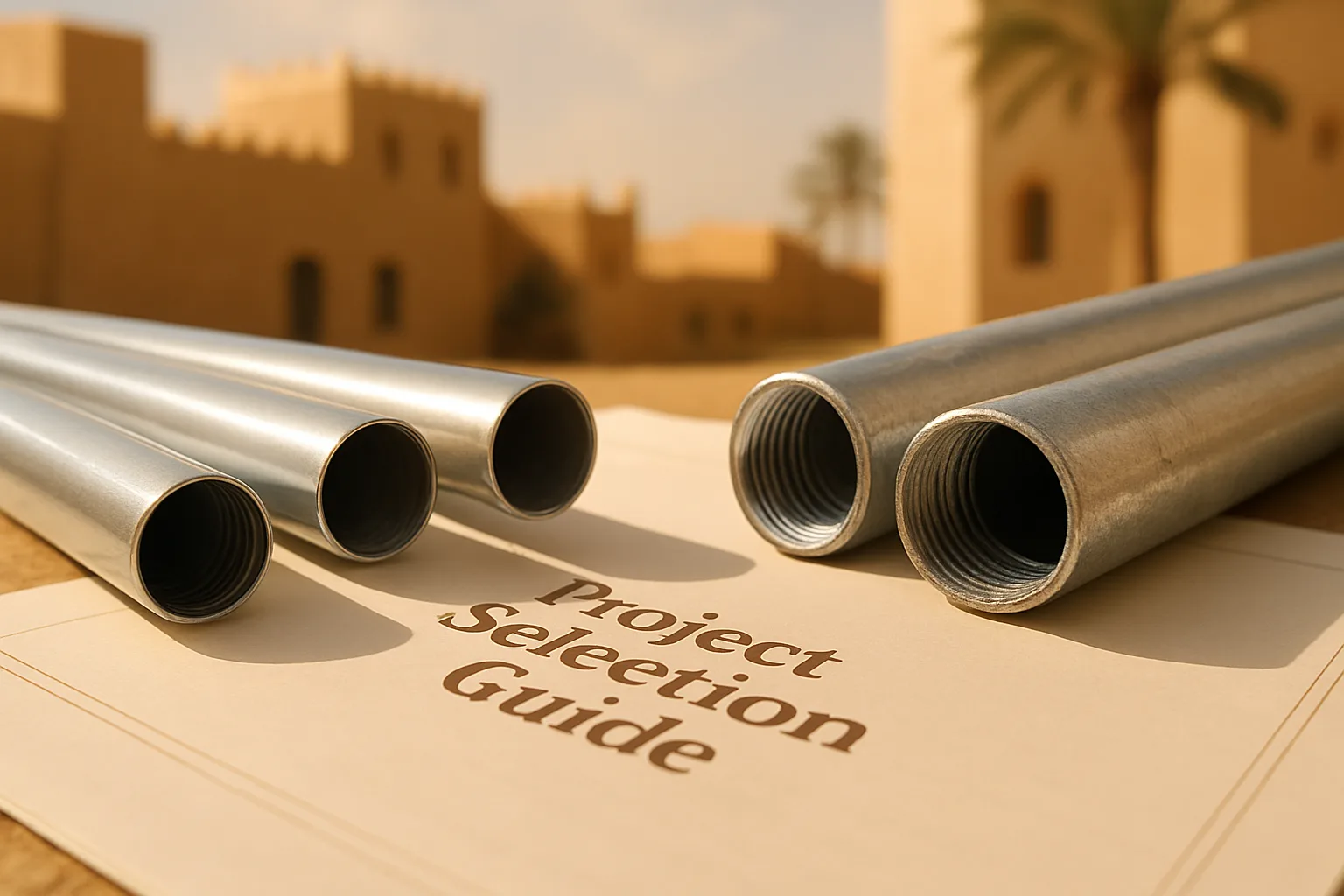
Compare EMT conduit and rigid steel conduit for Saudi projects: corrosion, installation speed, code compliance, and cost. Expert guidance from Alrouf.
EMT Conduit vs. Rigid Steel Conduit: Which One Should Saudi Contractors Choose?
For most commercial and industrial electrical installations in Saudi Arabia, EMT conduit (Electrical Metallic Tubing) offers the best balance of cost, installation speed, and adequate protection, provided it is properly galvanized and installed in non-corrosive or moderately corrosive environments. Rigid steel conduit (RSC) remains the superior choice for high-impact areas, severe corrosive conditions, and applications requiring maximum mechanical protection, such as petrochemical plants and heavy industrial facilities. The decision ultimately hinges on the specific environmental exposure, mechanical risk, and code requirements of each project.
EMT conduit is a lightweight, thin-walled steel tubing that is galvanized for corrosion resistance. Its primary advantage is ease of bending and installation, which translates to significant labor savings on large projects. For contractors working on commercial buildings, schools, hospitals, and residential complexes across the Kingdom, EMT conduit reduces installation time by up to 30-40% compared to rigid steel, allowing faster project completion and lower overall labor costs. However, EMT is not designed for areas where it will be subject to severe physical damage or where corrosive atmospheres are prevalent, such as coastal zones with high salinity or industrial plants with chemical vapors. For a deeper understanding of why EMT is often the preferred option, refer to this guide on the advantages of EMT for wiring.
Rigid steel conduit, on the other hand, has a much thicker wall, typically 3.0 mm or more, providing superior mechanical strength and durability. It is threaded at both ends and joined with couplings, creating a continuous, robust pathway that can withstand heavy impacts and harsh conditions. In Saudi Arabia's Eastern Province, where many projects are located near the Arabian Gulf or within industrial cities like Jubail and Dammam, rigid steel conduit is often specified for outdoor installations, underground runs, and areas exposed to corrosive elements. Its thicker galvanized coating and optional PVC coating offer enhanced corrosion resistance, making it the preferred choice for long-term reliability in demanding environments.
From a manufacturing perspective, Alrouf understands the critical role of material quality and consistent production. Our galvanized steel electrical boxes and accessories are designed to complement both EMT and rigid steel conduit systems, ensuring a seamless, code-compliant installation. We emphasize that the choice between EMT and rigid is not about which is universally better, but which is better suited to the specific application, environmental conditions, and budget constraints of your project. By evaluating these factors carefully, Saudi contractors can optimize both performance and cost-efficiency.
What Are the Key Differences in Corrosion Resistance Between EMT and Rigid Conduit?
Corrosion resistance is a critical factor in Saudi Arabia, especially in coastal areas like Dammam, Khobar, and Jubail, where humidity and salt-laden air can rapidly degrade unprotected steel. EMT conduit is manufactured from steel sheet that is hot-dipped galvanized, providing a zinc coating that offers moderate corrosion protection. However, the thin walls of EMT (typically 1.5 mm) mean that once corrosion begins, it can penetrate the material more quickly than in rigid steel. In indoor, dry environments, EMT performs well, but in outdoor or high-humidity settings, its lifespan may be significantly reduced unless additional protective measures, such as PVC coating, are applied.
Rigid steel conduit is also hot-dipped galvanized, but its thicker walls (3.0 mm or more) provide a more substantial barrier against corrosive elements. The zinc coating on rigid conduit is typically heavier, often exceeding 600 g/m², compared to EMT's lighter coating. This makes rigid steel conduit far more resistant to rust and pitting in saline atmospheres. For projects in the Eastern Province's coastal belt, where airborne chlorides are a constant threat, rigid steel conduit is often the default specification. Additionally, rigid conduit can be specified with a PVC outer jacket for even greater protection in highly corrosive industrial environments, such as those found in petrochemical plants. When selecting components for these harsh conditions, it's essential to review our advice on choosing galvanized steel boxes for coastal humidity.
It is also important to consider the installation environment. EMT conduit is frequently used in concealed applications, such as within walls or above ceilings, where it is protected from direct exposure to corrosive elements. In contrast, rigid steel conduit is commonly used in exposed locations, such as on rooftops, exterior walls, or in process areas, where it must withstand direct contact with moisture, chemicals, and physical impact. The Saudi Electrical Code (SEC) and many project specifications provide clear guidance on where each type is acceptable, often mandating rigid conduit for outdoor and hazardous locations.
At Alrouf, we manufacture galvanized steel boxes and enclosures that are designed to match the corrosion resistance of both EMT and rigid conduit systems. Our products undergo rigorous quality checks to ensure that the zinc coating is uniform and meets industry standards. We advise contractors to consider the full lifecycle cost of the conduit system, including maintenance and potential replacement, when making their selection. In corrosive environments, investing in rigid steel conduit upfront can save significant costs over the long term by avoiding premature failure and downtime.
How Does Installation Efficiency Compare Between EMT and Rigid Conduit?
Installation efficiency is a major driver of project cost and schedule, and here EMT conduit has a clear advantage. EMT is lightweight, typically weighing about one-third as much as rigid steel conduit of the same diameter. This reduces the physical strain on installers and allows for faster handling and positioning. EMT can be bent with a simple hand bender or a mechanical bender, and it does not require threading, as it is joined with set-screw or compression couplings. This eliminates the time-consuming process of cutting and threading that is mandatory for rigid steel conduit, which requires a pipe threader and threading dies.
For a typical commercial project, installing EMT conduit can be up to 40% faster than installing rigid steel conduit. This speed translates directly into labor cost savings, which can be substantial on large-scale developments. For example, a contractor running 10,000 meters of conduit on a shopping mall project could save hundreds of labor hours by choosing EMT. This efficiency is particularly valuable in Saudi Arabia's fast-paced construction market, where project deadlines are often tight and skilled labor is in high demand. To ensure you are using the right materials from the start, consult our essential guide to selecting the right EMT conduit.
However, rigid steel conduit offers advantages in terms of mechanical protection and system integrity. Its threaded joints create a continuous, rigid pathway that is less likely to sag or shift over time, which is important in industrial settings where vibration or physical impact is a concern. Rigid conduit also provides a superior equipment grounding path, which can be critical for safety in certain applications. While installation is slower, the resulting system is more robust and may require less maintenance over its service life.
At Alrouf, we support both installation methods by manufacturing a range of conduit fittings, boxes, and accessories that are compatible with EMT and rigid systems. Our progressive die stamping and robotic welding capabilities ensure that every component meets precise tolerances, facilitating smooth and efficient installation. We recommend that contractors evaluate the specific requirements of each project phase, considering factors such as accessibility, the need for future modifications, and the skill level of the installation crew, to determine the most efficient conduit choice.
What Do Saudi Electrical Codes and Standards Say About EMT and Rigid Conduit?
Compliance with the Saudi Electrical Code (SEC) and relevant international standards is non-negotiable for any electrical installation in the Kingdom. The SEC, which is largely based on the National Electrical Code (NEC), provides specific articles governing the use of EMT and rigid steel conduit. Article 358 of the NEC covers EMT, while Article 344 covers rigid metal conduit. These articles specify where each type is permitted, installation requirements, and support spacing. For example, EMT is not permitted in locations where it is subject to severe physical damage, unless approved for such use, while rigid conduit is allowed in all occupancies and environments.
In Saudi Arabia, the SEC also aligns with the Gulf Cooperation Council (GCC) standards and often references international standards such as IEC 61386 for conduit systems. These standards define performance requirements for mechanical strength, corrosion resistance, and temperature ratings. For EMT conduit, the standard typically requires a minimum wall thickness and a galvanized coating that meets specific weight and adhesion criteria. Rigid steel conduit must meet even more stringent requirements, including a thicker wall and a heavier zinc coating, to ensure its suitability for harsh environments.
Project specifications in Saudi Arabia, particularly for government and industrial projects, often dictate the type of conduit to be used. For instance, Saudi Aramco standards, which are widely adopted in the Eastern Province, frequently mandate rigid steel conduit for outdoor and hazardous area installations, while allowing EMT for indoor, non-hazardous areas. Contractors must be familiar with these specifications and ensure that the conduit and fittings they use are listed and approved by the relevant authorities, such as the Saudi Standards, Metrology and Quality Organization (SASO).
At Alrouf, we manufacture our galvanized steel boxes and accessories to meet or exceed the requirements of these codes and standards. Our commitment to quality ensures that our products are compatible with both EMT and rigid conduit systems, providing contractors with the confidence that their installations will pass inspection and perform reliably. We encourage contractors to consult the latest edition of the SEC and project-specific specifications before making a conduit selection, as non-compliance can lead to costly rework and project delays.
Which Conduit Type Offers Better Long-Term Value for Saudi Projects?
Long-term value is a critical consideration for project owners and contractors, as it encompasses not only initial material and installation costs but also maintenance, durability, and lifecycle performance. EMT conduit has a lower initial material cost, typically 30-50% less than rigid steel conduit, and its faster installation reduces labor costs. For projects with a limited budget or a short operational lifespan, EMT can offer excellent value. However, in corrosive environments, EMT may require more frequent maintenance or replacement, which can erode its initial cost advantage.
Rigid steel conduit, while more expensive upfront, offers superior durability and a longer service life, often exceeding 50 years in properly specified applications. Its thicker walls and heavier galvanized coating provide robust protection against corrosion, physical damage, and environmental stressors. In industrial facilities, where downtime for repairs is extremely costly, the reliability of rigid conduit can justify its higher initial investment. For example, in a petrochemical plant, a conduit failure could lead to production stoppage, safety hazards, and significant financial losses, making rigid steel the more cost-effective choice over the asset's life.
Another factor in long-term value is the ease of system modification. EMT conduit is easier to disassemble and reconfigure, which can be advantageous in facilities that undergo frequent layout changes. Rigid conduit, with its threaded joints, is more permanent but also more challenging to modify. Contractors should consider the expected lifecycle of the building or facility and the likelihood of future changes when selecting a conduit system.
At Alrouf, we help our clients make informed decisions by providing high-quality components that maximize the value of their chosen conduit system. Our galvanized steel boxes and enclosures are designed for durability and easy installation, reducing the total cost of ownership. We also offer custom fabrication services, such as progressive die stamping and robotic welding, to create tailored solutions that meet specific project requirements. By partnering with a manufacturer that understands the local environment and industry needs, Saudi contractors can achieve optimal long-term value. Learn more about our custom manufacturing services.
How Do Coastal and Industrial Environments in Saudi Arabia Influence Conduit Choice?
Saudi Arabia's Eastern Province is home to some of the most challenging environments for electrical installations, including coastal zones with high humidity and salt spray, and industrial areas with chemical vapors and extreme temperatures. In coastal cities like Dammam and Khobar, the air is laden with chlorides that can rapidly corrode unprotected steel. For outdoor installations in these areas, rigid steel conduit with a heavy galvanized coating or a PVC outer jacket is often the only reliable choice. EMT conduit, unless specifically coated for marine environments, is generally not recommended for outdoor coastal use.
Industrial environments, such as those in Jubail Industrial City or the Dammam Second Industrial City, present additional challenges. Chemical plants, refineries, and manufacturing facilities may have atmospheres containing sulfur compounds, acids, or other corrosive agents. In such settings, the conduit must not only resist corrosion but also withstand potential physical impact from equipment, vehicles, or maintenance activities. Rigid steel conduit, with its thick walls and robust construction, is the standard choice for these applications. Additionally, in hazardous areas where flammable gases or vapors may be present, rigid conduit is often required to provide a continuous, sealed pathway that prevents the propagation of flames.
Even in less severe environments, the choice of conduit can be influenced by proximity to the coast. For example, a commercial building located within a few kilometers of the Gulf may experience higher humidity and salt deposition than a building further inland. In such cases, contractors may opt for EMT with a corrosion-resistant coating, such as zinc-aluminum or PVC, to extend its lifespan. However, it is essential to verify that these coatings meet the requirements of the Saudi Electrical Code and the project specifications.
At Alrouf, we have extensive experience manufacturing components for projects in the Eastern Province's demanding environments. Our galvanized steel boxes and accessories are produced using high-quality steel and advanced coating processes to ensure maximum corrosion resistance. We also offer plastic injection molding parts that are inherently corrosion-resistant, making them ideal for certain coastal and industrial applications. By understanding the specific environmental challenges of each project, we help our clients select the most appropriate conduit and accessory systems for long-term reliability.
What Are the Practical Selection Criteria for Choosing Between EMT and Rigid Conduit?
Choosing between EMT and rigid steel conduit requires a systematic evaluation of several factors. First, assess the environmental conditions: Is the installation indoors or outdoors? Is it in a coastal area with high salinity? Is it in an industrial zone with chemical exposure? For indoor, dry, and non-corrosive environments, EMT is often sufficient. For outdoor, coastal, or industrial settings, rigid steel conduit is typically required. Second, consider the mechanical risks: Will the conduit be exposed to physical impact, vibration, or heavy loads? If so, rigid conduit's superior strength is a decisive advantage.
Third, evaluate the installation requirements: Is the project on a tight schedule? Are skilled labor and threading equipment available? EMT's ease of installation can save time and money, but only if the environment permits its use. Fourth, review the applicable codes and project specifications: The Saudi Electrical Code and client standards may dictate the conduit type for specific applications. Ignoring these requirements can lead to failed inspections and costly rework. Fifth, consider the total cost of ownership, including maintenance and replacement over the building's life. While EMT has lower upfront costs, rigid conduit may offer better value in the long run for harsh environments.
Another practical criterion is the availability of compatible fittings and accessories. Both EMT and rigid conduit require specific boxes, couplings, and connectors. Ensuring that these components are readily available and manufactured to high quality is essential for a smooth installation. At Alrouf, we manufacture a comprehensive range of galvanized steel boxes and accessories that are compatible with both conduit types, ensuring that contractors have a reliable supply of components that meet Saudi standards. For more information on selecting the right components, see our electrical box selection guide for Saudi projects.
Finally, consult with experienced engineers and manufacturers who understand the local conditions. At Alrouf, our team is available to provide technical guidance on conduit selection and to offer custom solutions for unique project requirements. By taking a holistic approach to conduit selection, Saudi contractors can ensure that their electrical systems are safe, compliant, and cost-effective.
◈ Key Takeaways
- ✦EMT conduit is ideal for indoor, dry, and non-corrosive environments, offering significant labor and material savings.
- ✦Rigid steel conduit is the preferred choice for outdoor, coastal, and industrial applications due to superior corrosion resistance and mechanical strength.
- ✦Always consult the Saudi Electrical Code and project specifications to ensure conduit selection meets compliance requirements.
- ✦Consider total lifecycle cost, including maintenance and replacement, not just initial material and installation costs.
- ✦Partner with a local manufacturer like Alrouf for high-quality, code-compliant boxes and accessories that work with both EMT and rigid conduit systems.
Frequently Asked Questions
❓ What is EMT conduit?
EMT (Electrical Metallic Tubing) is a lightweight, thin-walled steel conduit used to protect electrical wiring. In Saudi projects, it's a popular choice for indoor and dry locations due to its ease of bending and lower cost compared to rigid conduit.
❓ How is EMT conduit measured?
EMT conduit is measured by its nominal inside diameter, with common sizes in Saudi Arabia being 1/2 inch, 3/4 inch, and 1 inch. The actual outside diameter is slightly larger, which is important for selecting fittings and connectors.
❓ How do you bend EMT conduit?
To bend EMT conduit, use a hand bender or a mechanical bender for larger sizes. For a 90-degree bend, mark the conduit, align it with the bender's arrow, and pull the handle smoothly. Practice on scrap pieces to perfect your technique.
❓ How do you connect EMT conduit?
EMT conduit is connected using set-screw or compression fittings. Insert the conduit into the fitting and tighten the screws or compression ring to secure it. For a watertight connection, use compression fittings with appropriate seals.
❓ How strong is EMT conduit?
EMT conduit is strong enough for most indoor applications but is not as robust as rigid conduit. It can withstand moderate impact and crushing forces, but for high-risk areas or outdoor installations in Saudi Arabia, rigid conduit is often preferred.
Ready to Transform Your Space?
Contact Alrouf today for expert guidance and high-quality galvanized steel boxes and accessories for your next conduit installation.
Alrouf Electrical Accessories Manufacturer
Galvanized electrical boxes & precision metal-plastic components — Dammam — Dammam, Saudi Arabia


