


How Local Electrical Box Manufacturing Supports Saudi
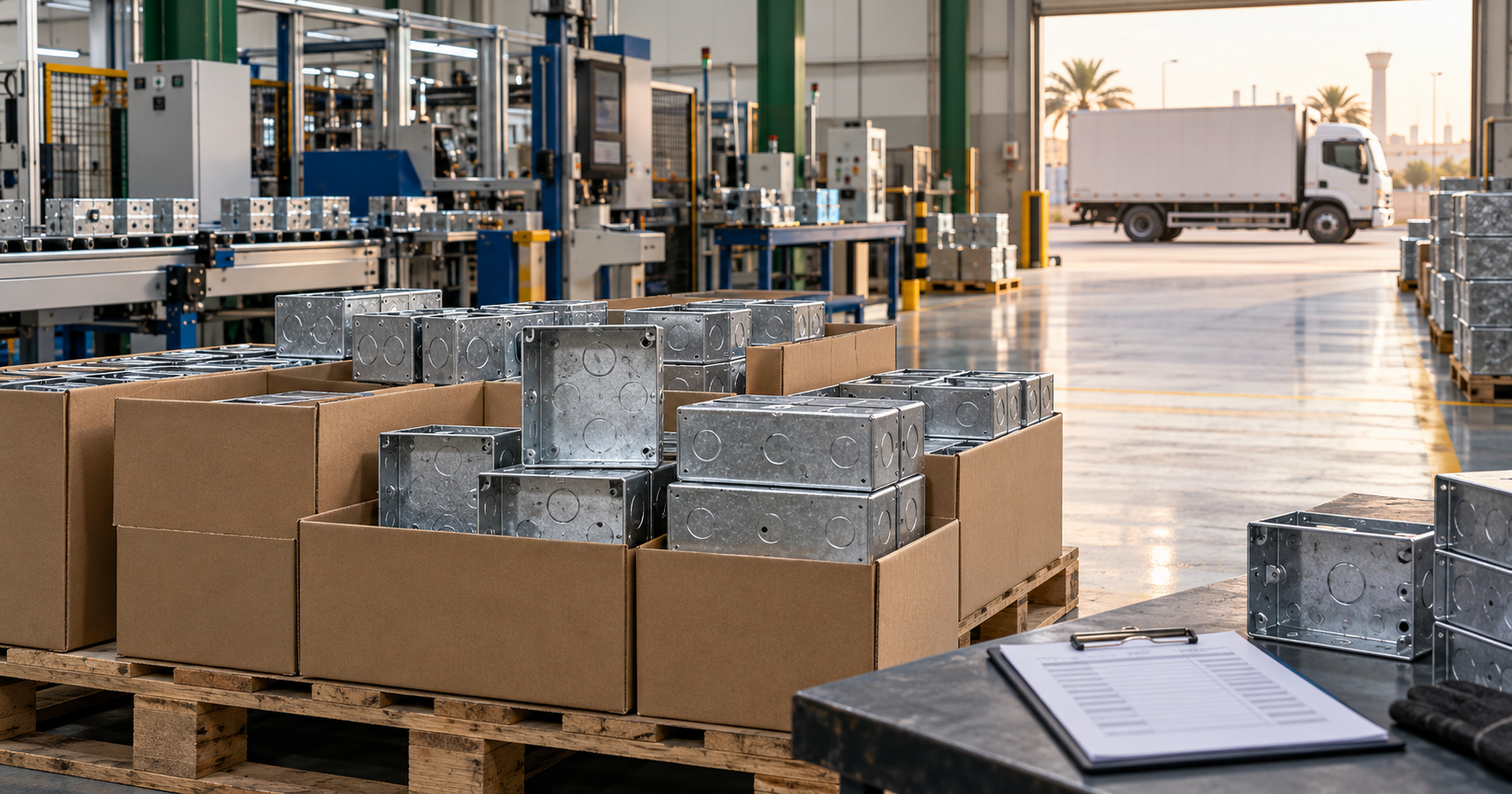
Locally manufactured electrical boxes can help Saudi procurement teams reduce their dependence on international shipping, communicate directly with suppliers, and respond more effectively to changing project requirements. The actual benefits depend on product availability, order volume, production capacity, destination, and confirmed delivery schedules. Buyers must still verify technical specifications, supporting documentation, and project-specific local-content requirements before placing an order.
Why Does Local Electrical Box Manufacturing Matter in Saudi Arabia?
Electrical boxes are relatively small components, but their availability can affect several stages of an electrical installation. If the correct switch boxes, junction boxes, covers, or accessories are unavailable, contractors may be unable to complete conduit installation, wiring, inspection, or wall-finishing activities as planned.
Working with a local electrical box manufacturer gives contractors and MEP procurement teams an additional supply option within the Kingdom. It may reduce exposure to some of the uncertainties associated with overseas procurement, such as international freight schedules, port handling, customs procedures, and long-distance transportation.
Local production can also make communication easier. Buyers may be able to discuss product codes, dimensions, knockout configurations, packaging, documentation, and delivery requirements directly with the manufacturer. However, no supplier should promise a particular lead time until the order requirements and current production schedule have been confirmed.
For Saudi projects, the value of local manufacturing is therefore not limited to national origin. It can also support clearer communication, more accessible technical information, and a shorter route between the production facility and the project site.
How Can Local Sourcing Reduce Supply-Chain Exposure?
Imported electrical accessories pass through several stages before reaching a Saudi project. These may include overseas production, export preparation, international freight, customs clearance, local warehousing, and inland transportation. A delay at any stage can affect the expected delivery date.
A Saudi manufacturer may remove some of these international stages from the supply chain. This does not mean that local delivery is immediate or guaranteed, but it can give procurement teams more direct visibility into:
- Current product availability
- Confirmed production schedules
- Order quantities
- Packaging arrangements
- Domestic transportation
- Required technical documents
- Expected dispatch dates
Actual lead times still depend on the selected products, order size, raw-material availability, production workload, destination, and any special project requirements. Buyers should request a written delivery schedule rather than relying on general statements such as “available locally” or “fast delivery.”
Local sourcing can be particularly useful when a project needs to coordinate deliveries with installation stages. Instead of assuming that all materials must arrive at once, the buyer and supplier can discuss whether scheduled deliveries are possible. Any such arrangement should be formally confirmed before it is included in the project programme.
How Should Buyers Plan Around Holidays and Seasonal Demand?
Official holidays, seasonal demand, and changes in working schedules may affect manufacturers, transport providers, warehouses, and project sites. Procurement teams should not assume that local production automatically removes these effects.
Before Saudi National Day, Eid holidays, or another planned project milestone, buyers should:
- Confirm the required product codes and quantities.
- Check which items are currently available.
- Request a confirmed production and dispatch schedule.
- Verify the delivery address and site-access requirements.
- Identify materials required for critical installation activities.
- Allow time for receiving inspection and consultant approval.
- Confirm any holiday-related changes to working or delivery schedules.
This approach is more reliable than making general assumptions about port congestion, customs delays, or guaranteed local availability. The purpose of procurement planning is to replace assumptions with confirmed information.
What Does Local Content Mean for Saudi Procurement?
Saudi Arabia’s industrial strategy encourages the development of domestic manufacturing and stronger local supply chains. Choosing Saudi-made products may support a project’s localization objectives and contribute to the broader development of the national industrial sector.
However, purchasing a product made in Saudi Arabia does not automatically give every project a specific local-content score or procurement preference. The treatment of local content depends on factors such as:
- The contracting authority
- The tender requirements
- The procurement mechanism
- The applicable local-content methodology
- The supplier’s supporting documents
- Product classification and country-of-origin evidence
- Any project-specific calculation or reporting requirements
The Local Content and Government Procurement Authority and individual project owners may apply particular requirements. Aramco’s In-Kingdom Total Value Add, or iktva, is a separate programme associated with Aramco’s supply chain; it should not be presented as a universal requirement for every construction project in Saudi Arabia.
Procurement teams should therefore ask the project’s commercial or compliance team which documents are required. Product markings and country-of-origin information can support product identification, but they do not independently prove a local-content score, tender eligibility, or certification.
What Should Buyers Verify Before Ordering Electrical Boxes?
Local origin is only one part of the purchasing decision. A locally manufactured electrical box must still match the approved electrical design and project specification.
Before placing an order, verify the following:
Product type and application
Confirm whether the project requires a switch box, device box, junction box, outlet box, or another enclosure type. Products that appear similar may have different dimensions, fixing arrangements, or intended uses.
Product code and dimensions
Check the exact product code, width, height, and depth. The selected box must provide the space and entry arrangement required by the approved installation.
Steel thickness
The nominal steel thickness should be stated in millimetres. Avoid depending only on terms such as “heavy-duty” or “heavy gauge,” because they do not provide a measurable specification.
Knockout configuration
Confirm the number, size, and position of the bottom and side knockouts. They must be compatible with the conduit layout and the approved fittings.
Material information
Review the declared steel and protective coating specification. Alrouf’s published company information states that its electrical boxes are manufactured from G90 galvanized steel associated with ASTM A653 material requirements. Buyers should confirm that this information applies to the exact model being ordered and request the latest supporting technical document.
Earth-terminal provision
Confirm whether the selected model includes an earth terminal and whether this matches the electrical design. Metallic boxes should be bonded or grounded where required by the approved wiring method and applicable project requirements.
Markings and documentation
Product markings can help inspectors compare delivered materials with the approved submittal, but a marking alone does not prove current certification. Request applicable datasheets, drawings, test reports, or certificates for the exact model where the project requires them.
Packing and delivery
Confirm the standard packing quantity, total order quantity, dispatch plan, delivery location, and receiving requirements. Do not assume that packaging or delivery sequencing can be changed unless the supplier agrees in writing.
How Can Local Manufacturing Support Quality Communication?
One advantage of dealing with a local manufacturer is the ability to raise technical questions closer to the source of production. If the project team identifies an issue involving dimensions, knockout placement, markings, or packaging, it may be easier to communicate directly with a Saudi-based supplier.
This accessibility does not replace quality inspection. Contractors should continue to compare delivered products with the approved submittal by checking:
- Manufacturer and product code
- Dimensions and depth
- Declared steel thickness
- Knockout configuration
- Earth-terminal details
- Surface and edge condition
- Cover and accessory compatibility
- Packing quantity
- Required technical documents
For large orders, the project may also request samples or arrange an inspection before full material release. The scope and acceptance criteria should be agreed between the relevant parties.
What Verified Information Can Be Used About Alrouf?
Alrouf Electrical Accessories Manufacturer states that it began operating in 2003 and is based in Dammam’s Second Industrial City. Its published product range includes galvanized steel electrical boxes and related electrical accessories.
The company also presents manufacturing capabilities that include progressive die stamping, automated assembly, robotic welding, tooling and die design, coil slitting, tubular manufacturing, and plastic injection molding. These capabilities help explain the company’s broader manufacturing background, but the process used for each individual product should not be assumed without confirmation.
Buyers can review the Alrouf electrical product range to identify suitable products. Before specification or purchase, request the current datasheet, product drawing, availability information, and supporting documents for the exact model.
Do not assume that every Alrouf product has a particular fire rating, ingress-protection rating, environmental classification, or third-party certification unless a current document specifically covers that model and installation.
Electrical Box Procurement Checklist
Use this checklist before approving a local electrical box order:
- Confirm the approved box type.
- Record the exact product code.
- Verify all dimensions and depth.
- Confirm steel thickness in millimetres.
- Check the knockout sizes, quantities, and positions.
- Verify the earth-terminal requirement.
- Review the declared raw material and coating.
- Request current technical documents.
- Verify whether any certificate applies to the exact model.
- Confirm the standard packing quantity.
- Request written availability and lead-time information.
- Confirm the dispatch and delivery schedule.
- Allow time for receiving inspection.
- Check the project’s local-content documentation requirements.
- Avoid relying on markings or promotional claims alone.
Frequently Asked Questions
What should buyers look for in a Saudi electrical box manufacturer?
Buyers should evaluate product specifications, current technical documents, manufacturing capability, quality-control procedures, communication, available product range, and confirmed delivery schedules. Local origin alone does not replace technical evaluation or project approval.
Can local electrical box manufacturing shorten delivery times?
It may reduce exposure to international freight and customs stages, but the actual lead time depends on availability, quantity, production workload, raw materials, destination, and order requirements. Always obtain a confirmed schedule from the supplier.
Does a Saudi-made electrical box automatically qualify for local-content points?
Not automatically. Local-content treatment depends on the tender, contracting authority, procurement mechanism, calculation method, and required supporting documents. The project’s procurement or compliance team should confirm the applicable requirements.
Are Alrouf electrical boxes manufactured in Saudi Arabia?
Alrouf states that it operates from Dammam’s Second Industrial City and manufactures electrical accessories in Saudi Arabia. Buyers should request the relevant product and country-of-origin documentation required for their project.
Are locally manufactured boxes automatically compliant with Saudi requirements?
No. Local manufacture and technical compliance are separate matters. Compliance must be established through the applicable product specification, test reports, certificates, project requirements, and consultant approval.
Can galvanized electrical boxes be used in fire-rated walls?
This cannot be determined from the galvanized material or steel thickness alone. Suitability for a fire-rated wall depends on the tested wall assembly, box configuration, installation method, spacing, protective measures, and applicable evidence. Request project-specific approval before use.
Discuss Your Electrical Box Requirements with Alrouf
Review Alrouf’s electrical box range or contact the Dammam team to request current product specifications, supporting documentation, availability, and a confirmed delivery schedule for your Saudi project.
See the full Alrouf product range
Download the Alrouf 2023 catalogue and browse the product range.


