


How to Choose a Metal Stamping Manufacturer in Dammam for
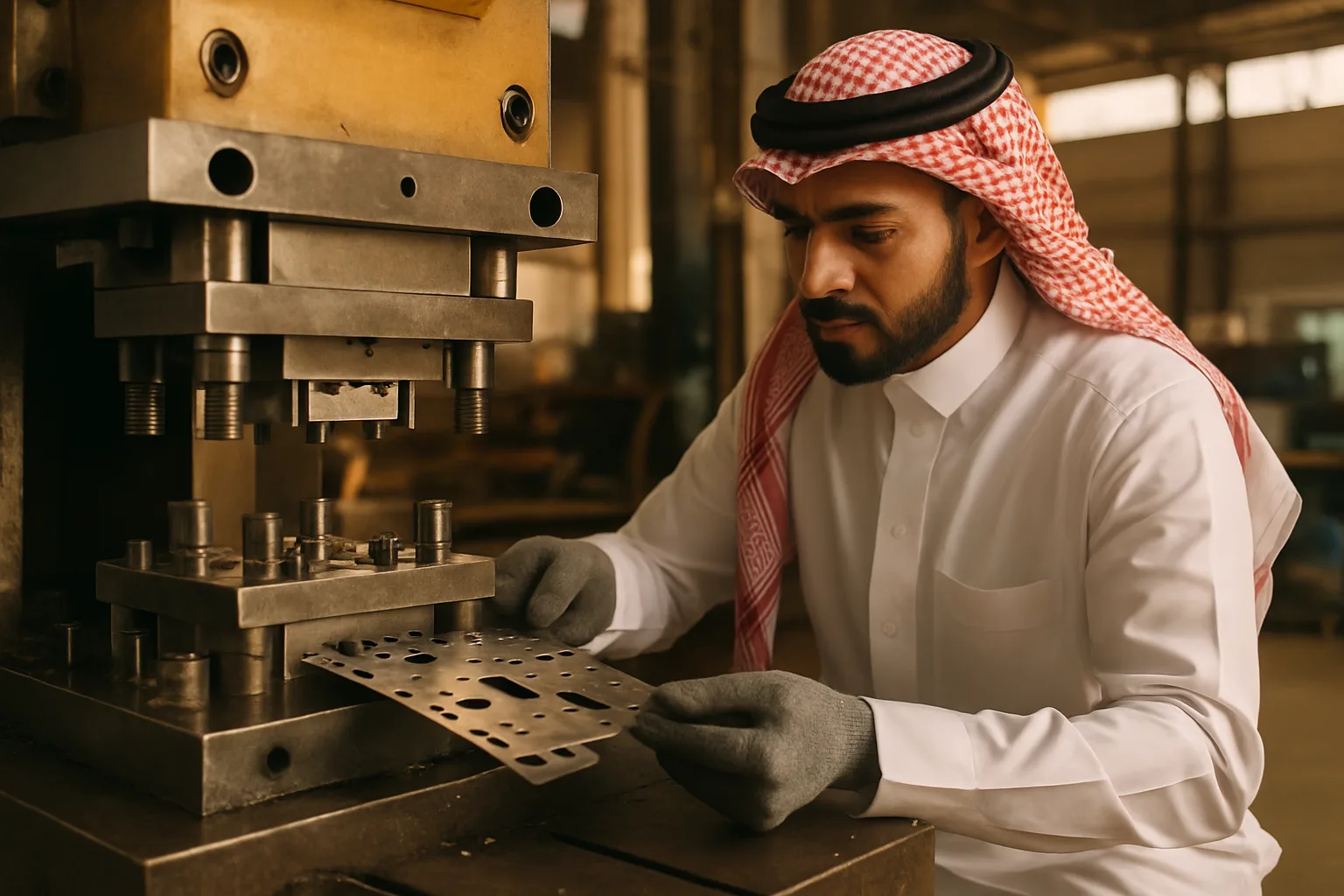
Choosing a metal stamping manufacturer in Dammam requires more than comparing unit prices. OEMs and industrial buyers should evaluate whether the manufacturer can repeatedly produce the required component according to the approved drawing, material specification, quantity, tolerances, finishing requirements, and quality plan.
The process should begin with a manufacturing suitability review. The buyer provides a technical drawing or physical sample, identifies the required material and estimated annual quantity, and explains the component’s application. The manufacturer can then assess whether stamping is the appropriate production method and determine the tooling, inspection, finishing, and secondary operations that may be required.
For companies seeking to localize repeat metal components in Saudi Arabia, ALROUF Industrial provides a clear review path based on the customer’s part—not a standard product catalogue.
What Does a Metal Stamping Manufacturer Offer OEM Buyers?
A metal stamping manufacturer converts flat sheet or coil material into repeatable metal parts using presses and purpose-built tooling. Depending on the component and the manufacturer’s verified capabilities, production may involve operations such as:
- Blanking and cutting
- Piercing holes or openings
- Bending and forming
- Drawing or shaping
- Embossing or coining
- Trimming
- Joining or assembly
- Surface finishing
Not every component is suitable for metal stamping. The decision depends on several factors, including its shape, material, thickness, tolerances, production quantity, and expected repeat demand.
This is why buyers should avoid requesting a price using only a photograph or general description. A technical drawing or sample provides the manufacturer with the information needed to conduct a meaningful review.
When Is Metal Stamping Suitable for a Component?
Metal stamping may be suitable when a company requires the same component in repeat quantities and needs consistent dimensions across production batches. It is commonly considered for brackets, plates, covers, clips, supports, formed panels, and other sheet-metal parts.
A manufacturer will normally review:
- Part dimensions and geometry
- Material type and thickness
- Required tolerances
- Hole locations and formed features
- Surface and edge requirements
- Finishing or coating specification
- Estimated order and annual quantities
- Inspection and documentation requirements
- Packaging and delivery expectations
Complexity alone does not determine suitability. A simple part ordered in very small quantities may not justify dedicated tooling, while a more complex component with stable, recurring demand may be a stronger candidate.
The correct production route should only be selected after the technical and commercial requirements have been reviewed.
What Is Progressive Die Stamping?
Progressive die stamping is a production method in which a metal strip moves through multiple stations within a die. Each station performs part of the operation, such as piercing, forming, bending, or cutting. The finished component is separated from the strip at the final stage.
This method can support efficient, repeatable production when the component design, material, tolerances, and required quantities justify dedicated tooling.
However, progressive stamping is not automatically the best option for every part. Some components may be better suited to single-operation stamping, fabrication, laser cutting, bending, or another manufacturing process.
The appropriate method depends on:
- Expected production volume
- Part size and shape
- Material behaviour
- Tooling requirements
- Dimensional tolerances
- Secondary operations
- Total production economics
ALROUF Industrial should only propose a manufacturing route after reviewing the submitted drawing or sample and confirming that the project fits its approved capabilities.
Why Does Repeatability Matter in Metal Stamping?
Repeatability means maintaining the required dimensions and features within the agreed tolerances throughout production. This is particularly important when the stamped part must fit into a larger assembly or align with other manufactured components.
Poor dimensional consistency can cause:
- Assembly problems
- Misaligned holes or fastening points
- Increased rework
- Component rejection
- Production delays
- Inconsistent finished products
Repeatability depends on more than the stamping press. It can also be influenced by the tooling condition, material consistency, process setup, inspection plan, and control of secondary operations.
Before production begins, the buyer and manufacturer should agree on the critical dimensions, acceptable tolerances, sampling frequency, inspection methods, and required quality records.
Why Are Drawings and Samples Important?
A drawing-led review reduces ambiguity and allows both parties to evaluate the same technical requirements.
A useful drawing should identify, where applicable:
- Overall dimensions
- Material specification
- Material thickness
- Critical tolerances
- Hole sizes and positions
- Bend locations and angles
- Surface-finish requirements
- Coating requirements
- Revision number
- Special inspection notes
A physical sample can provide additional context, especially when an existing imported or internally manufactured part is being considered for localization. However, a sample may not communicate every tolerance or material requirement. For this reason, the strongest submission normally combines a drawing with a sample or detailed technical information.
If the design is confidential, the buyer can ask about the appropriate confidentiality process before sharing sensitive files.
How Can Local Manufacturing Support Saudi Supply Chains?
Manufacturing repeat components in Saudi Arabia may help buyers simplify communication, reduce dependence on long international supply chains, and improve coordination during sampling, validation, and repeat production.
Potential advantages can include:
- Easier technical communication
- Faster review of drawing revisions
- Closer coordination during sampling
- Reduced exposure to international shipping disruptions
- Improved visibility into the manufacturing process
- Support for approved localization objectives
- Easier handling of repeat orders
These benefits should not be presented as guaranteed savings or fixed delivery improvements. Actual results depend on the component, tooling, material availability, quantity, quality requirements, production schedule, and delivery location.
Any contribution to a formal local-content requirement must also be supported by the relevant documentation and assessed under the applicable program methodology.
How Should Buyers Evaluate a Metal Stamping Partner?
A potential manufacturing partner should be evaluated against the needs of the specific part—not generic marketing claims.
1. Manufacturing suitability
Ask whether the manufacturer has reviewed the component’s material, geometry, tolerances, and recurring quantity before recommending stamping.
2. Relevant production capability
Confirm that the required production method falls within the manufacturer’s verified capabilities. Avoid assuming that every stamping company can handle every material, thickness, part size, or forming operation.
3. Tooling approach
Clarify how tooling will be reviewed, approved, maintained, and controlled. The buyer should also understand tooling ownership and storage arrangements before placing an order.
4. Quality planning
Identify the critical dimensions and agree on how they will be checked. Inspection requirements should be proportional to the part’s application and risk.
5. Material control
Confirm the exact material specification and determine which supporting documents are required. Descriptions such as “steel” or “galvanized metal” may be insufficient for a controlled manufacturing program.
6. Secondary operations
If the component requires welding, assembly, coating, plating, deburring, or another process, verify whether it is performed internally or through an approved external supplier.
7. Traceability and documentation
Agree on the records required for each production batch, such as material documents, inspection reports, revision references, or other project-specific records.
8. Repeat-order planning
Discuss expected annual demand, release quantities, forecasts, and revision controls. This helps the manufacturer evaluate whether the component is suitable for a repeat production program.
How Should Components for Coastal Environments Be Specified?
Components installed near the coast may face humidity, salt-laden air, and other corrosive conditions. Selecting galvanized steel alone does not automatically make a component suitable for every outdoor or coastal application.
The buyer should define:
- Installation location
- Indoor or outdoor exposure
- Expected moisture conditions
- Required service life
- Base material
- Coating type and thickness
- Cut-edge and formed-edge protection
- Required corrosion testing
- Maintenance expectations
- Applicable project standard
Any reference to a coating grade or salt-spray test should be based on the customer’s approved specification and supported by appropriate technical documentation. A test performed according to a particular method does not, by itself, predict an exact number of years of field performance.
The complete component design, material, coating, joints, drainage, and installation conditions must be considered together.
What Information Should You Send for a Manufacturing Review?
To receive a useful initial assessment, buyers should provide as much of the following information as possible:
- 2D drawing or 3D model
- Physical sample, if available
- Material and thickness
- Estimated order quantity
- Estimated annual demand
- Critical dimensions and tolerances
- Coating or finishing specification
- Required secondary operations
- Quality and documentation requirements
- Intended application
- Delivery destination
- Target schedule
If some information is not yet available, it should be marked as unconfirmed. This allows the manufacturer to identify the missing details without treating assumptions as approved specifications.
Common Mistakes When Sourcing Stamped Metal Parts
Selecting a supplier using unit price alone
The lowest quoted price may not include tooling, finishing, inspection, packaging, or other essential requirements. Quotes should be compared using the same technical and commercial scope.
Requesting a quote without a drawing
A photograph rarely communicates tolerances, material grade, or critical dimensions. It can be used for an initial discussion but should not be treated as a complete manufacturing specification.
Choosing the process before reviewing the part
Progressive stamping is not always the correct method. The component should be reviewed before the production route is selected.
Leaving annual demand undefined
Expected repeat quantity affects tooling and process decisions. Buyers should provide a realistic estimate or clearly state that demand remains under evaluation.
Treating all galvanized materials as equivalent
Galvanized materials can differ in base steel, coating method, coating weight, surface condition, and intended use. The required specification must be stated clearly.
Making unverified delivery assumptions
Production and delivery schedules depend on technical approval, tooling, materials, order quantity, inspection requirements, and production capacity. The schedule should be confirmed for the individual project.
Frequently Asked Questions
What is metal stamping?
Metal stamping is a manufacturing process that uses presses and tooling to cut or form flat metal into a specified shape. The process may include operations such as blanking, piercing, bending, drawing, and trimming.
What is progressive die stamping?
Progressive die stamping moves a metal strip through several die stations. Each station performs a separate operation until the finished part is formed and separated from the strip. Its suitability depends on the component design and production requirements.
Is every metal part suitable for stamping?
No. Suitability depends on the part’s geometry, material, thickness, tolerances, quantity, and secondary operations. Some parts may require a different production method.
Which materials can be used for stamped components?
Possible materials include different grades of steel, stainless steel, aluminium, copper, and brass. The available material and process must be confirmed with the manufacturer for the specific component.
How much does custom metal stamping cost?
There is no reliable standard price. Cost depends on the component design, material, tooling, quantity, tolerances, finishing, inspection, and packaging requirements. A drawing-based quotation is required.
How long does a custom stamping project take?
The timeline varies according to technical review, tooling requirements, material availability, sampling, validation, production quantity, and quality documentation. The manufacturer should provide a project-specific schedule after reviewing the requirements.
Can an existing component be considered for local manufacturing?
Potentially, yes. The buyer should submit the drawing or sample, material specification, annual quantity, and quality requirements. The manufacturer can then assess whether the part is suitable for its production capabilities.
Submit a Repeat Metal Component for Review
Do you have a repeat metal component that you currently import or manufacture through another supplier?
Send ALROUF Industrial your drawing or sample details, material requirements, estimated annual quantity, and required specifications. The team can review the component’s manufacturing suitability and advise whether it fits an appropriate production program.


