


How to Choose Electrical Boxes for EMT and PVC Conduit Systems
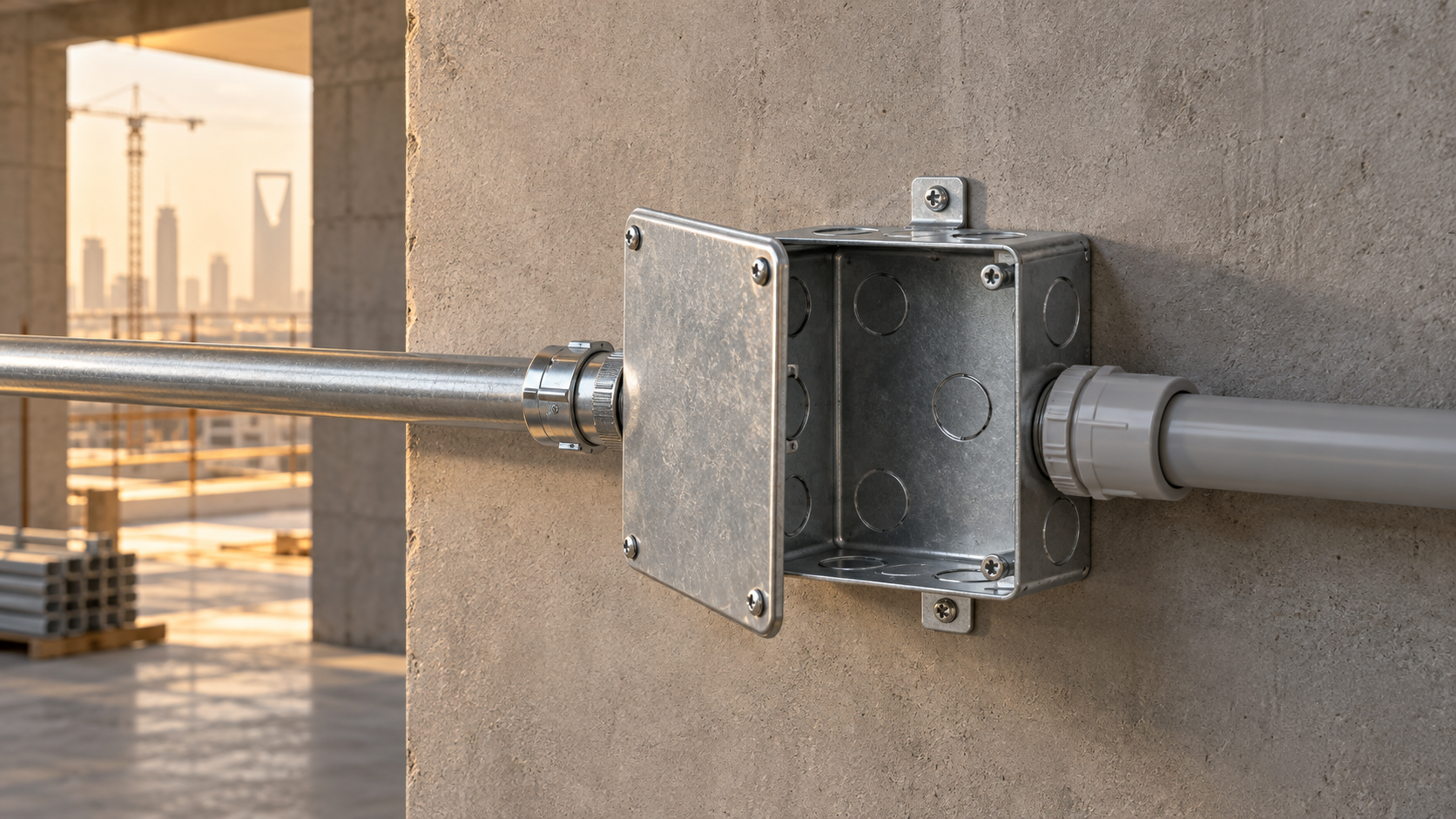
The right electrical box for an EMT or PVC conduit system depends on the conduit type and size, entry configuration, installation environment, box capacity, fittings, material, and applicable project requirements. Before ordering, confirm how the conduit will enter the box, how many conductors and connections it will contain, and whether the installation is indoor, outdoor, exposed, or concealed.
The electrical box and conduit must be selected as parts of one installation system. Even when each component is suitable individually, incompatible entry sizes, fittings, materials, or installation methods can create delays, poor connections, and difficulties during inspection.
Why Must the Electrical Box Match the Conduit System?
An electrical box provides space for wiring connections and supports relevant accessories, while the conduit routes and protects the conductors leading to that box. The connection between them must be appropriately selected and installed.
A compatible system should provide:
- Suitable conduit-entry dimensions.
- Enough space for conductors and connections.
- Secure attachment between the conduit and box.
- Protection appropriate to the installation environment.
- Access for installation, inspection, and maintenance.
- Appropriate continuity and bonding where metallic components are involved.
- Compliance with the approved project specification.
Choosing a box based only on its outside dimensions can cause problems if its openings, internal capacity, material, or mounting configuration do not match the conduit system.
What Is EMT Conduit?
EMT stands for Electrical Metallic Tubing. It is a metallic raceway used to route and protect electrical conductors in approved applications.
EMT is normally connected to an electrical box using fittings designed for the relevant conduit size, box entry, environment, and installation method. The fittings should be compatible with both the conduit and the box.
When selecting an electrical box for an EMT system, check:
- Conduit trade size.
- Number and direction of conduit entries.
- Type of approved connector.
- Knockout or opening dimensions.
- Box material.
- Required bonding method.
- Installation environment.
- Space available for pulling and terminating conductors.
A metallic conduit and metallic box may form part of the bonding arrangement when correctly selected and installed, but electrical continuity should never be assumed merely because both components are made of metal.
What Is PVC Electrical Conduit?
PVC electrical conduit is a non-metallic raceway designed for electrical wiring applications. It should not be confused with PVC pipe intended for plumbing or other non-electrical uses.
PVC conduit may be used in approved concealed, embedded, underground, corrosive, or other applications depending on its product rating and the project requirements.
When matching a box with PVC conduit, review:
- Whether the box is metallic or non-metallic.
- Conduit and fitting size.
- Entry type.
- Required adapter or connector.
- Expansion and movement requirements.
- Exposure to sunlight or heat.
- Water and dust protection.
- Need for a separate equipment-grounding conductor.
- Manufacturer installation instructions.
Because PVC is non-metallic, it does not provide the same electrical continuity as a metallic raceway. The grounding and bonding arrangement must therefore be addressed separately according to the approved electrical design.
Should You Use a Metal or Non-Metallic Electrical Box?
The answer depends on the complete installation, not on the conduit material alone.
Metal electrical boxes
A metal box may offer:
- Mechanical strength.
- Resistance to certain types of impact.
- Compatibility with appropriate metallic conduit fittings.
- A potential role in the bonding system when properly connected.
- Suitability for particular exposed or commercial applications.
However, the box must be correctly bonded where required. Its coating, openings, cover, fittings, and environmental protection must also match the application.
Non-metallic electrical boxes
A non-metallic box may offer:
- Resistance to electrochemical corrosion.
- Electrical insulation.
- Lower weight.
- Compatibility with certain non-metallic conduit systems.
- Suitability for specified concealed or corrosive applications.
However, its temperature rating, mechanical strength, fire characteristics, UV resistance, and installation limitations must be reviewed.
The conduit material does not automatically determine the box material. For example, PVC conduit may connect to a metal box using an approved adapter, provided the complete installation complies with the project design and product instructions.
How Do You Select the Correct Conduit-Entry Size?
The entry size must match the conduit and its approved fitting. An opening that is too small cannot receive the required connector, while an oversized or incorrectly modified opening may prevent secure installation or reduce the intended protection of the box.
Before ordering, confirm:
- Nominal conduit size.
- Connector or adapter type.
- Required knockout size.
- Number of conduit entries.
- Entry direction.
- Distance between adjacent entries.
- Space needed to tighten the fittings.
- Whether entries are factory-made or permitted to be created on-site.
Do not assume that the conduit’s nominal size equals the exact physical opening required in the box. Always check the dimensions of the selected fitting and the box manufacturer’s product data.
How Many Conduit Entries Does the Box Need?
The required number and location of entries depend on the wiring route.
A box may need conduit entries from:
- One side.
- Opposite sides.
- Adjacent sides.
- The rear.
- The top or bottom.
- Several directions.
The layout should allow installers to connect the conduit without interfering with covers, devices, terminals, fasteners, or other fittings.
Important questions include:
- How many conduits enter the box?
- What is the size of each conduit?
- Will conductors pass through or terminate inside?
- Is space needed for pulling?
- Are bends located immediately before the box?
- Will the selected fittings block adjacent entries?
- Can the cover be removed after installation?
A drawing or marked photograph can help the supplier identify an appropriate product when the entry arrangement is complex.
How Do You Determine the Required Box Size?
The box must provide adequate space for the conductors, connections, devices, terminals, and fittings it will contain. External dimensions alone do not confirm that the internal space is sufficient.
The project designer should consider:
- Number and size of conductors.
- Number of conduit entries.
- Splices or terminals inside the box.
- Devices mounted in or on the box.
- Internal clamps or fittings.
- Bending and pulling space.
- Future access requirements.
- Applicable box-fill and installation rules.
An undersized box can make wiring difficult and may place excessive stress on conductors or connections. An unnecessarily large box may create installation and cost complications.
Final box capacity must be confirmed against the applicable project code and electrical design.
How Does Installation Method Affect Box Selection?
The installation method changes the requirements for the electrical box and its accessories.
Concealed installations
For boxes installed inside walls, ceilings, or other concealed spaces, consider:
- Wall or ceiling construction.
- Mounting depth.
- Accessibility after completion.
- Alignment with the finished surface.
- Conduit-entry direction.
- Device or cover requirements.
Exposed installations
For boxes installed on visible surfaces, consider:
- Mechanical protection.
- Secure mounting.
- Accessible covers.
- Conduit alignment.
- Appearance.
- Exposure to dust, moisture, or accidental impact.
Outdoor or wet locations
For outdoor or moisture-exposed installations, galvanizing alone does not confirm suitability. Review:
- Complete enclosure design.
- Covers and joints.
- Seals and gaskets.
- Cable or conduit entries.
- Drainage and mounting orientation.
- Compatible fittings.
- Water and dust protection.
- Approved outdoor-use documentation.
The weakest connection can affect the protection of the complete assembly. A suitable box can still perform poorly if the wrong connector, cover, seal, or installation method is used.
How Does the Environment Affect Material Selection?
Saudi projects may expose electrical components to heat, dust, humidity, airborne salt, chemicals, or physical impact. The exact conditions should be defined before selecting the box.
Indoor conditioned areas
The main considerations may include:
- Box capacity.
- Installation method.
- Compatibility with conduit and devices.
- Accessibility.
- Mechanical protection.
Coastal or humid locations
Review:
- Corrosion exposure.
- Material and coating specification.
- Cut edges and openings.
- Fitting materials.
- Fastener compatibility.
- Moisture protection.
- Maintenance access.
Industrial environments
The specification may need to consider:
- Chemicals or airborne pollutants.
- Mechanical impact.
- Washdown or moisture.
- Dust.
- Temperature.
- Hazard classification.
- Project-specific approval requirements.
A product suitable for a standard indoor installation should not be assumed suitable for a coastal, industrial, hazardous, or outdoor environment.
What Should Be Checked When Using a Metal Box with EMT?
When an EMT conduit system connects to a metal electrical box, check:
- Correct connector type and size.
- Secure mechanical attachment.
- Condition of the box opening.
- Removal of sharp edges or burrs.
- Continuity across the connection.
- Required bonding arrangement.
- Compatibility of materials and finishes.
- Suitability of the fitting for the environment.
- Accessibility for inspection and maintenance.
The conductive nature of EMT and a metal box does not automatically prove that the grounding path is reliable. Correct bonding depends on the complete installation, approved fittings, connection integrity, and applicable electrical requirements.
A separate equipment-grounding conductor may be required by the project design or selected installation method. The responsible electrical engineer should confirm the grounding and bonding arrangement.
What Should Be Checked When Using a Box with PVC Conduit?
PVC conduit requires compatible fittings and a clearly defined grounding arrangement.
Check:
- Whether the conduit is rated for electrical use.
- Correct adapter or connector.
- Compatibility with the box material.
- Movement or expansion requirements.
- Sealing method where required.
- Support near the box.
- Protection from mechanical damage.
- UV and temperature ratings for exposed areas.
- Separate grounding-conductor requirements.
- Manufacturer instructions for connection and installation.
Do not use plumbing fittings as substitutes for approved electrical conduit fittings. Similar appearance does not prove dimensional or performance compatibility.
Can Knockouts Be Modified on Site?
Site modification should only be performed when permitted by the product instructions and project requirements.
Uncontrolled cutting can:
- Damage the protective coating.
- Create sharp edges.
- Produce an incorrect opening size.
- Weaken the box.
- Interfere with adjacent knockouts.
- Affect water or dust protection.
- Create difficulties with fitting installation.
- Leave exposed metal vulnerable to corrosion.
Where a new opening is permitted, it should be created using an appropriate method and finished according to the approved procedure. The installer should also confirm that the modification does not invalidate the product’s intended application or approval.
For repeated project requirements, a product with the correct factory-made entry configuration may provide a more consistent result.
What Documents Should Buyers Review?
Before approving an electrical box for an EMT or PVC conduit system, review the available documents relevant to the product and project.
These may include:
- Product data sheet.
- Product code.
- Dimensions.
- Box material and thickness.
- Surface finish.
- Knockout sizes and locations.
- Compatible fitting information.
- Installation instructions.
- Product-specific compliance documents.
- Environmental protection information.
- Approved project drawings.
- Consultant or project specification.
A company-level certificate should not be treated as proof that every box is approved for every conduit system or environment.
Documents should be checked for the exact product code, standard, application, issue date, and scope.
What Information Should Be Included in a Quotation Request?
A detailed quotation request helps the supplier identify the correct electrical box and reduces ordering errors.
Include:
- Required product code, if known.
- Box dimensions.
- Box material.
- Required thickness or finish.
- EMT or PVC conduit type.
- Nominal conduit size.
- Number of entries.
- Knockout or opening size.
- Entry directions.
- Installation method.
- Indoor or outdoor location.
- Environmental conditions.
- Required quantity.
- Delivery city.
- Project documentation requirements.
- Required delivery schedule.
If the product code is unknown, attach a drawing, marked image, or clear description of the application. Do not send confidential project files without following the approved information-sharing process.
Common Selection Mistakes
Avoid the following mistakes:
- Selecting the box before confirming conduit size.
- Assuming nominal conduit size equals knockout size.
- Ignoring the connector or adapter dimensions.
- Choosing the box based only on external dimensions.
- Failing to calculate the required internal capacity.
- Assuming every galvanized box is suitable outdoors.
- Treating metallic contact as proof of correct bonding.
- Using non-electrical PVC components.
- Modifying openings without approval.
- Ignoring expansion or movement in PVC systems.
- Mixing incompatible metals without technical review.
- Requesting a quotation without quantity or delivery information.
- Assuming one product is suitable for every installation environment.
Electrical Box Selection Checklist
Before ordering, confirm:
- Conduit type: EMT or PVC.
- Nominal conduit size.
- Connector or adapter type.
- Required entry size.
- Number and direction of entries.
- Box internal capacity.
- Box material.
- Surface finish or coating.
- Mounting method.
- Indoor or outdoor installation.
- Environmental exposure.
- Bonding and grounding requirements.
- Water and dust protection requirements.
- Product documentation.
- Quantity and delivery city.
Any technical requirement that remains unclear should be resolved before issuing the purchase order.
Frequently Asked Questions
Can EMT conduit connect to a metal electrical box?
Yes, provided the conduit size, connector, box opening, installation method, and environmental rating are compatible. The bonding and grounding arrangement must also comply with the approved electrical design.
Can PVC conduit connect to a metal electrical box?
Yes, an approved adapter or connector may be used when permitted by the product instructions and project requirements. Because PVC is non-metallic, the grounding arrangement must be addressed separately.
Does EMT conduit automatically ground a metal box?
Not automatically. A reliable grounding path depends on correct bonding, continuous connections, approved fittings, installation quality, and the electrical requirements applicable to the project.
Can a galvanized electrical box be used outdoors?
Not solely because it is galvanized. Outdoor suitability also depends on the enclosure design, covers, seals, conduit entries, fittings, mounting, and documented water and dust protection.
How do I know which knockout size is required?
Check the nominal conduit size and the dimensions required by the selected connector or adapter. Confirm compatibility using the technical data for both the fitting and electrical box.
Can regular PVC plumbing pipe be used as electrical conduit?
PVC pipe should only be used for electrical wiring when it is specifically manufactured, rated, and approved for that application. Plumbing products should not be substituted for electrical conduit without documented approval.
Need Electrical Boxes for an EMT or PVC Conduit System?
Share the required box code or dimensions, conduit type and size, entry configuration, quantity, installation environment, and delivery city with ALROUF Electrical Accessories.
The team can review the available electrical-box products and prepare a quotation based on the information provided.


