


How to Select Electrical Box Entry Sizes for EMT Conduit
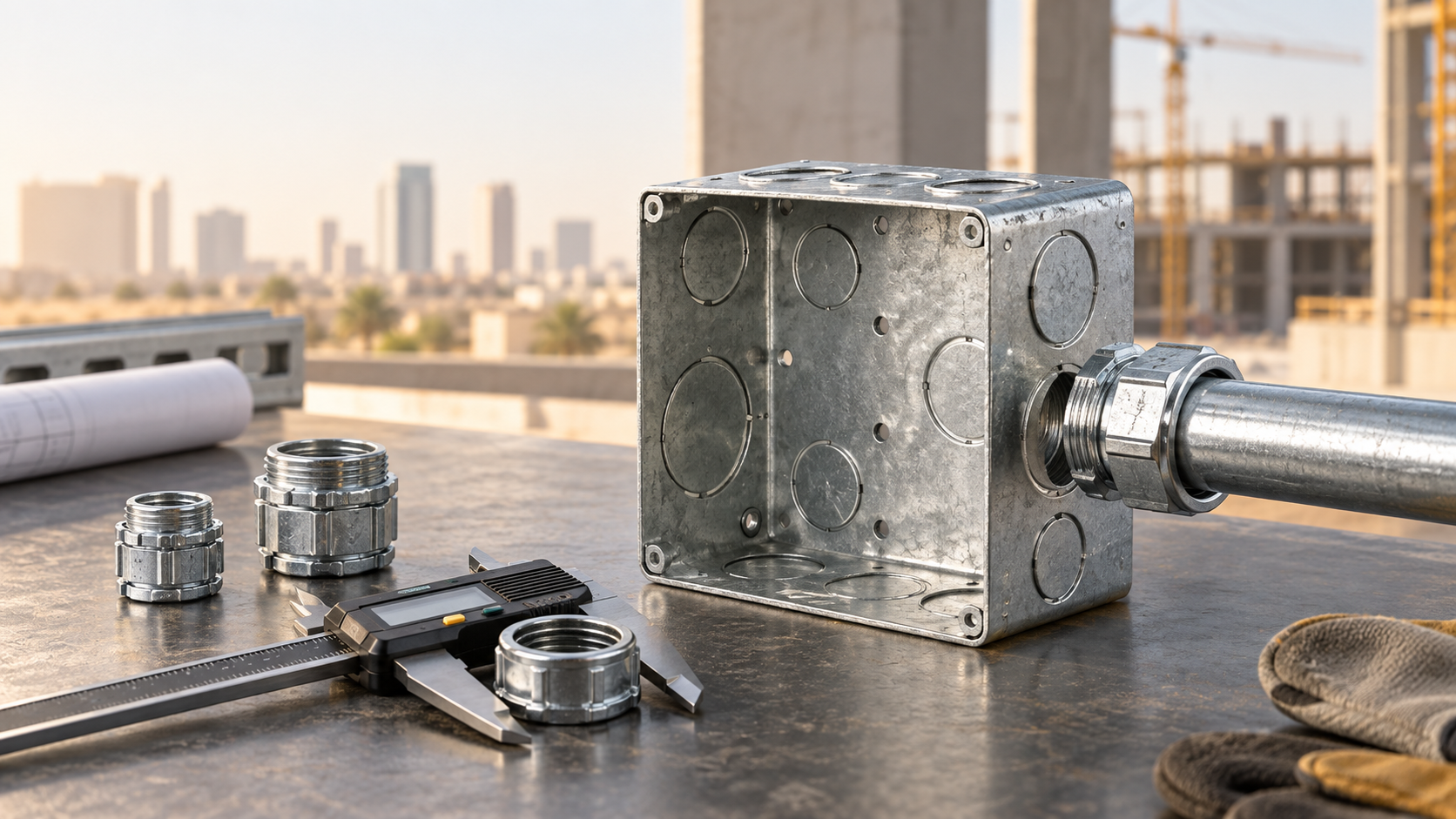
The correct electrical box entry size for EMT conduit depends on the conduit trade size, the dimensions of the approved connector, the number and direction of conduit entries, and the available space inside the box. Always verify the box opening and connector dimensions using current product data rather than assuming the nominal EMT size equals the required knockout size.
Selecting a suitable box is not simply a matter of matching two labels. The EMT conduit, connector, knockout, box capacity, mounting method and grounding arrangement must work together as one installation system.
What Does Electrical Box Entry Size Mean?
Electrical box entry size refers to the opening through which the conduit connector enters and attaches to the box. Depending on the product, this opening may be:
- A factory-made knockout.
- A threaded entry.
- A pre-punched opening.
- A project-approved opening created during installation.
The entry must provide enough space for the selected connector while allowing it to attach securely to the box.
An entry that is too small will not accept the connector. An oversized opening may prevent secure attachment, interfere with bonding or reduce the environmental protection intended by the box design.
The buyer must therefore confirm three connected dimensions:
- The nominal EMT trade size.
- The connector dimensions.
- The required box-entry or knockout size.
These values may be related, but they are not interchangeable.
Is EMT Trade Size the Same as Its Actual Diameter?
No. EMT trade size is a nominal product designation, not a direct measurement of its exact inside or outside diameter.
For example, a conduit described by a particular trade size must be matched with a connector and box entry designed for that trade size. Measuring the conduit and choosing a knockout based only on the measured diameter can result in an incorrect selection.
Actual dimensions and internal areas should be taken from:
- Approved EMT product data.
- Connector specifications.
- Electrical box drawings.
- Applicable code tables.
- Project-approved technical submittals.
The same trade-size description should appear consistently across the conduit, connector and associated documentation.
Why Must the Connector Be Selected Before the Box Entry?
The connector creates the mechanical interface between the EMT conduit and the electrical box. Therefore, the connector—not the conduit alone—determines the precise box opening required.
Before selecting the box, confirm:
- EMT trade size.
- Connector type.
- Connector body dimensions.
- Thread or locking method.
- Required knockout diameter.
- Space required for the locknut or securing mechanism.
- Suitability for the installation environment.
- Compatibility with the box material.
A connector may require more installation space than expected, especially when several conduit entries are positioned close together.
The installer should have enough room to tighten the connector without interfering with adjacent fittings, internal conductors, devices or the box cover.
How Many EMT Entries Does the Electrical Box Need?
The required number of entries depends on the routing of the conduit system and the function of the box.
An electrical box may receive EMT from:
- One side.
- Opposite sides.
- Adjacent sides.
- The top and bottom.
- The rear.
- Several directions.
Before ordering, determine:
- How many conduits enter the box?
- What is the trade size of each conduit?
- Do the conduits carry conductors through the box or terminate there?
- Will the box contain splices, terminals or devices?
- Are different conduit sizes used?
- Is space required for future approved entries?
- Can all connectors be installed and tightened?
- Will any fitting interfere with the cover?
A sketch showing the entry positions can help the supplier identify a suitable box. For complex arrangements, include the required distance between entry centres and their position relative to the edges.
How Does Entry Location Affect Installation?
Correct entry positioning improves conduit alignment and helps prevent stress on the connector or box.
Important considerations include:
- Direction of the conduit route.
- Distance from walls, ceilings or structural elements.
- Space around the box.
- Position of internal terminals or devices.
- Accessibility for tightening fittings.
- Required conductor bending space.
- Cover removal.
- Drainage or moisture considerations.
- Mounting points and supports.
Entries positioned too close to corners may be difficult to use. Closely spaced knockouts can also leave insufficient room for connector bodies or locknuts.
When several conduits enter one side, the box must be wide and deep enough to accommodate the fittings and conductors without overcrowding.
How Do You Determine the Required Box Size?
Box-entry compatibility is only one part of product selection. The box must also provide adequate internal space for all conductors, connections, fittings and devices.
Consider:
- Number of conductors.
- Conductor sizes.
- Number of conduit entries.
- Splices and terminals.
- Internal clamps.
- Mounted devices.
- Grounding and bonding components.
- Conductor bending space.
- Pulling requirements.
- Future access.
An electrical box may have the correct knockouts but still be too small internally.
The responsible designer should verify box-fill, conductor-bending and pulling requirements using the code and project specification applicable to the installation.
A larger box may sometimes simplify installation, but unnecessary oversizing can affect mounting space, appearance and procurement. The objective is to select a box that provides sufficient usable space without creating avoidable complications.
What Is the Difference Between a Junction Box and a Pull Box?
A junction box commonly provides space for conductor connections, branches or mounted electrical accessories, depending on its design.
A pull box primarily helps installers pull conductors through a raceway system, particularly where conduit direction, length or conductor size makes pulling difficult.
The distinction matters because a box intended for connections may have different space and entry requirements from one used as a pulling point.
Before selecting the product, define whether conductors will:
- Pass straight through.
- Change direction.
- Be spliced.
- Terminate.
- Connect to a device.
- Require additional pulling space.
Do not use the outside dimensions alone to determine whether the box is suitable for the intended function.
Can Factory Knockouts Be Used for EMT?
Factory knockouts may be used when their size, position and design are compatible with the selected EMT connector and the intended application.
Before installation, inspect the knockout for:
- Correct size.
- Clear identification.
- Damage or deformation.
- Sharp edges.
- Adequate spacing from adjacent openings.
- Compatibility with the connector.
- Effect on the box’s intended environmental protection.
A knockout should be removed using an appropriate method that does not deform the surrounding box surface. Any sharp edges or damage should be addressed according to the product instructions and project procedure.
Unused openings should remain closed or be sealed with suitable components when required by the application.
Can a New Conduit Entry Be Added on Site?
A new opening should only be created when permitted by the product instructions, project specification and responsible technical authority.
Adding an opening may affect:
- Structural strength.
- Surface coating.
- Corrosion protection.
- Environmental protection.
- Internal components.
- Required spacing.
- Product approval.
- Grounding and bonding.
If site modification is permitted, the opening should be:
- Correctly sized for the connector.
- Positioned away from mounting features.
- Free from sharp edges.
- Finished according to the approved procedure.
- Inspected before the conduit is connected.
For repeated installations, choosing a box with the correct factory entry arrangement may provide a more consistent result than modifying every box on site.
How Does the Box Material Affect EMT Connections?
EMT is metallic, but the connected electrical box may be metallic or non-metallic, depending on the approved installation.
Connecting EMT to a metal box
When EMT connects to a metal electrical box, check:
- Connector approval and compatibility.
- Secure mechanical attachment.
- Condition of the box opening.
- Required locknut or securing component.
- Continuity across the connection.
- Bonding requirements.
- Compatibility of metals and finishes.
- Environmental suitability.
Metal-to-metal contact alone does not automatically prove that a safe and continuous grounding path exists.
Connecting EMT to a non-metallic box
A non-metallic box requires a fitting designed for the selected conduit and box system. The grounding arrangement must be handled separately because the non-metallic box does not provide electrical continuity.
The responsible engineer should confirm the complete grounding and bonding method for either arrangement.
Does EMT Automatically Ground a Metal Electrical Box?
No. EMT and galvanized steel can conduct electricity, but conductivity alone does not confirm that an approved equipment-grounding path has been established.
A reliable system depends on:
- Correct bonding.
- Continuous connections.
- Approved connectors.
- Properly tightened fittings.
- Condition of the conduit and box.
- Installation quality.
- Applicable code requirements.
- The project’s approved grounding design.
A separate equipment-grounding conductor may also be required by the project specification or installation method.
Grounding and bonding decisions should be reviewed by the responsible electrical engineer and should not be based solely on the materials being metallic.
How Does the Installation Environment Affect Box Selection?
The installation environment affects the box material, surface protection, cover, openings, fittings and sealing requirements.
Indoor dry locations
Selection may focus on:
- Box dimensions.
- Entry configuration.
- Mounting method.
- Internal capacity.
- Accessibility.
- Compatibility with devices and fittings.
Humid or coastal locations
Additional considerations may include:
- Corrosion exposure.
- Material and coating specification.
- Condition of cut edges.
- Compatible fasteners.
- Connector protection.
- Condensation.
- Maintenance access.
The presence of a galvanized coating does not automatically make a box suitable for coastal conditions.
Outdoor installations
Outdoor suitability depends on the complete enclosure assembly, including:
- Cover design.
- Joints.
- Seals and gaskets.
- Conduit entries.
- Fittings.
- Mounting orientation.
- Drainage.
- Protection against water and dust.
- Product documentation.
An indoor box should not be considered suitable outdoors simply because it is made from galvanized steel.
Industrial environments
Industrial locations may require an additional review of:
- Chemical exposure.
- Dust.
- Washdown.
- Mechanical impact.
- Temperature.
- Hazard classification.
- Project-specific standards.
The project’s technical requirements should determine the final selection.
What Should Be Checked Before Connecting EMT to the Box?
Before installation, check:
- Conduit trade size.
- Connector type and size.
- Box entry dimensions.
- Box material.
- Entry position.
- Number of entries.
- Connector spacing.
- Box internal capacity.
- Condition of knockouts.
- Sharp edges or burrs.
- Surface damage.
- Bonding requirements.
- Environmental protection.
- Product instructions.
The conduit should align with the entry without placing unnecessary force on the box or fitting.
The raceway should also be supported according to the approved installation requirements. The box connection should not be expected to support the conduit system by itself.
What Documents Should Procurement Teams Review?
Before approving an electrical box for an EMT installation, review the available product and project information.
Relevant documents may include:
- Electrical box data sheet.
- Product code.
- Box dimensions.
- Material and thickness.
- Surface finish.
- Knockout schedule.
- Entry dimensions.
- Connector data.
- Installation instructions.
- Applicable product-compliance documents.
- Approved project drawings.
- Electrical design requirements.
- Grounding and bonding details.
A general certificate issued to the manufacturer does not automatically prove that a particular product is suitable for every EMT size or installation environment.
Each document should be checked against the exact product code and intended application.
What Information Should Be Included in a Quotation Request?
A complete request helps the supplier identify a suitable electrical box and provide an accurate quotation.
Include:
- Product code, if known.
- Required box dimensions.
- Box material.
- Surface finish.
- EMT trade size.
- Connector type, if selected.
- Required knockout size.
- Number of entries.
- Entry positions and directions.
- Internal-use requirements.
- Mounting method.
- Installation environment.
- Required quantity.
- Delivery city.
- Required documentation.
- Requested delivery schedule.
If a standard product code is not known, include a drawing, marked image or clear description.
Do not send confidential drawings through an unapproved channel. Follow the project’s information-sharing and confidentiality process.
Common Selection Mistakes
Avoid these common mistakes:
- Treating EMT trade size as an exact diameter.
- Selecting the knockout without checking the connector.
- Ignoring the connector body and locknut dimensions.
- Ordering the box before confirming entry positions.
- Providing insufficient internal capacity.
- Placing entries too close together.
- Assuming every galvanized box is suitable outdoors.
- Treating metal contact as proof of correct grounding.
- Creating site openings without approval.
- Ignoring coating damage around modified openings.
- Forgetting the required quantity or delivery location.
- Failing to connect the product documents to the requested code.
Electrical Box Entry Selection Checklist
Before ordering, confirm:
- EMT trade size.
- Connector type.
- Required entry diameter.
- Number of conduit entries.
- Direction of each entry.
- Distance between entries.
- Box dimensions.
- Internal capacity.
- Box material.
- Surface finish.
- Mounting arrangement.
- Bonding and grounding requirements.
- Installation environment.
- Water and dust protection requirements.
- Product documentation.
- Quantity and delivery city.
Any unclear requirement should be resolved before issuing the purchase order.
Frequently Asked Questions
Is EMT trade size the same as knockout size?
No. EMT trade size is a nominal designation. The required knockout or entry size must be confirmed using the dimensions of the selected connector and electrical box.
Can EMT connect directly to an electrical box?
EMT normally connects through an appropriate fitting. The fitting must be compatible with the conduit size, box entry, material, environment and installation requirements.
Can different EMT sizes enter the same box?
Yes, when the box provides compatible entries and sufficient internal space. The entry layout must allow all fittings to be installed without interfering with one another.
Does a metal box need to be bonded when connected to EMT?
The grounding and bonding arrangement must follow the approved electrical design and applicable requirements. Metallic contact alone should not be treated as proof of a reliable grounding path.
Can I create a new EMT entry in a galvanized box?
Only when modification is permitted. The opening must be correctly sized and positioned, and any sharp edges or coating damage must be treated according to the approved procedure.
Is a galvanized box automatically suitable for outdoor EMT installation?
No. Outdoor suitability depends on the complete box design, cover, seals, entries, fittings, drainage, mounting and documented environmental protection.
Need Electrical Boxes for an EMT Installation?
Share the required electrical-box code or dimensions, EMT trade size, connector and entry requirements, quantity, installation environment and delivery city with ALROUF Electrical Accessories.
The team can review the available electrical-box products and prepare a quotation based on the information provided.


